Protein-Ligand Docking (Rigid / Flexible / Induced Fit Docking)
 AI-Enhanced Scoring
  Multi-Mode Docking
  Wet-Lab Validation
 MagHelix™ deploys rigid, flexible, and induced-fit docking hierarchies with AI-enhanced scoring trained on experimental biophysical data. Wet-lab validation via SPR, X-ray, and MD simulation closes the computational-experimental gap.
Why Protein-Ligand Docking Is the Critical Bridge Between Structure and Synthesis?
Crystal structures reveal the binding site, but not which compound will bind with measurable affinity. Hit Identification generates leads; without structural rationale, medicinal chemistry becomes expensive trial-and-error. The MagHelix™ platform deploys mode-matched docking—rigid for shape-complementary libraries, flexible for rotamer-rich pockets, induced-fit for backbone-flexible targets—each benchmarked against internal biophysical and crystallography datasets to ensure score-to-affinity correlation.
What Sets the Docking Platform Apart
ML-Trained Scoring
ITC and BLI data train ML affinity models. R² > 0.75. ADMET Prediction & Modeling flags liabilities before docking.
Mode-Matched Hierarchy
Binding Pocket & Druggability Analysis pre-scores pocket flexibility to assign optimal mode. Benchmarked against PDB conformations.
Wet-Lab Validation Loop
SPR, co-crystallization, and MD Simulations confirm pose stability. Direct feedback to chemistry closes the loop.
The Protein-Ligand Docking Suite
Rigid Docking
High-Throughput Pose Screening for Shape-Complementary Libraries
Key Features:
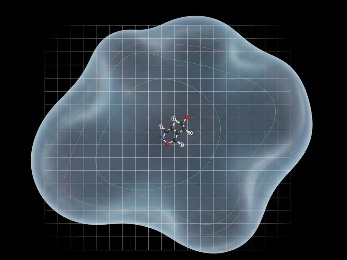
- Grid-Based Energy Sampling — Exhaustive search within a defined binding site grid; optimized for million-compound libraries.
- Shape & Electrostatic Complementarity — Rapid filtering via molecular shape overlap, hydrogen-bond matching, and hydrophobic burial.
- Ideal For — Well-ordered active sites; initial library triage; Hit Identification stage enrichment.
For virtual biotechs screening 10,000+ compounds, rigid docking delivers a prioritized subset in 24–48 hours. For pharma teams, rigid protocols integrate with Pharmacophore Modeling & Screening constraints derived from co-crystal structures. Every run includes receptor preparation with AlphaFold Protein Structure Prediction-assisted loop refinement and protonation-state assignment at physiological pH.
Flexible Docking
Side-Chain Adaptation for Rotamer-Rich Binding Pockets
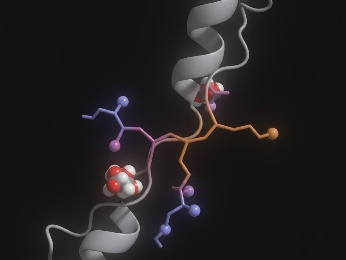
Key Features:
- Rotamer Library Sampling — Concurrent optimization of ligand pose and receptor side-chain rotamers within a 5–8 Å shell.
- Explicit Water Displacement Scoring — Evaluation of ordered water networks and their displacement energetics.
- Ideal For — Kinases, proteases, and targets with variable gatekeeper residues; Lead Optimization stage analog ranking.
Most binding pockets are not rigid. Flexible docking captures gatekeeper adaptation that rigid protocols miss. When combined with ADMET Prediction & Modeling, flexible docking scores correlate with measured pIC₅₀ across congeneric series.
Induced Fit Docking
Backbone Remodeling for Allosteric and Cryptic Pocket Targets
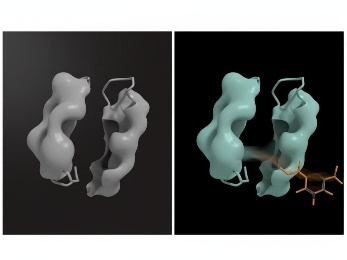
Key Features:
- Iterative Receptor Refinement — Alternating ligand pose sampling and receptor backbone/side-chain relaxation cycles.
- Ensemble-Based Conformational Sampling — Multiple receptor starting conformations derived from All-Atom Protein MD Simulation or AlphaFold Protein Structure Prediction confidence filtering.
- Ideal For — Membrane proteins, protein-protein interaction sites, allosteric modulators, and targets with documented cryptic pockets.
For membrane protein targets—GPCRs, ion channels, transporters—rigid docking against a single conformation misses viable chemotypes. Our induced-fit protocol starts with All-Atom Protein MD Simulation-derived ensemble clustering, then iteratively refines receptor geometry around docked ligands.
Platform Instrumentation
| Software / System | Core Capability |
|---|---|
| Schrödinger Glide + Prime | High-precision docking and induced-fit refinement with OPLS4 force field; loop prediction and side-chain optimization. |
| AutoDock Vina 1.2.0 | Ultra-large library virtual screening with batch-mode docking; flexible side-chain docking and macrocycle sampling. |
| GNINA 1.0 | Deep-learning-enhanced docking with CNN rescoring; trained on PDBbind for pose prediction and affinity estimation. |
| GROMACS 2023 + AMBER 22 | All-atom and coarse-grained MD for post-docking pose stability validation and Binding Free Energy Calculation (FEP/TI, MM/PBSA). |
| MOE / ICM-Pro | Pharmacophore-constrained docking and protein-nucleic acid interaction modeling; multi-target reverse docking. |
| OpenEye OEDocking + Spruce | Structure preparation, protonation-state assignment, and high-resolution pose prediction with explicit water handling. |
| PyMOL + Maestro | Interactive pose visualization, interaction fingerprint analysis, and medicinal chemistry guidance. |
Standardized Workflow
Project Workflow
A standardized, milestone-driven execution system. From target structure to validated binding hypotheses—managed by a single computational project team, tracked in real time.


01 Target Review & Structure Preparation
- Target structure review: PDB, AlphaFold, or Homology Modeling & Threading assessment.
- Structure quality check: resolution, B-factor analysis, missing loop reconstruction.
- Protonation state assignment at pH 7.4; cofactor and ion placement.
Deliverable: Prepared receptor structure + quality assessment report.
02 Binding Site Analysis & Druggability Assessment
- Binding Pocket & Druggability Analysis: active site, allosteric, or cryptic pocket mapping.
- Druggability scoring: pocket volume, hydrophobicity, hydrogen-bond count, water network analysis.
- All-Atom Protein MD Simulation for ensemble generation (induced-fit targets).
Deliverable: Pocket analysis report with druggability score and recommended docking mode.
03 Docking Execution & Scoring
- Mode selection: rigid, flexible, or induced-fit based on pocket dynamics score.
- Library preparation: protonation, tautomer enumeration, stereochemistry expansion.
- AI-enhanced scoring and consensus ranking.
Deliverable: Ranked docking poses with confidence scores and interaction diagrams.
04 Pose Refinement & Validation
- Top-ranking pose clustering and interaction fingerprint analysis.
- Binding Free Energy Calculation rescoring for top 50–100 compounds.
- Molecular Dynamics Simulations for pose stability (RMSD trajectory analysis).
Deliverable: Refined pose dataset with stability metrics and validation recommendations.
05 Report & Handoff
- Comprehensive docking report with ranked hit list.
- Structural rationale for each hit: interaction map, ligand efficiency, synthetic accessibility.
- Direct handoff to Hit Biophysical Characterization or Co-crystallization if contracted.
Deliverable: Final technical report + electronic data package + transition plan to Hit to Lead or Lead Optimization.
Sample Requirements
| Requirement | Details |
|---|---|
| Target structure | PDB ID, AlphaFold model, or Homology Modeling & Threading; specify binding site residues or co-crystal ligand reference |
| Compound library | SMILES, SDF, or Mol2 format; 1,000–1,000,000+ compounds accepted |
| Known actives / reference ligands | Co-crystal ligands, patent compounds, or SAR series for pose validation |
| Project scope | Hit Identification, Lead Optimization, or scaffold-hopping |
| Prior biophysical data | Any SPR/BLI/ITC or ADMET flags to guide constraint design |
Standard Deliverables
- Prepared receptor structure with protonation and water network documentation
- Ranked docking poses (top 100–500) with 3D coordinates and interaction fingerprints
- AI-enhanced scoring table with confidence intervals
- Pose stability validation via Molecular Dynamics (MD) Simulations (if contracted)
- Ligand efficiency and synthetic accessibility assessment for prioritized hits
- Electronic data package formatted for Structure-Based Virtual Screening or Hit to Lead handoff
Frequently Asked Questions
Case Study
Case Study: AutoDock Vina 1.2.0 Flexible Docking Benchmark
Published Evidence:
Eberhardt J, et al. AutoDock Vina 1.2.0: New Docking Methods, Expanded Force Field, and Python Bindings. J Chem Inf Model. 2021 Aug 23;61(8):3891-3898.
Key Findings:
- Flexible Docking: Selective receptor side-chain flexibility using the AutoDock4 force field, enabling adaptation without the 100× speed penalty of AutoDock4.
- Macrocycle Sampling: Dummy-atom method for macrocycle conformational sampling, applied in D3R Grand Challenge 4.
- Batch Mode: Simultaneous multi-ligand docking and batch-mode screening for industrial-scale libraries.
Industrial Translation:
For seed-stage biotechs, Vina 1.2.0's batch mode and Python bindings enable rapid integration into automated pipelines without proprietary license overhead. For pharma teams, flexible docking and macrocycle sampling expand druggable space beyond rigid-receptor approximations—directly applicable to kinase gatekeeper mutants and cyclic peptide libraries. Our platform pairs Vina 1.2.0 with GNINA CNN rescoring and MD simulation validation for pose stability confirmation.
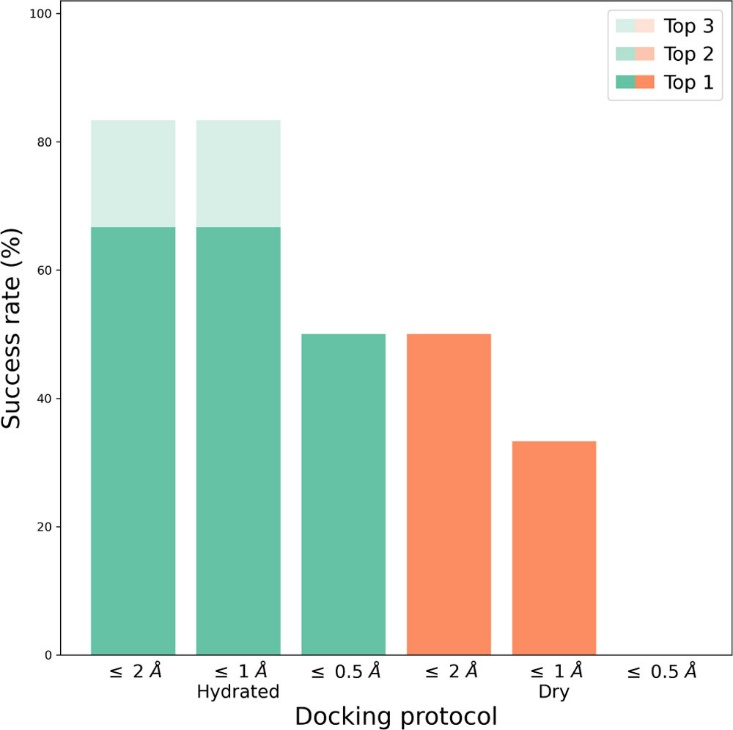
Figure 1. Redocking success rates for six HSP90 ligands with AutoDock4.2, comparing hydrated versus standard protocols across top 1–3 poses at RMSD thresholds of 2, 1, and 0.5 Å. (Eberhardt J, et al., 2025)
Reference
- Eberhardt J, et al. AutoDock Vina 1.2.0: New Docking Methods, Expanded Force Field, and Python Bindings. J Chem Inf Model. 2021 Aug 23;61(8):3891-3898.
Need validated protein-ligand docking data to advance your Lead Optimization pipeline? Our team can design a docking campaign tailored to your target class, compound library, and regulatory milestones. Contact our scientific team today to start your project.