
CADD, Docking & Virtual Screening
 Structure-Based Docking
  Pharmacophore Screening
  AI-Enhanced Virtual Screening
  De Novo Drug Design
Most hit discovery campaigns stall not because the compound library is too small, but because the docking score is disconnected from experimental truth. We run virtual screening as an integrated docking-to-validation service — not a software export — combining billion-compound search physics with SPR/ITC hit confirmation and co-crystal soaking under one project team. Whether you need to screen your first target without a GPU cluster, or break into PPI and allosteric space where HTS libraries fall short, we deliver ranked hit shortlists with binding modes you can trust.
Creative Biostructure at a Glance






Why Partner With Us
Generic docking scores are cheap. Experimentally validated hits are expensive to find. The gap between a docking rank and a confirmed binder is where most virtual screening programs die — not in the algorithm, but in the handoff. A computational CRO delivers a CSV file. A biophysics CRO asks you to send compounds. By the time the second vendor runs SPR, the first vendor's docking assumptions are already forgotten. We built this platform to eliminate that gap: docking, scoring, and biophysical confirmation are executed by the same scientists, tracked in the same database, and judged against the same success criteria.
Your CapEx is in disease biology and chemistry partnerships. Ours is in computational infrastructure and hit validation.
| Stage | What We Deliver | What You Don't Need to Build |
|---|---|---|
| Target Preparation | AI-predicted or experimental structure preparation; pocket druggability analysis ; protonation state optimization; conformational sampling | Structural bioinformatics team |
| Library Design | AI-customized focused libraries ; pharmacophore queries ; 10B+ virtual compound access | Compound collection, database licenses |
| Screening Execution | Structure-based and ligand-based virtual screening; molecular docking at billion-compound scale; FEP rescoring | GPU cluster, CADD software licenses |
| Hit Validation | SPR/ITC/BLI biophysical confirmation; co-crystal soaking for binding mode verification | Biophysics instrumentation suite |
Production-Ready Deliverables: Every campaign ships with ranked compound shortlists, docking poses , binding free energy estimates , and biophysical validation data — your chemists can enter Hit-to-Lead immediately.
- ✓ Milestone-based pricing aligned with your fundraising cycles
- ✓ No vendor coordination overhead — docking and wet-lab validation under a single project manager
PPIs. Allosteric sites. Covalent inhibitors. Cryptic pockets.
These are the spaces where physical libraries fail and computational design succeeds.
Proven track record where HTS fails
PPI flat interfaces, allosteric sites, and cryptic pockets resist standard libraries. Our induced-fit and covalent docking captures dynamic geometries and warhead chemistries rigid screens miss.
Multi-modal screening pivot
When SBVS yields low hit rates, we deploy LBVS and pharmacophore hopping ; when docking confidence is uncertain, FEP rescoring and co-crystal soaking close the loop without restarting the clock.
IP firewall and encrypted data infrastructure
Full audit trails for all docking scores, model parameters, and hit lists. Client retains 100% ownership of all computational models and derivative designs.
Core Service Modules
Service Module At-a-Glance
| Service | Core Capability | Structural + Computational Integration | Typical Timeline |
|---|---|---|---|
| Molecular Docking Services | Protein-ligand (rigid/flexible/induced-fit); protein-protein/peptide; protein-nucleic acid; covalent docking; scoring & post-docking refinement | MD equilibration of pocket residues; FEP rescoring of top poses; co-crystal validation | 2–4 weeks |
| Pharmacophore Modeling & Screening | Ligand-based generation; structure-based modeling; scaffold hopping; 3D-pharmacophore search | Homology models guide pocket-constrained pharmacophore construction; docking validates pharmacophore hypotheses | 2–4 weeks |
| Virtual Screening Services | AI-enhanced VS; structure-based VS (SBVS); ligand-based VS (LBVS) | AlphaFold2 or Cryo-EM structures enable SBVS for targets without crystal structures; ADMET pre-filtering reduces wet-lab load | 3–6 weeks |
| Drug Design & Library Analysis | De novo design; reverse docking & target fishing; HTS/DEL results analysis; database query & data integration | Generative AI designs; MD/FEP affinity prediction; synthetic accessibility scoring before synthesis | 4–8 weeks |
Molecular Docking Services
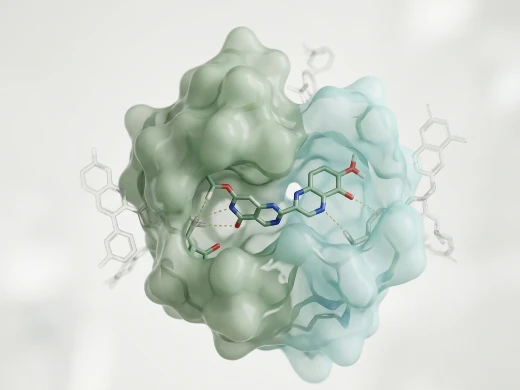
Precision Docking with Physics-Based and AI Scoring
Key Features:
- Protein-Ligand Docking — Rigid, flexible, and induced-fit protocols (Glide, AutoDock-GPU, custom pipelines) with target-class-customized scoring functions for kinases, GPCRs, proteases, and PPIs.
- Macromolecular & Covalent Docking — Protein-protein/peptide rigid-body and flexible docking; protein-nucleic acid interaction modeling; covalent docking with warhead chemistry and reactive pose filtering.
- Post-Docking Refinement — MD equilibration of binding pocket residues to relax induced-fit conformations; FEP rescoring of top-ranked poses to eliminate false positives; co-crystal soaking for experimental binding mode verification.
What We Offer: For seed-stage biotechs, docking-ready coordinates and ranked hit lists within weeks — no software license overhead. For pharma, audit-ready docking protocols with validated scoring functions, reproducible pose clusters, and direct linkage to biophysical confirmation.
Explore Docking →Pharmacophore Modeling & Screening
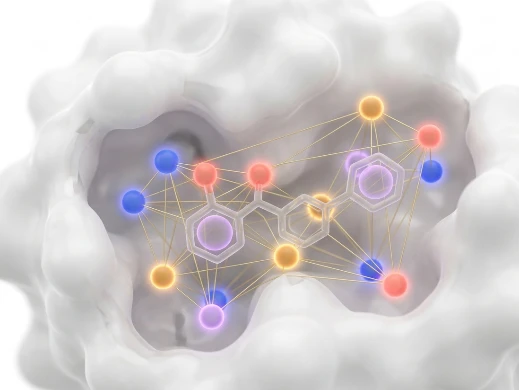
3D Chemical Feature Mapping for Scaffold Diversification
Key Features:
- Ligand-Based Pharmacophore Generation — Feature extraction from active ligands (H-bond donors/acceptors, hydrophobic centroids, aromatic rings, ionic interactions) with excluded-volume constraints to capture shape requirements.
- Structure-Based Pharmacophore Modeling — Pocket-derived feature maps from co-crystal or AI-predicted structures; pharmacophore refinement against binding site topology and dynamics.
- Scaffold Hopping & 3D Search — Shape-based and feature-based screening across 10B+ compounds to identify novel chemotypes preserving key interactions while escaping competitor IP space.
What We Offer: For targets with known actives but no crystal structure, pharmacophore modeling enables LBVS campaigns that rival SBVS in hit rates. For pharma, our scaffold-hopping protocols deliver patent-navigated chemical matter with preserved pharmacophore geometry.
Explore Pharmacophore Modeling →Virtual Screening Services
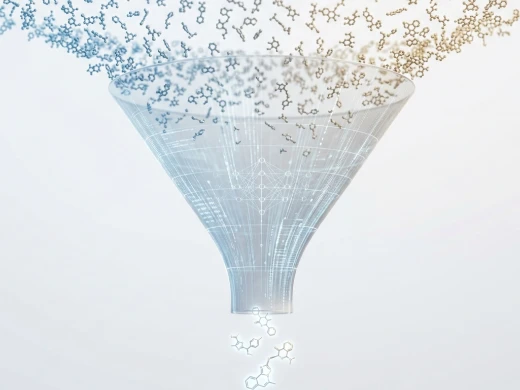
Billion-Compound Funnels with AI-Enhanced Scoring
Key Features:
- AI-Enhanced Virtual Screening — GNN and Transformer affinity prediction models retrained on closed-loop project data; ensemble scoring combining physics-based and ML predictions to rank candidates.
- Structure-Based Virtual Screening (SBVS) — Docking against AlphaFold2, Cryo-EM, or experimental structures; induced-fit and covalent-enabled workflows for challenging pockets.
- Ligand-Based Virtual Screening (LBVS) — Pharmacophore matching, shape-based screening, and QSAR models for targets without structural starting points.
What We Offer: For seed-stage biotechs, 10B-compound screening at seed-stage budgets — AI pre-filtering reduces physical screening load by >90%. For pharma, proprietary library deployment with maximum efficiency, every computational hit backed by SPR/ITC validation under the same project ID.
Explore Virtual Screening →Drug Design & Library Analysis
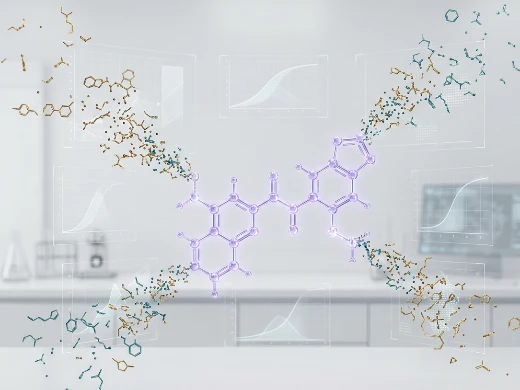
Generative AI and Retrosynthetic Design
Key Features:
- De Novo Drug Design — VAE/GAN and reinforcement-learning generative models explore chemical space while optimizing for target affinity, synthetic accessibility, and patent novelty.
- Reverse Docking & Target Fishing — Phenotypic hit deconvolution by docking against 10,000+ protein structures to identify primary targets and off-target liabilities.
- HTS/DEL Results Analysis — Statistical modeling of screening output; SAR pattern extraction; cluster analysis for series prioritization.
- Database Query & Integration — Enamine REAL, WuXi GalaXi, proprietary fragment libraries, and client compound collections unified under one screening architecture.
What We Offer: For biotechs without medicinal chemistry infrastructure, we deliver focused libraries of 20–50 AI-designed derivatives with predicted potency, selectivity, and ADMET profiles. For pharma, we supplement internal design teams with generative exploration of chemical space that manual design misses.
Explore Drug Design →Technology Platform
Integrated CADD Infrastructure: Computation + Validation, Zero Handoffs
Computational Platform — Dry Lab
Powered by our MagHelix™ CADD Platform and MagHelix™ AIDD Platform
| Capability | Details |
|---|---|
| AI/ML Scoring Engine | GNN and Transformer architectures for affinity prediction; VAE/GAN-based generative molecular design; proprietary ML scoring retrained with each closed-loop project |
| Structure-Based Docking | Glide, AutoDock-GPU, customized scoring pipelines; induced-fit and covalent docking enabled |
| Pharmacophore & LBVS | Pharmacophore mapping, shape-based screening, QSAR models |
| ADMET Prediction | Deep learning panel: Fsp3, LogP, hERG, CYP450, Papp, BBB permeability |
| Molecular Dynamics | GROMACS/AMBER microsecond simulations; membrane protein-lipid systems; enhanced sampling (metadynamics, REST2) |
| Virtual Library Access | >10 billion compounds (Enamine REAL, WuXi, proprietary fragments) + AI-customized focused libraries |
Platform Edge: The ability to pivot from docking to FEP rescoring to co-crystal soaking without changing project teams protects your timeline and budget.
Biophysical Validation Platform — Wet Lab
Powered by our MagHelix™ Structural Biology and SBDD Platform
| Capability | Details |
|---|---|
| Surface Plasmon Resonance (SPR) | Biacore 8K+ / T200; full kinetics (kon/koff), affinity (KD), thermodynamic characterization |
| Isothermal Titration Calorimetry (ITC) | MicroCal PEAQ-ITC; full thermodynamic binding characterization (ΔG, ΔH, ΔS) |
| Bio-layer Interferometry (BLI) | Octet RH16; high-throughput hit confirmation and counter-screening |
| Cryo-Electron Microscopy | Thermo Fisher Krios G4 / Glacios; single-particle analysis for large complexes and membrane proteins |
| X-ray Crystallography | Co-crystal soaking, automated screening robots, rapid ligand soaking |
| Thermal Stability Assays | Prometheus NT.48 DSF / DSC |
Wet Lab Edge: For difficult targets, the ability to pivot from docking to FEP rescoring to co-crystal soaking without changing project teams protects your timeline and budget.
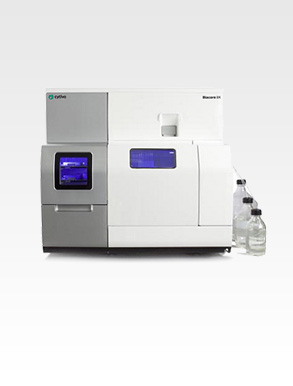
Cytiva Biacore 8K+
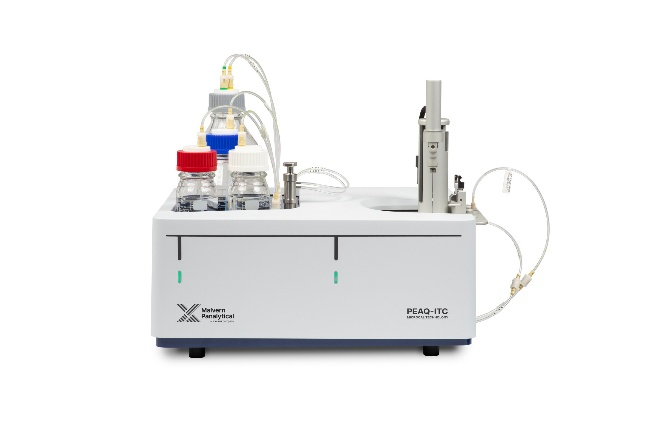
Malvern MicroCal PEAQ-ITC
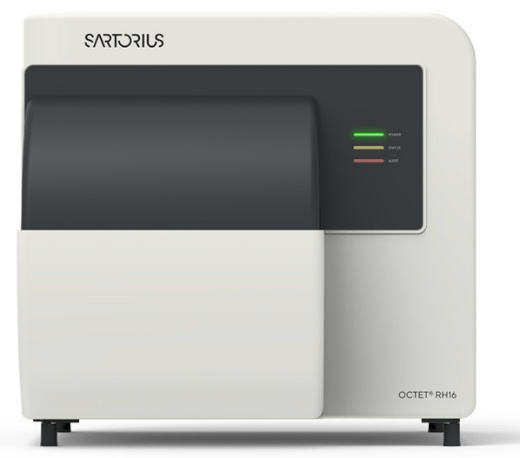
Sartorius Octet RH16
Platform specifications are subject to continuous upgrade. Contact our team for instrument availability and project-specific capability assessment.
Closed-Loop Discovery Engine
When Docking Meets Experimental Truth
Traditional CROs treat virtual screening as a software delivery: you receive a ranked list, and the relationship ends. Our platform treats every campaign as a calibration cycle — each biophysical measurement retrains the scoring models, so your second target screens better than your first.
Billion-Compound Docking
Physics-based docking (Glide, AutoDock-GPU) and AI scoring filter 10B+ compounds to a manageable shortlist, prioritizing chemotypes with predicted affinity and synthetic accessibility.
Feeds into Rescoring
FEP/MD Rescoring
Free Energy Perturbation and microsecond MD eliminate false positives from rigid docking, reranking candidates by dynamic binding stability.
Feeds into Wet-lab
Biophysical Confirmation
SPR, ITC, and BLI generate experimental affinity and kinetics datasets that validate — or invalidate — the computational predictions.
Feeds into Scoring
Model Retraining
Confirmed binders and confirmed negatives alike update target-class-specific ML scoring functions, improving prediction accuracy for the next virtual screening campaign.
Feeds back into AI
Industrial Value:
For Biotechs
Your first virtual screen builds a target-specific scoring model. Your second screen inherits that calibration — hit rates compound, and false-positive rates drop. You don't buy software licenses; you buy a learning system that gets sharper with every campaign.
For Pharma
Every docking score is paired with an experimental SPR/ITC outcome in a unified database, complete with timestamp, compound ID, and model version. This audit trail supports regulatory submissions, internal SAR reviews, and portfolio-level decision analytics.
Project Management & Execution
Project Workflow
A standardized, milestone-driven execution system. From target preparation to experimentally validated hit shortlist.


01 Strategy
- Target prep: structure curation, pocket druggability, and modality selection
- Library definition: AI-focused, proprietary, or commercial 10B+ set
Deliverable: Screening proposal with Gantt-chart, budget, and risk matrix
02 Screening
- Molecular docking / pharmacophore screening at 10B-compound scale
- Multi-parameter scoring and AI-enhanced candidate ranking
Deliverable: Raw screening output + Top 500 compounds with 3D poses
03 Rescoring
- MD equilibration of top poses for binding stability assessment
- FEP / MM/PBSA rescoring to eliminate false positives
Deliverable: Computational validation report with refined shortlist
04 Validation
- SPR / ITC / BLI binding confirmation for kinetics and affinity
- TSA / DLS aggregation and target stability flags
Deliverable: Biophysical validation report with kinetics and QC statistics
05 Delivery
- Ranked hit shortlist with docking scores and 3D interaction maps
- ADMET risk pre-assessment: solubility, hERG, CYP flags
Deliverable: Final report + data package + Hit-to-Lead transition plan
Sample Requirements
| Sample Type | Specification |
|---|---|
| Target Structure | PDB file or FASTA sequence (for AI prediction); experimental structure preferred for SBVS |
| Reference Ligands | Known actives for pharmacophore/QSAR model construction (if available; not required for structure-only campaigns) |
| Compound Libraries | SDF files for proprietary collections; or specify desired commercial libraries (Enamine, WuXi, etc.) |
Standard Deliverables
Upon project completion, clients receive comprehensive experimental reports including:
- Virtual screening report with ranked compound shortlist and docking scores
- 3D binding mode predictions with interaction maps
- ADMET risk assessment for prioritized hits
- Biophysical validation data (SPR/ITC/BLI) for confirmed hits
- Follow-up optimization recommendations and Hit-to-Lead transition plan
Frequently Asked Questions
Case Study
Structure-Based Virtual Screening for IQGAP1–Cdc42 PPI
Goal: Disrupt a protein–protein interaction interface by identifying small-molecule binders via structure-based virtual screening and pocket-directed library design.
Key Data:
- Library: 212,966 compounds (Specs.net, MW 100–800) docked against IQGAP1 GRD (PDB: 3fay) using AutoDock Vina; grid box centered on conserved motif 1192YYR1194
- Hit funnel: Top 1,000 compounds by binding energy retained; cluster analysis by chemical structure for diversity; two distinct pockets (A + B) identified at the PPI interface
- Top hits: Rank 5 compound AK-778/41507563 (–7.98 kcal/mol, pocket B) with H-bonds to N1189/V1045 and π–π interaction with Y1192; Rank 41 compound AK-968/41172133 (–7.41 kcal/mol, dual-pocket A+B)
Why it matters: PPI targets are widely considered "undruggable." This validates our ability to structurally enable a PPI interface through homology modeling and pocket mapping, then execute a focused virtual screen with deliverables ready for immediate procurement and biophysical confirmation. For biotechs, it means accessing CADD-driven hit discovery for targets your internal team may have deprioritized due to lack of structural starting points. For pharma outsourcing teams, it proves we can tackle the hardest target classes with a computation-first, structure-rationalized approach.
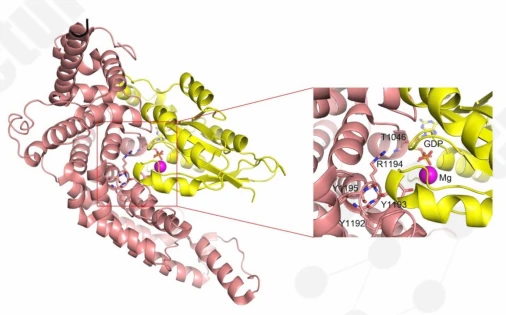
Figure 1. The binding of GRD with Cdc42.
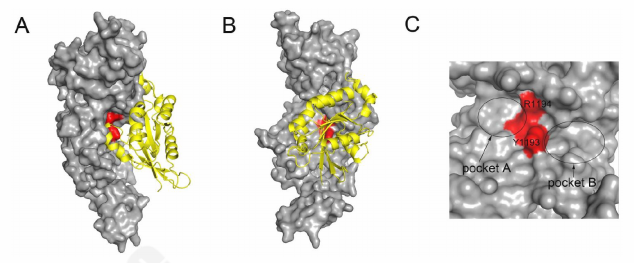
Figure 2. The binding interface between GRD with Cdc42.





