Virtual Co-Crystal Screening Services
 AI Pose Prediction
  Physics-Based Ranking
  Experimental Validation
 Fragment libraries of 1,000+ compounds cannot all be soaked. We pre-rank ligands using AlphaFold Protein Structure Prediction-guided pose generation and physics-based scoring, delivering a focused soaking list with 10× higher hit rates before a single crystal enters the drop.
Why Virtual Co-Crystal Screening Is the Critical Foundation
Crystallographic fragment screening without pre-filtering is brute force: soaking 500 fragments to find 20 hits burns synchrotron time and crystal stocks. Seed-stage biotechs lack the crystal farms to support blind soaking; big-pharma teams need focused libraries that maximize data-per-crystal. Our platform integrates AlphaFold Protein Structure Prediction, Molecular Docking Services, and Binding Free Energy Calculation (FEP/TI, MM/PBSA) rescoring to build a prioritized soaking list, feeding directly into MagHelix™ Co-crystallization and Soaking and AI-Assisted X-ray Crystallography Services workflows.
What Sets the Platform Apart
AI-Guided Pose Prediction
AlphaFold Protein Structure Prediction and Molecular Docking Services generate binding poses for fragment libraries, identifying orthosteric and cryptic pocket occupancy before soaking.
Physics-Based Hit Ranking
Rosetta/GROMACS rescoring and Binding Free Energy Calculation (FEP/TI, MM/PBSA) triage false positives, ensuring only chemically plausible binders advance.
Seamless Wet-Lab Handoff
Ranked soaking lists feed directly into MagHelix™ Co-crystallization and Soaking with Echo-accurate nanoliter dispensing and automated data collection pipelines.
Technology Suite
AI-Assisted Virtual Screening & Pose Generation
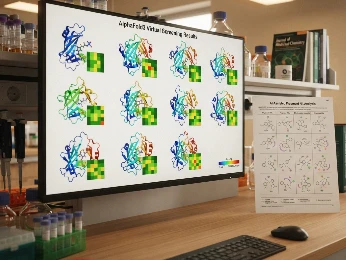
AlphaFold3/GNINA Pose Prediction and Cryptic Pocket Mapping
Key Features:
- AlphaFold3/GNINA Pose Prediction — Predicts protein-ligand complex structures for fragment-sized molecules; 78.5% success rate on pocket-aligned RMSD benchmarks for covalent and non-covalent binders.
- Cryptic Pocket Mapping — AlphaFold Protein Structure Prediction ensemble models reveal transient pockets invisible in apo structures, expanding the druggable surface for fragment exploration.
- Fragment Library Curation — Ro3-compliant libraries (Maybridge, Idorsia, in-house) filtered by synthetic accessibility, solubility, and pan-assay interference (PAINS) flags.
- Ensemble Docking — Multiple receptor conformers from Molecular Dynamics (MD) Simulations account for pocket flexibility, improving pose diversity.
Ideal For: Virtual biotechs without crystallization infrastructure; Membrane Protein & Lipid MD Simulation targets where crystal soaking is expensive; programs requiring rapid progression from Gene-to-Protein Production to Fragment-based Screening (FBS) hits.
What We Offer: A computational pre-screen that compresses 1,000-compound libraries into 50–100 prioritized soaks. AI-generated poses are rescored by physics-based methods and validated against Crystal Grade Protein Preparation quality data, ensuring the soaking list matches crystal system constraints.
Physics-Based Rescoring & Soaking List Optimization
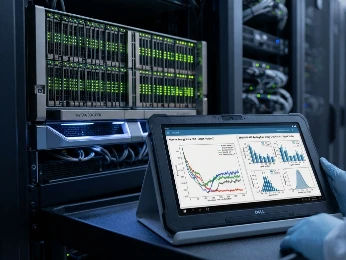
Rosetta/GROMACS Energy Minimization and FEP/TI Affinity Ranking
Key Features:
- Rosetta/GROMACS Energy Minimization — All AI poses are relaxed and scored to resolve steric clashes and optimize hydrogen-bond networks.
- FEP/TI Affinity Ranking — Binding Free Energy Calculation (FEP/TI, MM/PBSA) estimates relative binding free energies for top-ranked fragments, further narrowing the soaking list to high-confidence candidates.
- PanDDA-Ready Soaking Formats — Output lists are formatted with compound ID, predicted binding site, suggested DMSO concentration, and cryoprotectant compatibility for direct import into AI-Assisted X-ray Crystallography Services pipelines.
- Hit Rate Analytics — Post-soaking feedback loops compare predicted vs. observed binding poses, refining ML models for subsequent Drug Design & Library Analysis campaigns.
Ideal For: Large-scale fragment screening campaigns; targets with limited crystal availability; Lead Optimization programs requiring structural validation of Hit to Lead candidates.
What We Offer: A ranked soaking list with predicted binding modes, confidence scores, and experimental protocols. Each compound is assigned a priority tier (Tier 1: high-confidence soak; Tier 2: exploratory soak), enabling efficient allocation of crystal stocks and synchrotron beamtime.
Platform Instrumentation
| Instrument | Capability |
|---|---|
| GNINA 1.3 / AutoDock Vina | CNN-scored and physics-based fragment docking |
| Schrödinger Glide / IFD-MD | Induced-fit docking for flexible pocket targets |
| OpenEye / RDKit | Ligand preparation, tautomer enumeration, and pose analysis |
| GROMACS/AMBER HPC | Post-docking relaxation and FEP rescoring |
| Echo 550 Acoustic Dispenser | Nanoliter-precision fragment dispensing into crystallization plates |
| Formulatrix Rock Imager 1000 | Pre-soaking crystal quality assessment and imaging |
Standardized Workflow
Project Workflow
A milestone-driven system from target structure to prioritized soaking list.


01 Target Review
- Structure assessment and AlphaFold Protein Structure Prediction model review
- Pocket druggability analysis and cryptic site mapping
- Fragment library selection (Ro3, in-house, custom)
- Deliverable: Target assessment + screening strategy
02 AI Pose Generation
- Fragment library docking (GNINA/Glide)
- Molecular Dynamics (MD) Simulations ensemble generation
- Deliverable: Raw pose ensemble + confidence scores
03 Physics Rescoring
- Rosetta energy minimization and clash resolution
- Binding Free Energy Calculation (FEP/TI, MM/PBSA) ranking
- Deliverable: Rescored hit list + binding mode report
04 Soaking List Finalization
- Tiered soaking list (Tier 1/2) with predicted binding sites
- DMSO/cryoprotectant compatibility check
- Deliverable: Final soaking list + experimental protocol
05 Experimental Validation
- MagHelix™ Co-crystallization and Soaking with Echo dispensing
- Automated data collection at synchrotron
- PanDDA analysis and hit confirmation
- Deliverable: Validated structures + final report
Sample Requirements
- Target Structure: PDB file, AlphaFold Protein Structure Prediction model, or Homology Modeling & Threading output; resolution > 2.5 Å preferred
- Fragment Library: Ro3-compliant set (250–2,000 compounds) or custom curated library in SDF/SMILES
- Known Binders: Reference compounds or cofactors for pose validation and benchmarking
- Crystal System Info: Space group, cryoprotectant, DMSO tolerance, and soaking conditions (if known)
- Downstream Goal: Fragment-based Screening (FBS), Hit Identification, or Lead Optimization structural validation
Standard Deliverables
- Ranked soaking list with AI confidence and physics-based scores (CSV/Excel)
- Predicted binding mode analysis with interaction fingerprints and pocket maps
- Rescored pose ensemble with quality checks (PoseBusters-validated)
- Binding Free Energy Calculation (FEP/TI, MM/PBSA) ranking report (if selected)
- Experimental validation data (if selected): X-ray coordinates and PanDDA event maps
- Final technical report with hit prioritization and Lead Optimization recommendations
Frequently Asked Questions
Case Study
Case Study: AI-Guided Virtual Screening Boosts Crystallographic Fragment Screening Hit Rates for a GPCR
Goal: Benchmark an integrated computational-experimental pipeline that uses virtual screening to prioritize fragment soaking for a thermostabilized GPCR, comparing hit rates between broad library screening and AI-guided follow-up.
Key Findings:
- Initial broad screening: 568 fragments soaked against tsA2AR yielded 23 hits (4% hit rate), including 3 orthosteric and 20 novel intracellular allosteric binders.
- AI-guided follow-up: Virtual screening targeting the newly discovered intracellular pocket identified 109 follow-up compounds; 56 produced clear electron density (51% hit rate).
- Biophysical validation: 19 of the 56 X-ray hits were independently confirmed by grating-coupled interferometry (GCI), establishing a cross-validated hit set.
- Structural novelty: The intracellular pocket represents a previously uncharacterized allosteric site, offering a new vector for receptor modulation.
Industrial Translation: This independent study demonstrates that combining initial crystallographic screening with AI-guided virtual follow-up compresses fragment-to-lead timelines and dramatically improves hit rates. For biotechs and pharma teams, this validates our platform's core value: computational pre-screening eliminates low-probability soaks, preserving crystal stocks and synchrotron budget for high-confidence candidates.
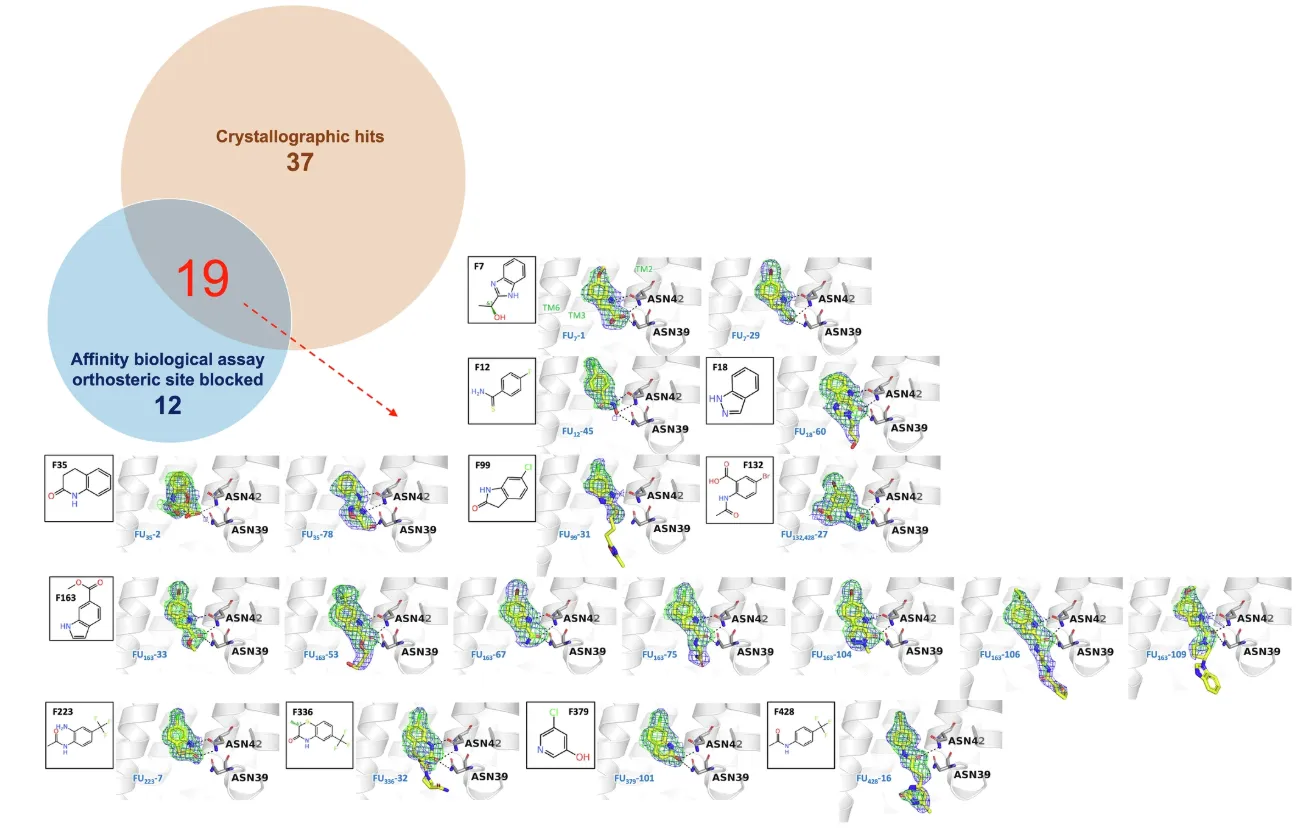
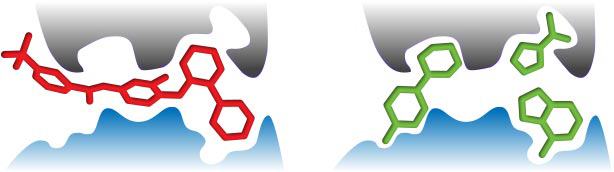
Figure 1. Follow-up compounds/fragments targeting the intracellular binding site of tsA2AR validated by X-ray crystallography and affinity biological assays.
Reference
Huang C-Y, et al. An integrated experimental and computational pipeline for crystallographic fragment screening of membrane protein in the lipid cubic phase. Commun Chem. 2026;9:20.
Our technical team responds within 24 hours. All inquiries protected under NDA.