Fragment Screening by NMR (STD-NMR)
 AI-Assisted Epitope Mapping
 Label-Free Screening
 Integrated Hit Validation
Fragment hits hide in millimolar noise. Our STD-NMR platform detects weak binders directly from cocktails, maps binding epitopes at the proton level, and validates hits through integrated Hit Biophysical Characterization — all without isotopic protein labeling.
Why Fragment Screening by NMR Is the Critical Foundation
Fragment-based drug discovery without reliable hit detection is chemistry without direction. Seed-stage biotechs cannot afford the protein labeling and crystal infrastructure required for AI-Assisted X-ray Crystallography Services; big-pharma teams need orthogonal validation of Virtual Screening Services predictions against solution-state behavior. Our AI-Enhanced NMR Spectroscopy Services platform integrates STD-NMR with WaterLOGSY and CPMG confirmation, delivering label-free hit identification and epitope maps directly into Hit to Lead and Lead Optimization workflows.
What Sets the Platform Apart
Label-Free & No Isotope Required
STD-NMR detects millimolar-affinity fragments using unlabeled protein, eliminating the cost and time of Gene-to-Protein Production isotope labeling.
Cocktail Screening with Deconvolution
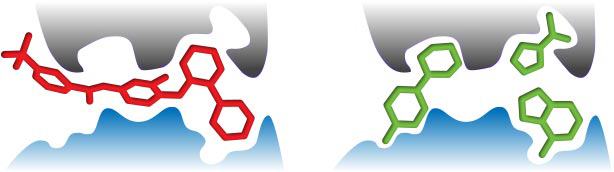
Up to 8 fragments per tube are screened in mixtures; AI deconvolution identifies individual binders from overlapping spectra, tripling throughput.
AI-Assisted Epitope Mapping
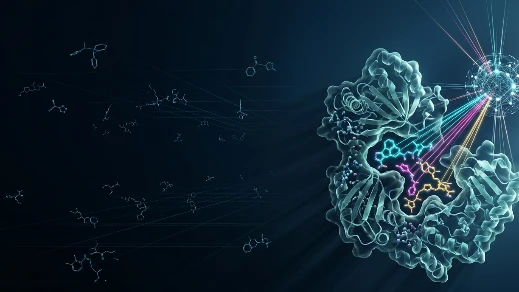
Saturation transfer intensity profiles reveal which ligand protons contact the protein, generating 3D epitope hypotheses for Molecular Docking Services.
Technology Suite
AI-Assisted STD-NMR Screening & Epitope Mapping
Saturation Transfer Difference and AI Deconvolution for Fragment Hit Discovery
Key Features:
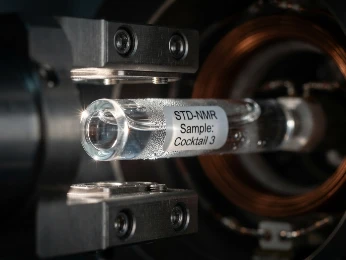
- Saturation Transfer Difference (STD) — Selective protein saturation transfers magnetization to bound ligands; only binding fragments appear in the difference spectrum, with signal intensity proportional to proximity.
- Cocktail Deconvolution — Mixtures of 5–8 fragments are screened per tube; AI spectral deconvolution identifies individual hits without re-screening singletons, reducing protein consumption by 80%.
- Epitope Mapping by STD Amplification — Relative STD amplification factors per proton group reveal the ligand's binding orientation, generating pharmacophore constraints for Pharmacophore Modeling & Screening.
- WaterLOGSY Cross-Validation — Water-mediated NOE experiments confirm hits and identify solvent-exposed binding modes, orthogonal to STD data.
Ideal For: Virtual biotechs without isotope-labeling infrastructure; Membrane Protein & Lipid MD Simulation targets where crystallography fails; Fragment-based Screening (FBS) campaigns requiring rapid hit triage.
What We Offer: A fully outsourced STD-NMR screening pipeline. You provide unlabeled protein and fragment library; we deliver hit lists, epitope maps, and binding site hypotheses. AI-assisted cocktail analysis compresses traditional weeks-long screening into days, while epitope data feeds directly into Drug Design & Library Analysis.
Integrated Hit Validation & Affinity Quantification
Orthogonal NMR Confirmation and Affinity Ranking for Fragment Hits
Key Features:
- Line Broadening & CPMG Confirmation — Secondary ligand-observed experiments confirm primary STD hits and eliminate false positives from aggregation or non-specific binding.
- 1H-15N HSQC Titration — For labeled proteins, chemical shift perturbation mapping localizes the binding site to specific residues, validating epitope predictions.
- Affinity Ranking by Titration — STD build-up curves and competition experiments estimate KD values (µM–mM range), prioritizing hits for Binding Free Energy Calculation (FEP/TI, MM/PBSA).
- Hit-to-Lead Handoff — Validated fragments advance to MagHelix™ Co-crystallization and Soaking or All-Atom Protein MD Simulation for growing and linking strategies.
Ideal For: Hit Identification campaigns requiring orthogonal validation; Natural Product Research & Development extract screening; MagHelix™ FBDD Platform integration.
What We Offer: Every hit is validated by at least two orthogonal NMR methods and ranked by estimated affinity. Data packages include epitope maps, binding site hypotheses, and SAR recommendations for medicinal chemistry.
Platform Instrumentation
| Instrument | Capability |
|---|---|
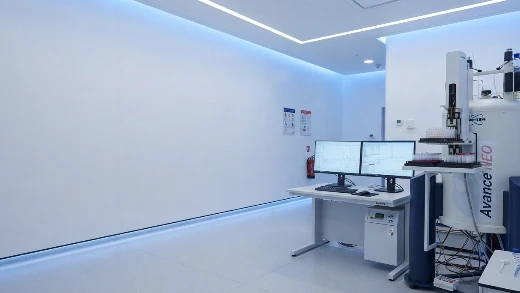
| Bruker AVANCE NEO 600 MHz | STD-NMR, WaterLOGSY, and CPMG screening with TCI cryoprobe |
| Bruker AVANCE NEO 800 MHz | High-resolution epitope mapping and HSQC titration for labeled targets |
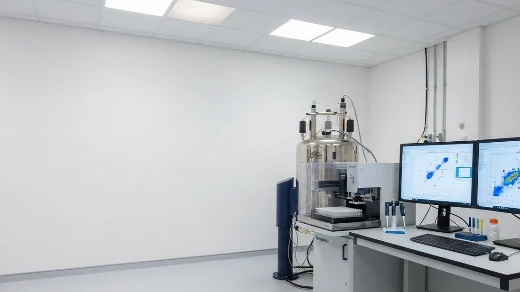
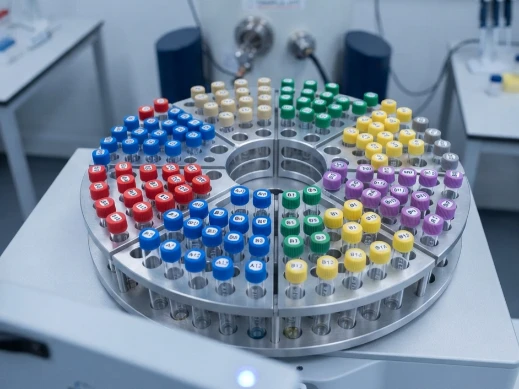
| SampleJet Automated Changer | 96-tube automated screening with barcode tracking and temperature control |
| CryoProbe TCI (1H/13C/15N) | Triple-resonance detection for protein-observed validation experiments |
| NVIDIA DGX A100 | AI spectral deconvolution and STD amplification factor analysis |
| Sartorius Octet SF3 | BLI orthogonal validation of NMR hits for affinity ranking |
| NanoTemper Prometheus NT.48 | NanoDSF thermal stability confirmation of protein-ligand complexes |
| AKTA Pure Chromatography | SEC polishing of protein samples prior to NMR screening |
Standardized Workflow
Project Workflow
A milestone-driven system from protein to validated fragment hits.


01 Target Review
- Protein quality assessment (SEC, NanoDSF)
- Binding site hypothesis from AlphaFold Protein Structure Prediction
- Deliverable: Feasibility report + screening strategy
02 Library & Assay Setup
- Fragment library curation (Ro3, solubility QC)
- AI cocktail grouping to minimize spectral overlap
- Deliverable: Library QC + cocktail design
03 STD-NMR Screening
- Cocktail STD-NMR screening (5–8 per tube)
- AI deconvolution and hit identification
- Deliverable: Primary hit list + STD spectra
04 Hit Validation
- WaterLOGSY/CPMG orthogonal confirmation
- 1H-15N HSQC binding site mapping (if labeled)
- Deliverable: Validated hit list + affinity estimates
05 Downstream Handoff
- Hit list handoff to Molecular Docking Services
- Epitope maps for Pharmacophore Modeling & Screening
- Deliverable: SBDD starter pack + final report
Sample Requirements
- Target Protein: >95% pure by SEC; concentration 5–50 µM; unlabeled or 15N-labeled
- Fragment Library: Ro3-compliant; 100–2,000 compounds; solubility verified in aqueous buffer + ≤5% DMSO
- Buffer Compatibility: Phosphate or HEPES; pH 6.5–8.0; no high-salt or detergent interference (for MPs, nanodiscs preferred)
- Reference Compounds: Known binders or cofactors for assay validation
- Downstream Goal: Hit to Lead, Lead Optimization, Fragment-based Screening (FBS), or ADMET Prediction & Modeling
Standard Deliverables
- Primary hit list with STD amplification factors and confidence scores
- Epitope mapping report (proton-level binding orientation)
- Orthogonal validation data (WaterLOGSY, CPMG, or HSQC)
- Affinity ranking (KD estimates from titration or competition)
- AI-deconvoluted spectral data and analysis scripts
- Final technical report with SBDD recommendations
Frequently Asked Questions
Case Study
Case Study: STD-NMR Screening Identifies SARS-CoV-2 PLPro Fragment Binders
Goal: Evaluate STD-NMR and WaterLOGSY as primary screening tools for fragment binders targeting the papain-like protease (PLPro) of SARS-CoV-2, a key viral enzyme involved in polyprotein cleavage and immune suppression.
Key Findings:
- Screening scale: A DSI-poised fragment library of 607 compounds was screened by STD-NMR and WaterLOGSY, yielding 86 binding compounds (14.2% hit rate).
- Hit prioritization: Five candidates were prioritized for in-depth analysis; three exhibited quantifiable affinities and two distinct binding sites on PLPro.
- Orthogonal validation: STD-NMR hits were cross-validated by competition experiments and mapping studies, confirming specific binding over aggregation artifacts.
- Structural insight: The dual-site binding profile suggests opportunities for fragment linking to improve potency and selectivity.
Industrial Translation: This independent study demonstrates that STD-NMR remains a robust, label-free primary screening tool for viral and challenging targets. For biotechs and pharma teams, the 14% hit rate and ability to resolve multiple binding sites from a single screen validate our platform's efficiency — directly supporting our Fragment Screening by NMR (STD-NMR) service for rapid hit identification without isotopic labeling investment.
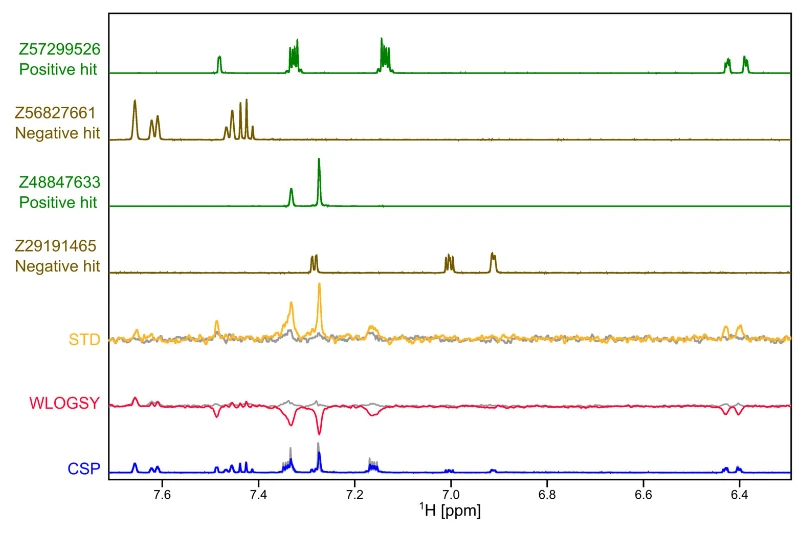
Figure 1. Representative STD-NMR screening data for fragment cocktails against SARS-CoV-2 PLPro. Positive hits (green) exhibit clear STD signals (yellow trace) and WaterLOGSY sign changes (red trace), while negative hits (brown) show no binding response.
Reference
Pyper DJ, et al. NMR screening of low molecular weight inhibitors targeting the papain-like protease (PLPro) of SARS-CoV-2. FEBS Open Bio. 2025;15(10):1667–1677.
Our technical team responds within 24 hours. All inquiries protected under NDA.