Binding Free Energy Calculation (FEP/TI, MM/PBSA)
 Alchemical FEP
  End-Point Thermodynamics
  Experimental Correlation
 Quantified binding free energies that rank analogs by ΔG, cutting synthesis cycles and experimental burden for resource-constrained teams.
Why Binding Free Energy Calculation Is the Critical Foundation
Lead optimization stalls when teams rank compounds by docking scores that poorly correlate with measured affinity. Seed-stage biotechs cannot afford to synthesize every analog; pharma teams need quantitative ΔG to prioritize patent-sensitive series. We deliver FEP/TI precision for final candidates and MM/PBSA throughput for early triage — directly feeding lead optimization and ADMET decisions.
What Sets the Platform Apart
FEP/TI Precision
Alchemical free energy perturbation delivers ΔG within ~1 kcal/mol of experimental values for lead-series analogs.
MM/PBSA Scale
End-point thermodynamics screens 1,000+ compounds per week at a fraction of FEP cost, enabling scaffold triage before synthesis commitment.
AI-Enhanced Sampling
ML-driven ensemble selection and enhanced sampling protocols reduce convergence time by 40%, accelerating turnaround for milestone-driven programs.
Technology Suite
Alchemical Free Energy Perturbation (FEP/TI)
Relative & Absolute FEP — Alchemical transformations between lead analogs or ligand-to-none
Key Features:
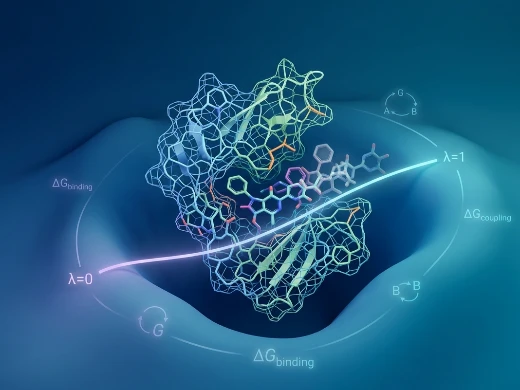
- Relative & Absolute FEP — Alchemical transformations between lead analogs (RBFE) or ligand-to-none (ABFE) using GROMACS/AMBER with soft-core potentials.
- Replica Exchange & Hamiltonian Sampling — Hamiltonian replica exchange and λ-dynamics improve convergence for tight-binding or highly flexible ligands.
- Cycle Closure & Error Analysis — Statistical rigor with cycle closure checks, overlap matrix analysis, and uncertainty quantification for every ΔG estimate.
Ideal For: Lead optimization campaigns requiring rank-ordering of 5–20 analogs; programs with existing co-crystal structures where minor substitutions modulate affinity; patent-sensitive series where each synthesis must count.
What We Offer:
Pharma teams receive a ranked ΔG table with statistical errors and structural rationale for affinity changes. Seed-stage biotechs access pharma-grade FEP without building an internal MD team, with results delivered in 2–4 weeks.
MM/PBSA & MM/GBSA End-Point Analysis
High-Throughput Affinity Ranking via End-Point Thermodynamics
Key Features:
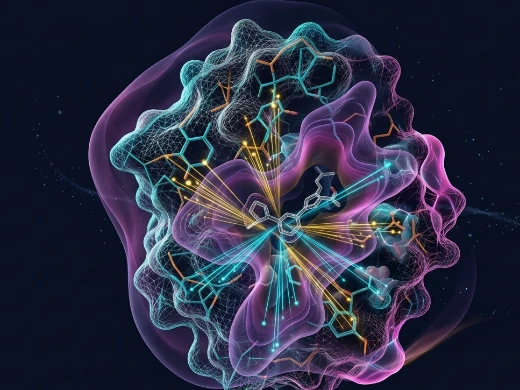
- High-Throughput Affinity Ranking — End-point thermodynamics decomposes ΔG_bind into van der Waals, electrostatic, polar solvation, and non-polar contributions for rapid analog comparison.
- Per-Residue Energy Decomposition — Identifies hot-spot residues driving affinity and selectivity, guiding medicinal chemistry substitutions.
- Ensemble Averaging from MD — Binding free energies averaged over 50–200 MD snapshots to capture receptor flexibility and induced-fit contributions.
Ideal For: Early lead triage where FEP is cost-prohibitive; scaffold comparison across 50–200 virtual analogs; selectivity profiling against off-target homologs.
What We Offer:
A prioritized compound list with predicted ΔG_bind, per-residue decomposition maps, and selectivity indices. Results feed directly into virtual screening triage and medicinal chemistry prioritization.
Thermodynamic Integration & Experimental Correlation
Continuous λ-Integration with Experimental Data Calibration
Key Features:
- Thermodynamic Integration (TI) — Continuous λ-integration path with adaptive sampling for systems where FEP perturbations suffer from insufficient overlap.
- Experimental Data Integration — Correlation of computed ΔG with SPR/ITC measured affinities to calibrate force-field parameters and improve model accuracy.
- AI-Augmented Force Fields — Machine-learned corrections to classical force fields for halogen bonds, metal coordination, and charged species.
Ideal For: Charged ligands or metalloproteins where standard force fields struggle; programs with existing ITC/SPR data seeking predictive model calibration; ion-channel or kinase inhibitor series with non-classical interactions.
What We Offer:
A calibrated computational protocol where predicted ΔG correlates with your experimental assay data. We deliver force-field validation reports and uncertainty bounds, ensuring computational predictions guide synthesis with quantified confidence.
Platform Instrumentation
Core Instruments
| Instrument | Capability |
|---|---|
| NVIDIA DGX H100 | FEP/TI ensemble simulation and AI-augmented force-field inference at scale |
| GROMACS/AMBER HPC Cluster | Microsecond-scale alchemical and end-point free energy calculations |
| Schrödinger FEP+ Suite | Commercial FEP workflow validation and cross-platform benchmarking |
| Sartorius Octet SF8 | High-throughput BLI for experimental ΔG correlation and affinity ranking |
| Bruker AVANCE NEO 800 MHz | NMR validation of ligand-bound conformations supporting FEP starting poses |
| PerkinElmer EnVision Nexus | Multimode assay readout for IC50/EC50 correlation with computed ΔG |
| Waters ACQUITY UPLC H-Class | Purity and solubility profiling of analogs entering FEP validation |
Standardized Workflow
Project Workflow
A milestone-driven execution system from structure to ranked affinity.


01 Target Review
- Structure assessment and ligand series inventory
- Force-field selection and thermodynamic cycle design
02 System Setup
- Receptor preparation and ligand parameterization
- Solvation, equilibration, and quality check MD
03 FEP/TI or MM/PBSA Execution
- FEP λ-window production or MM/PBSA snapshot collection
- Convergence monitoring and cycle closure
04 Analysis & Ranking
- Statistical analysis and error estimation
- Rank ordering with structural rationale
05 Experimental Validation
- SPR/ITC affinity confirmation
- Crystallography for select hits
Sample Requirements
- Target Structure: PDB/AF model or experimental structure of receptor-ligand complex
- Ligand Series: 2D/3D structures of analogs in SDF/MOL2 format; desired modifications and substitution sites
- Experimental Data: Prior ITC/SPR/Kd values (if available) for model calibration
- Project Scope: Relative FEP, absolute FEP, or MM/PBSA screening; selectivity targets (if any)
Standard Deliverables
- Ranked ΔG table with statistical errors and confidence intervals
- Structural rationale report explaining affinity changes per substitution
- Per-residue energy decomposition maps (MM/PBSA)
- Convergence diagnostics and overlap matrices (FEP)
- Force-field calibration report (if experimental data provided)
- Electronic data package (raw trajectories, analysis scripts, input files)
Frequently Asked Questions
Case Study
Case Study: GPU-Resident FEP for Rapid, Accurate Binding Affinity Prediction — Benchmarking GROMACS on Heterogeneous GPU Architectures
Goal:
Benchmark a fully GPU-resident free-energy perturbation (FEP) implementation in GROMACS for absolute binding free energy (ABFE) calculations, validating that GPU acceleration delivers CPU-comparable accuracy with order-of-magnitude speed-ups suitable for high-throughput lead optimization.
Key Data:
- Benchmark scope: Eight ligand–protein pairs (including two charged ligands) across BRD4 inhibitors, evaluated with 31 λ-windows for ligand–solvent and 42 for complex simulations.
- Accuracy lock: GPU-derived ΔG values on both NVIDIA A100 and MetaX C500 align with all-CPU reference within ~1.0 kcal/mol (AUE 0.653 ± 0.081 kcal/mol; RMSE 0.775 ± 0.083 kcal/mol).
- Speed breakthrough: Fully GPU-resident FEP achieves up to ~8× acceleration on A100 and ~4× on MetaX C500 versus 32-core CPU, shrinking end-to-end ABFE turnaround from ~400 h to ~48 h.
Why it matters:
For teams running affinity-driven SAR campaigns, this benchmark resolves the classic throughput–accuracy dilemma. GPU-resident FEP preserves the ±1 kcal/mol precision required for confident compound ranking while compressing multi-week timelines into days. Integrating this workflow into our platform delivers rapid, statistically robust binding affinity predictions that directly accelerate lead optimization and reduce preclinical decision cycles.
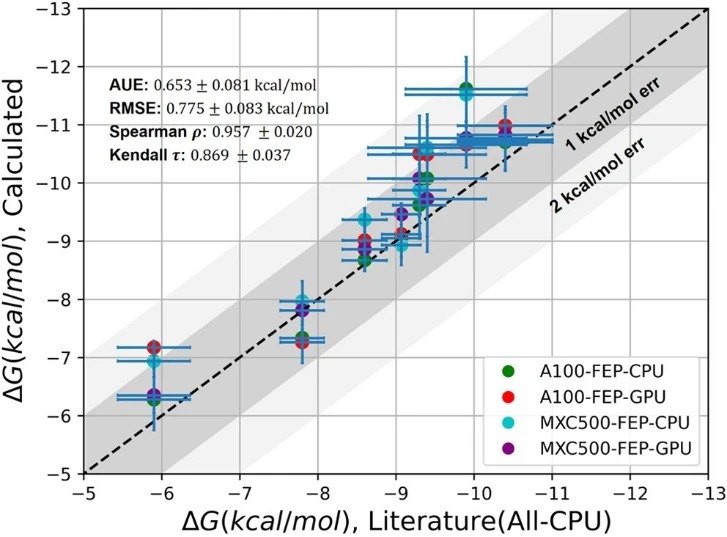
Figure 1. Correlation of absolute binding free energies (ΔG_binding) computed via CPU-only versus GPU-accelerated FEP workflows across eight benchmark systems. (Chen Y.; et al. 2025)
Reference
Chen Y, Yang J. Acceleration of the GROMACS Free-Energy Perturbation Calculations on GPUs. ACS Omega. 2025 May 30;10(22):22858-22873.
Our technical team responds within 24 hours. All inquiries protected under NDA.