MagHelix™ Strategic Platforms: The Convergence of Intelligence and Atomic Precision
We redefine the "Design-Make-Test" cycle by integrating High-Performance Computing (HPC), Generative AI, and world-class Biophysical laboratories. MagHelix™ is not just a collection of tools; it is an intelligent ecosystem designed to de-risk complex drug discovery projects and transform digital hypotheses into proven therapeutic candidates.
Overcoming the "High-Attrition" Barrier in R&D
In the current pharmaceutical landscape, traditional drug discovery platforms face diminishing returns. The "rule of five" is no longer sufficient for complex targets like GPCRs, ion channels, and intrinsically disordered proteins (IDPs).
* The Structural Bottleneck: Traditional trial-and-error crystallization can take months, often failing due to protein instability.
* The "Data Silo" Problem: Computational predictions (in silico) frequently lack direct experimental validation, leading to high failure rates in in vivo stages.
* Scalability Limits: Manual screening of chemical libraries is insufficient to explore the vast "chemical dark matter" required for first-in-class discovery.
Our Core Platforms
AI Focus: AlphaFold-assisted domain mapping, AI-driven virtual co-crystal screening, and automated protein crystallization robotics.
The bedrock of our "Atomic Truth" philosophy. We combine traditional structural biology expertise with AI to solve the most challenging structures, including GPCRs and large multi-protein complexes, ensuring high-resolution data for Structure-Based Drug Design (SBDD).
AI Focus: Deep learning-based automated image recognition for phenotype analysis and AI-driven toxicity prediction models.
A high-throughput in vivo validation bridge. By integrating AI-powered morphological analysis with zebrafish disease models, we provide rapid, cost-effective insights into drug efficacy and safety before progressing to mammalian studies.
AI Focus: Machine learning-enhanced docking scoring functions, FEP+ (Free Energy Perturbation) calculations, and cryptic pocket identification.
Our Computer-Aided Drug Design platform utilizes advanced physics-based modeling and AI to explore chemical space. We focus on enhancing binding affinity and selectivity for high-stakes targets through precise molecular simulations.
AI Focus: ML-assisted fragment library design, automated NMR/X-ray fragment screening analysis, and AI-driven fragment-to-lead expansion.
Specializing in finding starting points for "undruggable" targets. Our Fragment-Based Drug Discovery platform identifies low-molecular-weight hits and uses AI-guided structural biology to evolve them into potent, drug-like leads.
AI Focus: Generative AI for de novo design, ultra-large library screening (>10 billion compounds), and ADMET predictive modeling.
The "Digital Brain" of our operations. Supported by a specialized HPC cluster and extensive biological databases, this platform executes complex algorithms to pinpoint high-probability hits and optimize leads in silico.
The Evolution: MagHelix™ AI-Enhanced Advantage
To navigate the increasing complexity of modern drug targets, the MagHelix™ ecosystem has evolved. By integrating High-Performance Computing (HPC) with gold-standard wet-lab validation, we provide a "Platform Selection Guide" that highlights how our AI-enhanced workflows outperform traditional methodologies in speed, precision, and IP security.
Platform Selection & AI-Efficiency Guide
| Technology / Method | Ideal Target Type | AI-Enhanced Advantage (Our Moat) | Deliverables & Time Savings |
|---|---|---|---|
| AIDD & CADD Platform | Small Molecules, Enzyme Inhibitors, Cryptic Pockets | Generative AI (RFdiffusion) & FEP+: Beyond simple docking, we use physics-based AI to predict binding free energy with chemical accuracy, exploring "dark matter" chemical space. | 50% Reduction in hit-to-lead cycles; Delivery of prioritized candidate lists with predicted in vitro potency. |
| Structural Biology & SBDD | GPCRs, Ion Channels, Large Multi-protein Complexes | AlphaFold-3 & AI-Driven Co-Crystallization: We use deep learning to predict optimal protein constructs and virtual co-crystal compatibility, drastically reducing experimental trial-and-error. | Atomic-resolution structures (X-ray/Cryo-EM) in weeks; High-confidence MOA validation for patent filings. |
| FBDD Platform | PPIs (Protein-Protein Interactions), "Undruggable" Targets | ML-Assisted Fragment Evolution: AI algorithms analyze NMR/X-ray fragment screening data to automatically suggest high-probability "linking" or "merging" strategies. | Validated Lead Scaffolds with high ligand efficiency; 40% faster expansion from fragments to potent leads. |
| Zebrafish Screening | Rare Diseases, Systemic Toxicity, Organ-Specific Efficacy | Deep Learning Phenotypic Analysis: Automated AI image recognition quantifies subtle morphological changes in in vivo models that are invisible to the human eye. | Rapid in vivo PoC (Proof-of-Concept) data; High-throughput safety profiling delivered 3x faster than mammalian models. |
| Antibody & Biologics AI | Monoclonal Antibodies, Bispecifics, ADCs | In Silico Humanization & Affinity Maturation: AI models predict aggregation propensity and solubility while maintaining CDR integrity. | Optimized Biologic Leads with superior stability; Dramatically reduced in vitro screening workload. |
Why This Evolution Matters for Your Pipeline
- • De-Risking Early R&D: We don't just provide "black box" AI predictions. Every computational output is filtered through our deep structural biology expertise and verified in our own labs.
- • HPC-Powered Throughput: Our proprietary High-Performance Computing clusters ensure that complex Molecular Dynamics (MD) simulations that previously took months are now completed in days.
- • Defensible IP: By providing experimental atomic coordinates (PDB files) alongside AI-designed molecules, we ensure your intellectual property is backed by the highest level of "Biophysical Truth."
The MagHelix™ Integrated Design-Make-Test Cycle
We implement an accelerated Design-Make-Test cycle, bridging generative AI with advanced structural biology to move your project from digital inception to in vivo proof-of-concept.
Strategic Design & Assessment
The MagHelix™ AIDD Platform evaluates druggability and identifies cryptic pockets to define the optimal R&D roadmap for challenging targets.
AI-Powered In Silico Exploration
Our CADD & AIDD Platforms execute ultra-large library screening and de novo molecular design via proprietary HPC clusters to pinpoint high-probability hits.
Precision Synthesis & Hit Expansion
Supported by the FBDD Platform, we perform scaffold hopping and analog synthesis, tightly coupled with rapid biochemical assays to confirm ligand efficiency.
Atomic-Resolution Structural Validation
The Structural Biology Platform utilizes Cryo-EM or X-ray Crystallography to visualize interactions at atomic resolution, providing the "Physical Truth" for rational lead refinement.
Iterative Optimization & In Vivo Validation
Candidates undergo ADMET optimization and final Zebrafish Platform in vivo profiling to ensure the delivery of high-quality Preclinical Candidates (PCC).
Sample Requirements & Deliverable
Sample Requirements
To ensure the highest data quality and platform compatibility, we recommend the following guidelines:
- •
Target Proteins: Purity >95% (as determined by SDS-PAGE/SEC); concentration typically 1-5 mg/mL (depending on the platform).
- •
Small Molecules/Fragments: Solid or DMSO-dissolved (min. 10 mM); purity >95% by HPLC/MS.
- •
Genetic Material: For zebrafish model generation, please provide sequence data or verified plasmid constructs.
- •
Shipping: All biological samples must be shipped on dry ice or in temperature-controlled packaging as per our logistics protocol.
Deliverables
Each project concludes with a comprehensive IND-enabling data package:
- •
Structural Data: Final 3D atomic coordinates (PDB/mmCIF files), electron density maps, and diffraction/Cryo-EM raw data.
- •
Computational Reports: Detailed MD simulation trajectories, docking scores, FEP+ energy profiles, and AI-generated candidate lists.
- •
Biological Data: In vivo efficacy and toxicity reports with high-resolution phenotypic imaging (Zebrafish assays).
- •
Technical Documentation: Full methodology description, materials and equipment lists, and expert analysis for regulatory submission.
Case Study
Case Study: Deep Phenotypic Profiling of Neuroactive Drugs in Larval Zebrafish
Background: Behavioral larval zebrafish screens are a powerful high-throughput format for finding neuroactive molecules relevant to human physiology. However, traditional analysis often fails to capture subtle phenotypic nuances. This study aimed to use Deep Metric Learning (DML) to transcend simple correlation-based distances and precisely map the bioactivity of small molecules in vivo.
Key Technical Milestones:
- Advanced Generative & Metric Learning: Researchers trained DML models on a library of 650 CNS-active compounds. By utilizing high-replicate screening data, the AI learned to distinguish deep biological signatures from noise, significantly outperforming canonical correlation-distance methods.
- Correction of "Shortcut Learning": A critical milestone was identifying that initial AI models exploited subtle experimental artifacts (e.g., plate layout). The team implemented a rigorous physical well-wise randomization protocol—a gold standard in high-throughput screening—to ensure the AI learned genuine biological phenotypes.
- High-Throughput In Vivo Validation: The platform's predictive power was tested against diverse drug-like libraries. The AI-driven phenotypic analysis successfully generalized to orthogonal datasets, proving that deep learning can reliably predict the physiological impact of unknown compounds in a living system.
- Biophysical & In Vitro Confirmation: To close the loop, prospective predictions were validated via radio-ligand binding assays against human protein targets. The study achieved an impressive hit rate of 58%, directly linking in vivo zebrafish behavior to specific molecular target engagement.
Conclusion: This independent research confirms that the integration of Deep Learning and Zebrafish Phenotyping can accurately predict human protein-target activity. The 58% hit rate demonstrates that this "Dry-to-Wet" loop is a robust strategy for identifying potent neuroactive leads, which is consistent with the logic followed by our integrated MagHelix™ service.
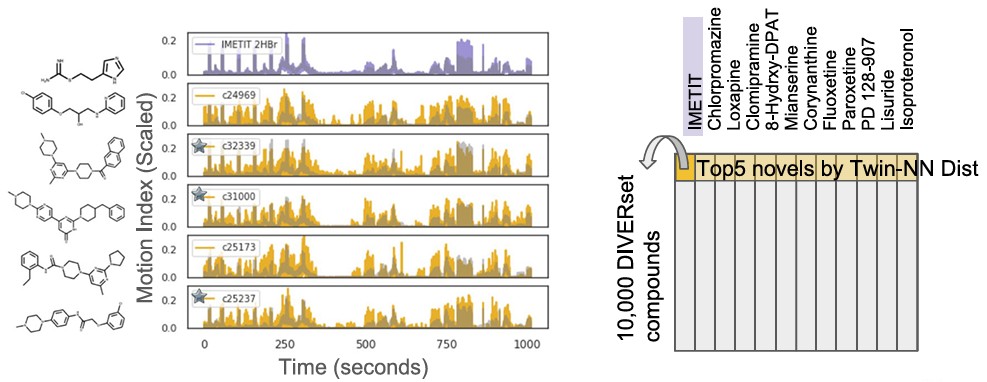
Figure 1. Phenoblast approach: motion index time-series matches (left) and phenotypic distance matrix (right) for NT-650 mechanism prediction. (Gendelev L, et al., 2024)
Why Trust Our MagHelix™ Platforms?
Proprietary HPC Infrastructure
Our platforms are powered by specialized High-Performance Computing (HPC) clusters, optimized for microsecond-scale Molecular Dynamics (MD) simulations and the rapid training of deep learning models like AlphaFold-3 and RFdiffusion.
Integrated Dry-to-Wet Loop
Unlike pure computational firms, we eliminate the "prediction gap." Every in silico hit generated by our AIDD or CADD platforms is cross-validated through our in-house Cryo-EM, X-ray, and Zebrafish screening facilities.
Decade of Structural Expertise
With over 10 years of leadership in structural biology, our Ph.D.-led teams provide the "Physical Truth" (atomic coordinates) required to turn AI hypotheses into defensible Intellectual Property (IP) for our B2B clients.
Scalable & Modular Solutions
From ultra-large library screening of billions of compounds to niche in vivo toxicity profiling in zebrafish, our platforms offer the flexibility to support both standalone pilot studies and end-to-end drug discovery programs.
IND-Ready Data Integrity
We provide comprehensive data packages, including raw diffraction images, MD trajectories, and phenotypic video data that meet global regulatory standards, ensuring high traceability for your clinical transitions.
Frequently Asked Questions
For any inquiries, our drug discovery experts are ready to help you get technical support to accelerate your hit-to-lead transition and maximize the success rate of your preclinical candidates.