Lead Discovery & Optimization: Accelerating the Evolution from Hit to Candidate
We integrate Generative AI, Computational Chemistry, and Atomic-Resolution Structural Biology into a seamless workflow. By bridging the gap between in silico prediction and in vivo validation, we deliver optimized leads with superior potency, selectivity, and drug-like properties.
Overcoming the Bottlenecks in Modern Drug Discovery
The landscape of modern drug discovery is shifting toward increasingly complex targets, such as GPCRs, ion channels, and Protein-Protein Interactions (PPIs). Traditional linear screening methodologies often struggle with high attrition rates due to poor early-stage prediction of ADMET properties and binding stability, leading to costly failures in late-stage development.
Our Strategic Response (The "How"):
To bridge these gaps, Creative Biostructure implements an intelligent Design-Make-Test closed-loop framework. By integrating Computational Biology and Generative AI at the inception of every project, we pre-evaluate molecular affinity and pharmacokinetics in silico. This predictive approach minimizes redundant experimental iterations, allowing R&D resources to be strategically concentrated on the most promising drug-like candidates.
Reduction
Success Rate
Simulations
Countries
Integrated Solutions for Every Stage of Lead Discovery
From initial hit identification to preclinical candidate selection, our modular drug discovery services combine high-throughput technologies with AI-driven insights to de-risk your drug discovery journey.
AI Focus: MagHelix™ AIDD for ultra-large library virtual screening and fragment-based design.
Rapidly identify high-quality starting points through assay development, high-throughput screening (HTS), and fragment-based approaches, tailored to challenging and "undruggable" targets.
AI Focus: Machine Learning-enhanced binding kinetics analysis and fragment-to-lead expansion.
Validate and evolve hits using an array of biophysical characterization tools to confirm binding, followed by strategic fragment-to-lead growth to optimize initial potency and selectivity.
AI Focus: SBDD-driven generative chemistry and property-based molecular optimization.
Intelligent medicinal chemistry and synthesis focusing on SAR analysis, scaffold hopping, and multiparameter optimization, powered by our unique structure-guided expertise and FTE services.
AI Focus: Deep Learning models for predictive ADMET and pharmacokinetic profiling.
Comprehensive de-risking via in vitro ADME-Tox profiling, NMR-based pharmacometabonomics, and zebrafish-based screening to evaluate safety and efficacy before clinical entry.
AI Focus: Bioinformatics-driven phytochemical identification and scaffold prioritization.
Specialized services for the identification, production, and extraction of bioactive natural products, leveraging our computational platform to unlock novel chemical space.
Leveraging Multidimensional Platforms to Ensure Lead Quality
We offer a comprehensive suite of computational and experimental platforms designed to address specific challenges across diverse target classes, including GPCRs, enzymes, and Protein-Protein Interactions (PPIs). We provide not only standalone technical services but also integrated, customized workflows that harmonize multiple technologies to ensure the structural integrity and biological potency of every delivered lead.
| Platform / Method | Key Advantages | Best Use Cases | Sample Suitability | Precision / Sensitivity |
|---|---|---|---|---|
| MagHelix™ AIDD | Ultra-large library screening; ML-driven ADMET prediction | Virtual screening, de novo design, scaffold hopping | Digital libraries, SMILES, SDF | ★★★★★ (In Silico) |
| Cryo-EM (SPA) | Atomic resolution of native conformations; no crystallization needed | Complex proteins, GPCRs, membrane proteins | Purified protein (high-MW) | ★★★★★ (Atomic) |
| X-ray Crystallography | Gold standard for SBDD; high-resolution ligand-binding maps | Small molecules, rigid proteins, fragment screening | Crystallizable proteins | ★★★★★ (Atomic) |
| Surface Plasmon Resonance (SPR) | Real-time, label-free kinetics | Interaction validation, rank-ordering leads | Small molecules, biologics | ★★★★☆ (Biophysical) |
| Micro-ED | Rapid structure determination from nano-crystals | Small molecules, natural products, peptides | Powder, nano-crystals | ★★★★☆ (Sub-angstrom) |
| Isothermal Titration Calorimetry (ITC) | Measures thermodynamics; label-free | Detailed binding mechanism studies | Proteins in solution | ★★★☆☆ (Calorimetric) |
From In Silico Design to Experimental Validation
We implement a highly integrated Design-Make-Test cycle, harmonizing generative AI with advanced structural biology to ensure rapid iteration and high-quality lead delivery.
Strategic Design & Target Assessment
We evaluate target druggability using AI-driven cryptic pocket identification and structural analysis to define the optimal R&D roadmap.
AI-Powered In Silico Exploration
Our MagHelix™ platform executes ultra-large library virtual screening and de novo molecular design to pinpoint high-probability hits.
Precision Synthesis & Hit Expansion
Experienced medicinal chemists perform scaffold hopping and analog synthesis, supported by rapid biochemical assays to confirm initial activity.
Atomic Structural Validation
We utilize Cryo-EM or X-ray Crystallography to visualize target-ligand interactions at atomic resolution, driving rational lead refinement.
Iterative Optimization & PCC Selection
Candidates undergo deep optimization for potency and ADMET properties to ensure the delivery of high-quality Preclinical Candidates (PCC).
Seamless Project Initiation & High-Standard Deliverables
Sample Requirements
- •
Protein / Target: Please provide target sequence information (FASTA), high-copy plasmids, or purified protein. For purified samples, purity of ≥90% (by SDS-PAGE/SEC) and concentration of ≥1 mg/mL are preferred.
- •
Small Molecule Compounds: We accept chemical structures in SDF or SMILES formats for computational projects. For experimental validation, please provide physical samples in milligram (mg) quantities accompanied by a COA (Certificate of Analysis).
- •
Sample Packaging & Labeling: Use 1.5 mL or 2 mL RNase/DNase-free microcentrifuge tubes, tightly sealed and clearly labeled with unique identifiers.
- •
Transport Conditions: Ship proteins and biological samples on dry ice to maintain structural integrity; ship small molecules according to their specific stability requirements (room temperature or 4°C).
Our Deliverables
- •
Comprehensive Technical Report: A detailed dossier including full experimental protocols (Materials & Methods), AI predictive modeling parameters, and raw experimental datasets for complete transparency.
- •
Validated Lead Compounds: Delivery of optimized lead entities (high-purity chemical samples) ready for downstream functional assays.
- •
Structural & Digital Assets:* 3D Models: High-resolution structural files in PDB, SDF, or PyMOL Session formats, visualizing atomic target-lead binding.* Analytical Data: Raw/processed data from biophysical characterization (SPR sensorgrams, ITC isotherms) and structural metrics.
- •
Quality & Compliance Documentation: Full QC documentation and data traceability to support your internal R&D milestones or future regulatory filings.
Featured Lead Discovery Case Study
De Novo Design of Picomolar Affinity Binders to Helical Peptide Targets via RFdiffusion
Background: Many peptide hormones (e.g., PTH, Glucagon) adopt α-helical structures only upon binding their receptors, making them "conformationally variable" and extremely difficult targets for traditional binder design. This study aimed to use Generative AI to design proteins that bind these short, flexible peptides with high specificity and picomolar affinity.
Key Technical Milestones:
- Advanced Generative Design (RFdiffusion): Researchers extended the RFdiffusion framework to enable binder design for flexible targets. By utilizing partial diffusion (successive noising and denoising), they generated binders starting from random noise without the need for subsequent experimental optimization.
- Structural Precision: The study demonstrated that these AI-generated binders can recognize specific helical propensities in peptide targets. The designs were so precise that they required no manual scaffolding, representing a major leap in In Silico-to-In Vivo efficiency.
- Biophysical Validation: Experimental validation confirmed that the AI-optimized leads achieved picomolar affinity. These binders were successfully used to enrich and detect Parathyroid Hormone (PTH) and Glucagon in complex biological samples.
- Functional Application: Beyond simple binding, the leads were integrated into bioluminescence-based protein biosensors, proving their stability and functional utility in diagnostic and clinical management contexts.
Conclusion: This study proves that the synergy of RFdiffusion and partial diffusion refinement can overcome the challenge of targeting flexible, helical peptides. The ability to generate picomolar-affinity binders de novo significantly accelerates the development of potent leads for diagnostics and therapeutic interventions.
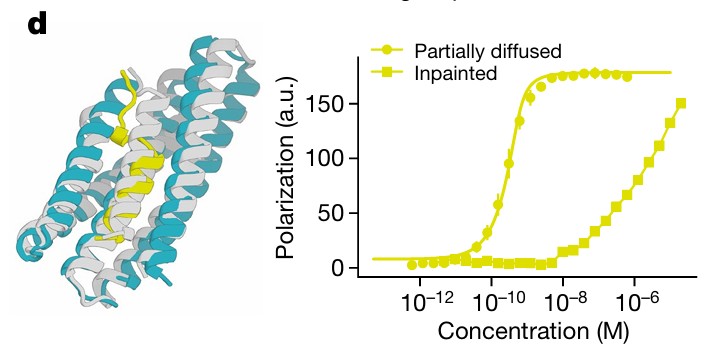
Figure 1. Crystal structures and FP titrations of GCG binders showing structural similarity and enhanced binding after partial diffusion (Vázquez Torres S, et al., 2024).
Why Trust Our Lead Discovery?
Multidisciplinary Ph.D. Team
Our core scientific team consists of Ph.D. experts specialized in computational biology, medicinal chemistry, and structural biology, bringing an average of 10+ years of industrial R&D experience to every project.
AI-Experimental Synergy
To ensure biological relevance, every in silico prediction from our MagHelix™ AIDD platform is rigorously validated through our in-house structural biology pipeline, including Cryo-EM and X-ray Crystallography.
Adherence to Global Standards
All deliverables, including comprehensive technical reports and raw datasets, are prepared to meet IND-enabling standards, ensuring high traceability and transparency for regulatory filings.
Proven Track Record
We have successfully supported leading biopharmaceutical companies and academic institutions across 30+ countries, overcoming structural challenges for "undruggable" targets such as GPCRs and complex PPIs.

Frequently Asked Questions
- Potency & Selectivity: Robust target engagement with a clear therapeutic window.
- ADMET Profiling: Favorable metabolic stability, permeability, and safety profiles.
- Physicochemical Properties: Adequate solubility and stability for downstream formulation.
- In Vivo Proof-of-Concept: Demonstrated efficacy and dose-response in relevant disease models.
For any inquiries, our drug discovery experts are ready to help you get technical support to accelerate your hit-to-lead transition and maximize the success rate of your preclinical candidates.