Protein-Nucleic Acid Interaction Modeling (Docking)
 AI-Enhanced Interface Scoring
  Rigid-Body → Flexible Refinement
  Wet-Lab Validation via SPR & Crystallography
 Transcription factors, CRISPR effectors, and RNA-binding proteins drive gene regulation and disease—but their structures with DNA or RNA targets are underrepresented in the PDB. The Molecular Docking Services platform deploys sequence-aware docking with explicit ion handling and nucleic acid flexibility, validated through biophysical and structural biology pipelines.
Why Protein-Nucleic Acid Docking Is the Critical Bridge Between Sequence and Structure?
DNA and RNA sequences encode binding specificity, but structure reveals the mechanism. For biotechs developing CRISPR-based therapeutics or antisense oligonucleotides, knowing where and how a protein grips its nucleic acid target determines guide-RNA design and off-target risk. For pharma teams targeting transcription factors or viral RNA-binding proteins, docking identifies druggable pockets at the protein-nucleic acid interface that crystallography alone misses.
What Sets the Platform Apart
Sequence-Aware Scoring
ML models trained on ITC and BLI data. R² > 0.75. ADMET Prediction & Modeling flags liabilities pre-docking.
Nucleic Acid Flexibility
Explicit phosphate backbone and base-pair flexibility. Major/minor groove accessibility scored. Benchmarked against PDB.
Wet-Lab Validation Loop
SPR, Co-crystallization, and MD Simulations confirm stability.
The Protein-Nucleic Acid Docking Suite
Protein-DNA Docking
Sequence-Specific Transcription Factor and Nuclease Complex Modeling
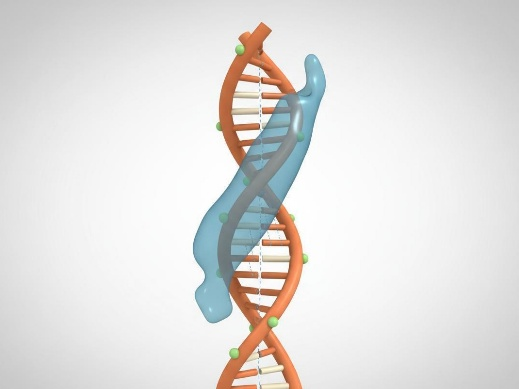
Key Features:
- Major/Minor Groove Recognition — Explicit scoring of base-specific hydrogen bonds and shape complementarity in the DNA major groove.
- Phosphate Backbone and Ion Handling — Electrostatic compensation via explicit Mg²⁺/Na⁺ placement around the negatively charged DNA backbone.
- Ideal For — Transcription factor-DNA complexes; CRISPR effector-target DNA; restriction enzyme specificity; Hit Identification for DNA-targeting therapeutics.
For biotechs developing CRISPR-Cas systems, our DNA docking protocol identifies guide-RNA binding sites and PAM-interaction geometries using AlphaFold Protein Structure Prediction-assisted protein models and canonical B-DNA templates. For pharma teams, transcription factor-DNA docking reveals allosteric pockets adjacent to the DNA interface for small-molecule intervention.
Protein-RNA Docking
RBP and Viral RNA Complex Modeling
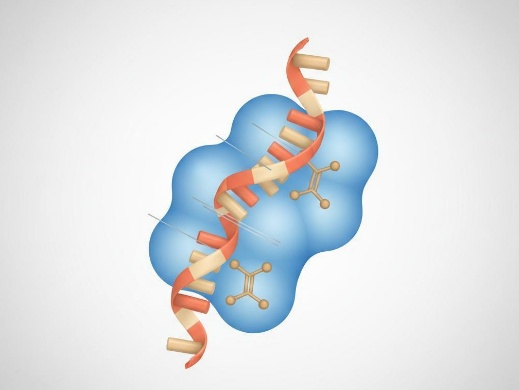
Key Features:
- Single-Stranded and Structured RNA — Docking to ssRNA, stem-loops, and pseudoknots with base-pairing constraints.
- Electrostatic and Stacking Terms — Explicit π-π stacking scoring for aromatic residues intercalating between RNA bases.
- Ideal For — RNA-binding protein targets; viral RNA-protein interactions; mRNA regulation; Lead Optimization for RNA-targeting programs.
RNA interfaces differ fundamentally from DNA. For biotechs targeting viral RNA-dependent RNA polymerases, our protocol captures induced-fit adaptations in RNA recognition motifs. When combined with ADMET Prediction & Modeling, RNA-binding scores correlate with measured affinity across congeneric series.
Flexible Refinement
Backbone and Base-Pair Adaptation
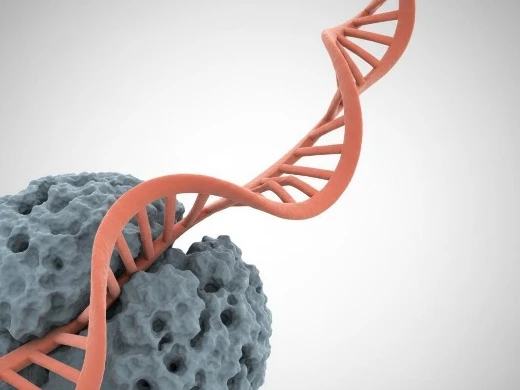
Key Features:
- Nucleic Acid Backbone Flexibility — Limited phosphate and sugar conformational sampling to capture DNA bending or RNA kinking.
- Induced Protein Adaptation — Side-chain and loop refinement at the protein interface.
- Ideal For — Bent DNA complexes; kinked RNA structures; allosteric protein-nucleic acid interactions.
For membrane-associated transcription factors or viral nucleoproteins, rigid-body docking against straight DNA or A-form RNA misses biologically relevant conformations. Our flexible refinement protocol starts with All-Atom Protein MD Simulation-derived ensemble clustering, then optimizes nucleic acid geometry around docked proteins.
Platform Instrumentation
| Software / System | Core Capability |
|---|---|
| HDOCK | Hybrid protein-DNA/RNA docking combining template-based modeling and ab initio free docking. |
| HADDOCK 2.4 | Information-driven flexible docking with nucleic acid topology, helical restraints, and explicit ion handling. |
| NPDock | Protein-nucleic acid docking with coarse-grained and all-atom refinement stages. |
| 3dRPC / RPDOCK | FFT-based protein-RNA docking with RNA-specific scoring functions and base-pairing constraints. |
| RosettaDock | High-resolution interface refinement with nucleic acid backbone and side-chain flexibility. |
| GROMACS 2023 + AMBER 22 | All-atom MD with OL15/OL21 nucleic acid force fields for post-docking stability validation. |
| NVIDIA A100 GPU Cluster | Parallelized ensemble docking and large-scale protein-nucleic acid screening. |
| PyMOL + ChimeraX | Nucleic acid visualization, base-pair analysis, and electrostatic surface mapping. |
Standardized Workflow
Project Workflow
A standardized, milestone-driven execution system. From target sequence to validated complex models—managed by a single computational project team, tracked in real time.


01 Target Review & Structure Preparation
- Target structure review: PDB, AlphaFold, or Homology Modeling & Threading assessment.
- Sequence analysis: binding motifs, PAM sites, or known recognition sequences.
- Protonation and ion placement at pH 7.4.
Deliverable: Prepared protein structure + quality assessment report.
02 Nucleic Acid Modeling & Interface Analysis
- DNA/RNA structure generation: B-DNA, A-RNA, or Ab Initio Modeling & Co-evolutionary Analysis for structured RNA.
- Major/minor groove mapping and phosphate backbone accessibility scoring.
- Helical restraint definition and base-pairing validation.
Deliverable: Nucleic acid model + interface analysis report.
03 Docking Execution & Scoring
- Rigid-body FFT search or flexible refinement execution.
- Sequence-specific scoring and ion compensation evaluation.
- AI-enhanced rescoring of top poses.
Deliverable: Ranked complex models with confidence scores.
04 Refinement & Validation
- Interface stability analysis via MD simulation (RMSD, RMSF).
- Binding Free Energy Calculation for top complexes.
- Nucleic acid conformational stability check.
Deliverable: Refined interface dataset with stability metrics.
05 Report & Handoff
- Comprehensive docking report with ranked complex list.
- Structural rationale: base-specific contacts, hydrogen bonds, ion bridges.
- Direct handoff to Hit Biophysical Characterization or Co-crystallization if contracted.
Deliverable: Final report + data package + transition plan to Hit to Lead or Lead Optimization.
Sample Requirements
| Requirement | Details |
|---|---|
| Protein structure | PDB ID, AlphaFold model, or Homology Modeling & Threading; specify DNA/RNA binding domain residues |
| Nucleic acid sequence | Target DNA or RNA sequence; specify single-stranded, double-stranded, or structured RNA |
| Known binding data | Motif sequences, EMSA data, or SELEX results for constraint design |
| Project scope | Transcription factor mapping, CRISPR guide validation, or RNA-binding inhibitor discovery |
| Prior biophysical data | Any SPR/BLI/ITC or ADMET flags to guide interface design |
Standard Deliverables
- Prepared protein and nucleic acid structures with ion placement and base-pairing documentation
- Ranked complex models (top 100–500) with 3D coordinates and base-specific contact maps
- Sequence-specific interface scoring and ion bridge analysis
- Complex stability validation via Molecular Dynamics (MD) Simulations with nucleic acid force fields (if contracted)
- Base-specific contact analysis and motif validation report
- Electronic data package formatted for Gene-to-Protein Production or Lead Optimization handoff
Frequently Asked Questions
Case Study
Case Study: RoseTTAFoldNA — Accurate Prediction of Protein-Nucleic Acid Complexes
Published Evidence:
Baek M, et al. Accurate prediction of protein–nucleic acid complexes using RoseTTAFoldNA. Nat Methods. 2024 Jan;21(1):117-121.
Key Findings:
- End-to-End Architecture: Extended the RoseTTAFold three-track network to predict nucleic acid and protein-nucleic acid complex structures in a single trained model.
- Accuracy: Average lDDT of 0.73 across all predictions; 0.84 for high-confidence models (plDDT > 0.9). 81% of high-confidence predictions correctly modeled the protein-nucleic acid interface.
- Generalization: Strong performance on complexes with no detectable sequence similarity to training structures (average lDDT = 0.68).
Industrial Translation:
For seed-stage biotechs, RoseTTAFoldNA delivers rapid protein-nucleic acid complex hypotheses without crystallography infrastructure. For pharma teams, the confidence estimates guide experimental prioritization—high-confidence models proceed directly to Molecular Dynamics (MD) Simulations validation, while low-confidence targets trigger Co-crystallization or cryo-EM campaigns. Our platform integrates RoseTTAFoldNA within an audit-ready workflow, pairing predicted complexes with nucleic acid-specific docking refinement and biophysical validation.
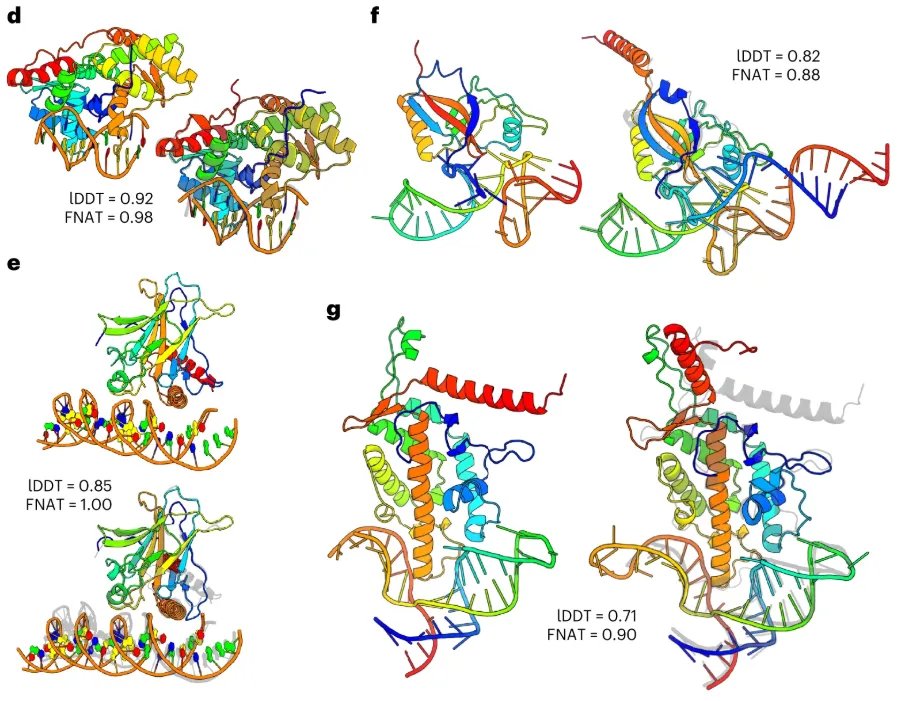
Figure 1. Four examples of protein–NA complexes without homologs in the training set: the BpuJ1 endonuclease bound to a modified cognate DNA. (Baek M, et al, 2024)
Reference
- Baek M, et al. Accurate prediction of protein–nucleic acid complexes using RoseTTAFoldNA. Nat Methods. 2024 Jan;21(1):117-121.
Need validated protein-nucleic acid interaction data to advance your transcription factor, CRISPR, or RNA-targeting pipeline? Our team can design a docking campaign tailored to your target, nucleic acid sequence, and regulatory milestones. Contact our scientific team today to start your project.