AI-Enhanced NMR Spectroscopy Services
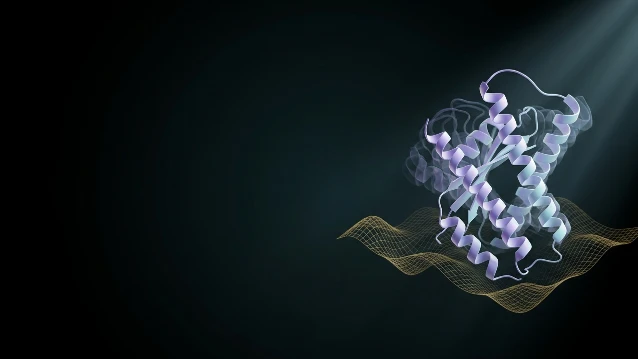
 ML-Assisted Assignment
 STD-NMR Fragment Screening
 Solution Structures & Dynamics
NMR captures conformational dynamics, binding epitopes, and weak fragment interactions in native solution — data that static methods miss. Our AI-driven platform compresses assignment and screening timelines from months to weeks, with direct handoff to Molecular Dynamics (MD) Simulations and Fragment-based Screening.
Creative Biostructure at a Glance
Over a decade of trusted expertise powering biotech, pharma, and research institutions worldwide to advance therapeutic innovation.






Why Partner With Us
Most NMR structural biology programs stall at the assignment stage. A single NOESY spectrum can harbor thousands of cross-peaks, and manual interpretation consumes months of spectroscopist time. Virtual biotechs cannot justify the $5M+ CapEx of an 800 MHz magnet, cryoprobe, and isotope-labeling infrastructure. Pharma teams often split protein production, isotope labeling, and data interpretation across vendors — losing the continuity required to link chemical shifts to binding mechanisms. We built this platform to eliminate that friction: one team where AI-driven assignment, automated structure calculation, and fragment screening share the same milestone clock.
Your CapEx is in compute and chemistry. Ours is in high-field magnets and isotope-labeling expertise.
| Stage | What We Deliver | What You Don't Need to Build |
|---|---|---|
| AI Expression Design | AlphaFold3-guided construct boundaries; isotope-labeling strategy (¹³C/¹⁵N, ²H, selective methyl) | Molecular biology team |
| Isotope-Labeled Production | E. coli or yeast expression in minimal media; Target Protein Production | Fermentation suite |
| AI-Accelerated Data Collection | Non-uniform sampling (NUS) with ML reconstruction; automated multidimensional experiments (HSQC, NOESY, TROSY) | NMR facility |
| ML-Guided Assignment & Structure | Deep learning peak picking; automated NOESY assignment; CYANA/CNS structure calculation | Bioinformatics team |
| Dynamic Handoff | Ensemble structures + relaxation data directly to MD or Hit Biophysical Characterization | — |
Production-Ready Deliverables: Every project ships with BMRB deposition-ready chemical shift lists, PDB-format structural ensembles, relaxation/dynamics reports, and direct handoff to Molecular Docking or Lead Optimization.
- ✓ Milestone-based pricing aligned with your fundraising cycles
- ✓ No vendor coordination overhead — isotope labeling, data collection, assignment, and structure under a single project manager
Intrinsically disordered proteins. Allosteric pockets. Weak fragment binders. "Undruggable" is our starting point.
Proven track record where others fail
IDPs, peptide hormones, nucleic acid-binding domains, and allosteric regulatory proteins — targets that evade crystallization due to flexibility or lack of diffracting crystals.
Multi-modal pivot capability
When NOESY data are sparse, we deploy AlphaFold-NMR conformer selection; when targets exceed 50 kDa, we switch to methyl-TROSY or segmental isotope labeling without restarting the project clock.
IP firewall & encrypted data infrastructure
Full audit trails, GLP-ready documentation, client retains 100% ownership of all spectral data, assignments, and structural ensembles.
Core Service Modules
Service Module At-a-Glance
| Service | Core Capability | Structural + Computational Integration | Typical Timeline |
|---|---|---|---|
| Fragment Screening by NMR (STD-NMR) | Weak-affinity fragment detection; hit validation; binding epitope mapping | ML-boosted SHARPER NMR for rapid K_D determination; chemical shift perturbation mapping; integration with FBDD | 1–2 weeks |
| Protein Structure Determination by NMR | Solution-state structures; conformational ensembles; μs–ms dynamics | AI-assisted resonance assignment (ARTINA); automated NOESY analysis; AlphaFold3-guided initial models; handoff to MD | 6–10 weeks |
Fragment Screening by NMR (STD-NMR)
Detecting Weak Binders That Other Miss
Key Features:
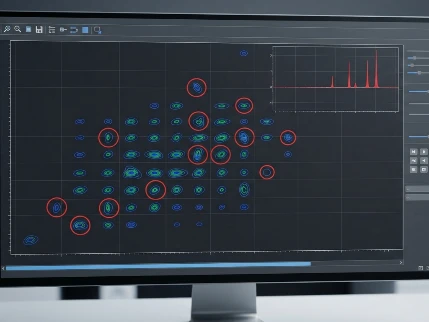
- Saturation Transfer Difference (STD) NMR — Detects fragment binding at millimolar affinities that evade SPR or ITC, with binding epitope information encoded in differential signal attenuation.
- ML-Boosted SHARPER NMR — Machine learning models rank fragment affinities from just two titration points, enabling 144 K_D determinations per day on a 600 MHz QCI cryoprobe — versus a handful by conventional titration methods.
- Chemical Shift Perturbation (CSP) Mapping — ¹H-¹⁵N HSQC titrations pinpoint ligand binding sites at residue-level resolution, guiding medicinal chemistry optimization.
- Orthogonal Validation — STD-NMR hits are cross-validated with DLS (aggregation control) and TSA (thermal stabilization) before progression to co-crystallization.
What We Offer: For Fragment-based Drug Discovery programs, STD-NMR provides the first experimental evidence of ligand-protein contact — critical for prioritizing hits before X-ray or Cryo-EM structure validation. For virtual biotechs, our 96-position SampleJet automation eliminates the need for on-site NMR operators.
Protein Structure Determination by NMR
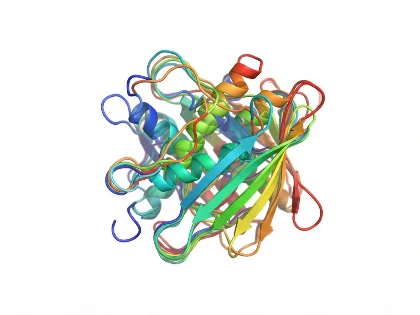
Solution-State Structures in Conformational Ensemble
Key Features:
- AI-Accelerated Resonance Assignment — ARTINA deep learning (ResNet peak picking + GNN chemical shift refinement) automates backbone and side-chain assignment, reducing the bottleneck from months to days.
- Automated NOESY Analysis — ML-guided cross-peak deconvolution and distance restraint generation feed directly into CYANA/CNS structure calculation.
- AlphaFold-NMR Conformer Selection — AlphaFold3 ensembles are scored against experimental chemical shifts and NOESY data, identifying hidden conformational states invisible to restraint-satisfaction protocols alone.
- Dynamics Characterization — R₁, R₂, heteronuclear NOE, and CPMG relaxation dispersion quantify μs–ms motions — data that static X-ray or Cryo-EM structures cannot capture.
What We Offer: For peptide therapeutics and intrinsically disordered proteins, NMR delivers the ensemble-averaged structures and dynamic landscapes required for rational drug design. For allosteric drug discovery, relaxation data reveal cryptic pocket opening events.
Technology Platform
Integrated NMR Infrastructure: AI Assignment + Isotope Labeling + Structure Calculation, Zero Handoffs
Traditional NMR splits isotope labeling, data collection, and interpretation across separate groups — losing critical chemical context at every transfer. Our platform unifies all stages under one project team, with AI predictions informing pulse sequence selection and experimental chemical shifts feeding back into model training.
Computational Platform — Dry Lab
| Capability | Details |
|---|---|
| AI Assignment Engine | ARTINA (ResNet peak picking + GNN shift refinement + GBT structure ranking); NMRNet SE(3) Transformer for ¹H/¹³C/¹⁵N chemical shift prediction |
| AlphaFold-NMR Integration | Conformer selection from AlphaFold3 ensembles against experimental shifts and NOESY data; multistate ensemble fitting |
| Automated Structure Calculation | CYANA/CNS with AI-generated distance and dihedral restraints; TALOS-N secondary structure prediction; MolProbity validation |
| Fragment Scoring ML | ML-boosted 1H LB SHARPER NMR for rapid affinity ranking from sparse titration data |
| Dynamics Analysis | Automated relaxation curve fitting (R₁, R₂, NOE); CPMG dispersion analysis for μs–ms kinetics |
Experimental NMR Platform — Wet Lab
| Capability | Details |
|---|---|
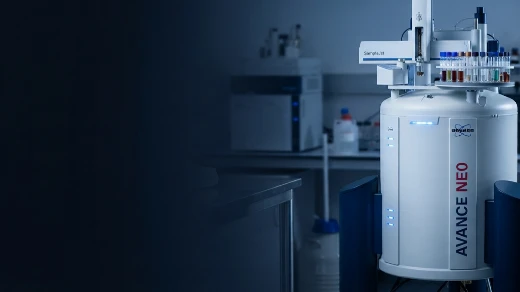
| High-Field NMR | Bruker Avance NEO 600 MHz and 800 MHz spectrometers; QCI cryoprobes (¹H/¹³C/¹⁵N/²H quadruple-resonance) |
| Automation | SampleJet 96-position automatic sample changer; IconNMR for unattended overnight multidimensional acquisition |
| Isotope Labeling | ¹³C/¹⁵N uniform labeling in minimal media; ²H back-exchange for proteins >30 kDa; selective ILV-methyl labeling |
| Advanced Experiments | TROSY for large complexes; BEST/CRINEPT for very large systems; ¹⁹F-NMR for ligand screening and dynamics |
| Micro-Scale Sensitivity | 1.7 mm microprobe and CryoProbe QCI (4K) delivering 4–5× sensitivity gain over room-temperature probes |
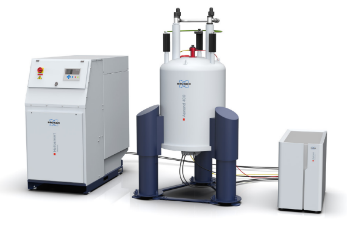
Bruker Avance NEO 800 MHz
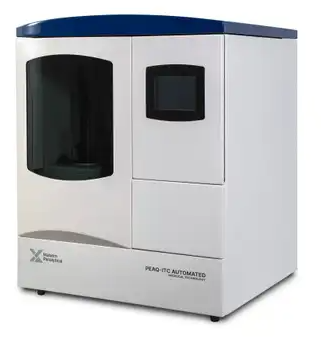
MicroCal PEAQ-ITC
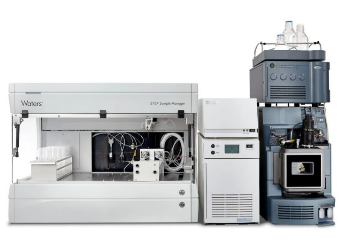
Waters AutoPurification System
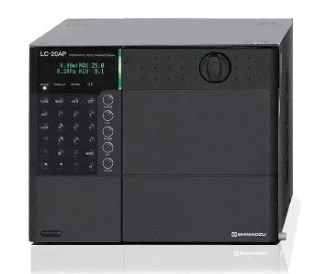
Shimadzu LC-20AP Prep-HPLC
Platform Edge: The ability to express a ¹³C/¹⁵N-labeled sample on Monday, collect HSQC and NOESY data overnight on Tuesday, and deliver AI-assisted assignments by Thursday — all under one project team — compresses traditional 4-month NMR structure determination into 6-week iterations.
Platform specifications are subject to continuous upgrade. Contact our team for instrument availability and project-specific capability assessment.
Closed-Loop Discovery Engine
When AI Prediction Meets Chemical Shift Truth
Static AI models predict single-state structures from sequence. Experimental NMR reveals the dynamic reality that models miss — conformational exchange, invisible states, and ligand-induced population shifts. Our platform feeds every spectral dataset back into the design cycle.
AI Chemical Shift Prediction
NMRNet predicts ¹H/¹³C/¹⁵N shifts from sequence; deviations flag dynamic regions and assignment priorities for experimental focus
→ Feeds into Assignment
ML-Accelerated Assignment
ARTINA automates peak picking and resonance assignment; NOESY cross-peaks assigned with AI confidence scores
→ Feeds into Structure
Ensemble Structure & Dynamics
NMR-derived restraints + AlphaFold3 models generate conformational ensembles; relaxation data refine binding site plasticity
→ Feeds into CADD
Structural Feedback
Experimental chemical shifts and NOESY patterns retrain target-specific shift predictors, improving next-campaign accuracy
→ Feeds back into AI
Industrial Value:
For Biotechs
Your first NMR assignment trains the AI models for your second target. Chemical shift and dynamics data from Phase 0 become training data for Phase 1 — a compounding learning partnership.
For Pharma
Every computational prediction is linked to an experimental outcome with project ID, timestamp, and model version — fully audit-ready for regulatory submissions and internal portfolio reviews.
Project Management & Execution
Project Workflow
A standardized, milestone-driven execution system. From sequence intake to deposition-ready coordinates.


01 Expression & Labeling
- AlphaFold3-guided construct design; isotope-labeling strategy; E. coli/yeast expression in minimal media
Deliverable: Expression strategy + labeling report
02 Purification & QC
Deliverable: Purified labeled protein with yield documentation
03 Data Collection
- NUS-accelerated HSQC, NOESY, TROSY; automated acquisition via SampleJet; real-time spectral quality monitoring
Deliverable: Raw spectral dataset (TopSpin format)
04 AI Assignment
- ARTINA deep learning peak picking; GNN chemical shift refinement; automated NOESY assignment
Deliverable: Chemical shift assignment table (BMRB-ready)
05 Structure/Dynamics
- CYANA/CNS structure calculation; AlphaFold3 ensemble refinement; relaxation/dynamics analysis
Deliverable: Structural ensemble + dynamics report
Sample Requirements
| Sample Type | Specification |
|---|---|
| Protein/Peptide | >95% purity; >0.3 mM in 50 µL (1.7 mm tube) or 300 µL (5 mm tube); NanoDSF Tm >35°C; DLS PDI <1.2 |
| Isotope Labeling | ¹³C/¹⁵N required for structure determination; ²H-labeling for proteins >30 kDa; selective methyl labeling (ILV) for very large complexes |
| Fragment Library | 10 mM DMSO stock; aqueous solubility >50 µM; purity >95% |
| Prior Data | Any known chemical shifts (BMRB format); previous homology models; expected binding site information |
Standard Deliverables
Upon project completion, clients receive comprehensive experimental reports including:
- Chemical shift assignments (BMRB format) with AI confidence scores
- 3D structural ensemble (PDB format) with distance and dihedral restraint lists
- Relaxation and dynamics reports (R₁, R₂, heteronuclear NOE, CPMG dispersion)
- Fragment binding epitope maps and K_D values (STD-NMR/SHARPER)
- Molecular Docking-ready ensemble coordinates
- Direct handoff to Molecular Docking, MD Simulation, or Lead Optimization
Our technical team responds within 24 hours. All inquiries protected under NDA.
Frequently Asked Questions
Case Study
Case: Structural Characterization of Target Peptide by NMR
Goal: Determine the three-dimensional solution structure of a customer-provided target peptide through isotope-labeled recombinant expression and multidimensional NMR spectroscopy, delivering an atomic-resolution conformational model to support peptide-based drug design.
Key Data:
- NMR Data Collection: 3.3 mM peptide in THF-d₂/H₂O with DSS internal standard; ¹H-¹⁵N HSQC, ¹H-¹³C HSQC, TOCSY (80 ms), NOESY (200 ms) acquired at 25°C
- Resonance Assignment: Sequential connectivity established via HN-Hα fingerprint and HN-HN NOE analysis; overall assignment rate >90%; C-terminal proline identified in two conformations (cis/trans), with cis conformation selected for structure calculation
- Structure Calculation: 200 structures generated via CNS/Aria with NOE-derived distance restraints; 20 lowest-energy structures selected; no distance violations >0.5 Å or dihedral violations >5°
- Structural Features: Residues 3–29 adopt a long α-helix; structure validated by Protein Structure Validation Suite (PSVS)
Why it matters: For peptide therapeutics and biologics programs, the solution-state conformation dictates receptor binding affinity and proteolytic stability. This case demonstrates our end-to-end capability — from gene synthesis and isotope labeling to multidimensional NMR and 3D structure calculation — delivering a validated structural ensemble without crystallization. For virtual biotechs, this eliminates the need to coordinate molecular biology, isotope fermentation, and spectroscopy vendors. For pharma, the >98% purity and complete assignment documentation support IND-enabling CMC packages.
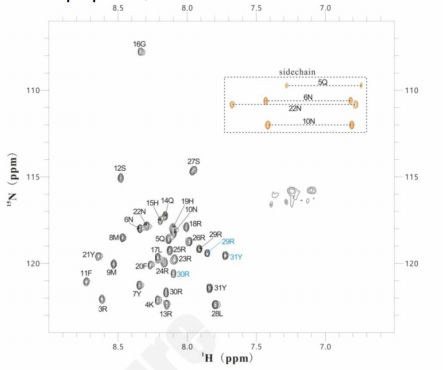
Figure 1. 1H-15N HSQC spectrum with sequential resonance assignments. C-terminal proline cis/trans conformations labeled in blue.
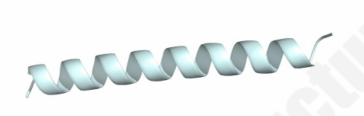
Figure 2. 3D structural ensemble of the target peptide. Residues 3–29 form a long α-helix.
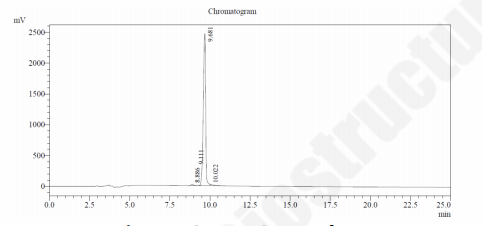
Figure 3. Analytical HPLC confirming peptide purity of 98.03%.
Need AI-enhanced NMR spectroscopy to accelerate your fragment-based or structural biology program? Our team can design a customized NMR pipeline tailored to your target class, labeling constraints, and regulatory milestones. Contact our scientific team today.