Protein-Protein/Peptide Docking (Rigid Body / Flexible Docking)
 AI-Trained Interface Scoring
  Rigid-Body → Flexible Hierarchy
  Wet-Lab Validation via SPR & Co-Crystallization
 PPI targets account for 80% of the human interactome yet remain largely undruggable by small molecules. The Molecular Docking Services platform deploys rigid-body docking for initial interface mapping and flexible docking for conformational adaptation, validated through biophysical and structural biology pipelines.
Why Protein-Protein/Peptide Docking Is the Critical Bridge Between Structure and Biologics?
Cell-based assays miss PPI interface dynamics. Crystallography captures snapshots but not binding pathways. For biotechs targeting transcription factors or scaffold proteins, rigid-body docking narrows the chemical space before synthesis. For pharma teams, flexible docking captures induced conformational changes that rigid approximations miss—delivering structurally rationalized hit lists for PPI modulators and peptide therapeutics.
What Sets the Platform Apart
AI-Trained Interface Scoring
ML models trained on ITC and BLI data. R² > 0.75. ADMET Prediction & Modeling flags liabilities pre-docking.
Rigid-to-Flexible Hierarchy
Interface flexibility pre-scored via Binding Pocket & Druggability Analysis. Optimal mode assigned. Benchmarked against PDB.
Structural Validation Loop
SPR, Co-crystallization and Soaking, and Molecular Dynamics (MD) Simulations confirm stability. Feedback to peptide engineering closes loop.
The Protein-Protein/Peptide Docking Suite
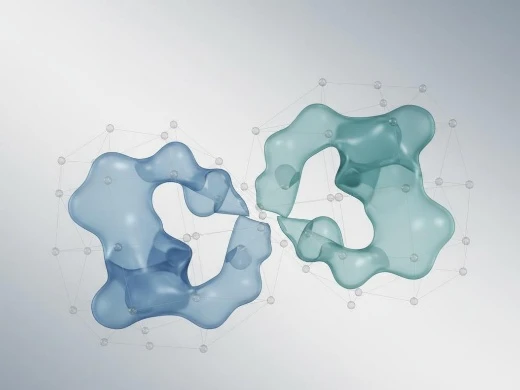
Rigid-Body Docking
FFT-Based Interface Screening for Large Complexes
Key Features:
- Geometric Complementarity Search — Exhaustive 6D rigid-body search for optimal protein-protein interface shape matching.
- Statistical Potential Scoring — Pairwise residue-residue potentials trained on native PDB complexes.
- Ideal For — Antibody-antigen docking, symmetric multimers, initial PPI interface mapping.
For virtual biotechs without structural biology infrastructure, rigid-body docking delivers antibody-antigen orientation hypotheses in 24–48 hours using AlphaFold Protein Structure Prediction-derived monomers. For pharma teams, rigid-body output integrates with Pharmacophore Modeling & Screening constraints for hotspot-focused library design.
Flexible Docking
Interface Refinement for Induced-Fit PPIs
Key Features:
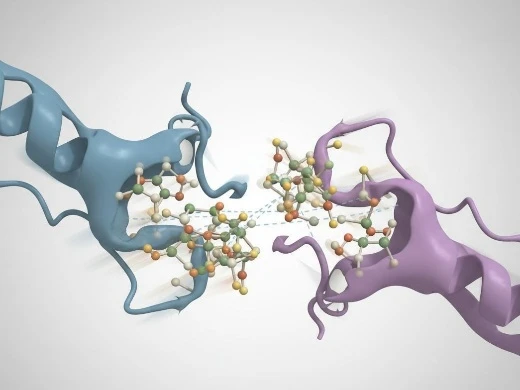
- Side-Chain & Backbone Relaxation — Limited interface adaptation capturing conformational selection and induced fit.
- Hotspot-Driven Sampling — Focused refinement around conserved anchor residues.
- Ideal For — Induced-fit PPIs, conformational selection targets, allosteric modulation.
Most PPI interfaces are not rigid. Flexible docking captures loop movements and side-chain rotations that rigid-body protocols miss. When combined with Complex Structure Prediction, flexible docking generates biologically relevant complex models for downstream Lead Optimization.
Peptide Docking
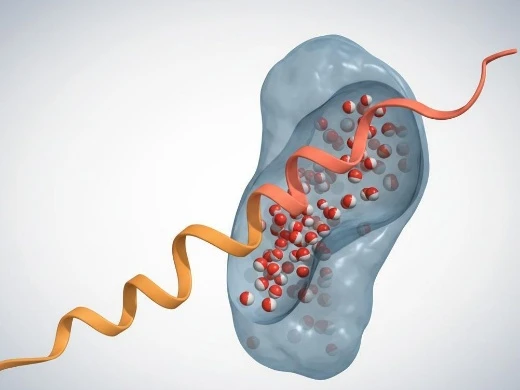
Backbone-Flexible Peptide-Protein Interaction Modeling
Key Features:
- Internal Degrees of Freedom Sampling — Peptide backbone phi/psi exploration with receptor interface adaptation.
- Macrocycle Support — Stapled and cyclic peptide ring-closure constraints.
- Ideal For — Peptide therapeutics, PPI hotspot inhibitors, epitope mimics.
For biotechs developing peptide drugs, our protocol samples peptide conformations inaccessible to small-molecule docking while maintaining pharmacophore alignment. For pharma teams, peptide docking outputs feed directly into AI for Antibody & Biologics workflows for epitope-to-paratope translation.
Platform Instrumentation
| Software / System | Core Capability |
|---|---|
| HADDOCK 2.4 | Integrative docking with NMR/Cryo-EM restraints; flexible interface refinement and coarse-grained sampling. |
| ClusPro | Fast rigid-body docking with cluster-based ranking; benchmarked on CAPRI targets. |
| RosettaDock | High-resolution interface refinement with side-chain and backbone flexibility; ΔΔG prediction. |
| ZDOCK + M-ZDOCK | FFT rigid-body docking and symmetric multimer prediction; billion-configuration sampling. |
| HPEPDOCK | Peptide-protein docking with backbone flexibility; supports linear and cyclic peptides. |
| GROMACS 2023 + AMBER 22 | Post-docking interface stability validation and Binding Free Energy Calculation (FEP/TI, MM/PBSA). |
| Schrödinger BioLuminate | Protein-protein interface analysis and hotspot mapping; molecular interaction fingerprinting. |
Standardized Workflow
Project Workflow
A standardized, milestone-driven execution system. From target structure to validated complex models—managed by a single computational project team, tracked in real time.


01 Target Review & Structure Preparation
- Target structure review: PDB, AlphaFold, or Homology Modeling & Threading assessment.
- Interface definition: chain IDs, residue ranges, known hotspot data.
- Structure quality check: missing loops, interface B-factors.
Deliverable: Prepared structure + interface map.
02 Interface Analysis & Mode Selection
- Interface druggability analysis: hotspot scoring, pocket depth, hydrophobicity.
- Mode selection: rigid-body or flexible based on interface dynamics.
- Pharmacophore constraint design from known interactions.
Deliverable: Interface analysis report + recommended mode.
03 Docking Execution & Scoring
- Rigid-body FFT search or flexible refinement execution.
- Clustering and ranking by interface score and shape complementarity.
- AI-enhanced rescoring of top poses.
Deliverable: Ranked complex models with confidence scores.
04 Interface Refinement & Validation
- Interface stability analysis via MD simulation (RMSD, RMSF).
- Binding Free Energy Calculation for top complexes.
- Hotspot residue validation.
Deliverable: Refined interface dataset with stability metrics.
05 Report & Handoff
- Comprehensive docking report with ranked complex list.
- Structural rationale: hotspot map, interface area, hydrogen bonds.
- Direct handoff to Hit Biophysical Characterization or Co-crystallization.
Deliverable: Final report + data package + transition plan to Hit to Lead or Lead Optimization.
Sample Requirements
| Requirement | Details |
|---|---|
| Target structures | PDB IDs or AlphaFold models for both partners; specify chain IDs and interface residues |
| Prior complex data | Known hotspot residues, mutagenesis data, or SAXS envelopes for integrative docking |
| Peptide sequences | Linear, cyclic, or stapled peptide sequences with desired conformational constraints |
| Project scope | PPI inhibitor discovery, antibody-antigen modeling, or peptide therapeutic design |
| Prior biophysical data | Any SPR/BLI/ITC or ADMET flags to guide interface constraint design |
Standard Deliverables
- Prepared receptor structure with protonation and water network documentation
- Ranked docking poses (top 100–500) with 3D coordinates and interaction fingerprints
- AI-enhanced scoring table with confidence intervals
- Pose stability validation via Molecular Dynamics (MD) Simulations (if contracted)
- Ligand efficiency and synthetic accessibility assessment for prioritized hits
- Electronic data package formatted for Structure-Based Virtual Screening or Hit to Lead handoff
Frequently Asked Questions
Case Study
Case Study: HADDOCK3 — A Modular Platform for Integrative Protein-Protein Docking
Published Evidence:
Giulini M, Reys V, Teixeira JMC, et al. HADDOCK3: A Modular and Versatile Platform for Integrative Modeling of Biomolecular Complexes. J Chem Inf Model. 2025;65(13):7315-7324.
Key Findings:
- Modular Architecture: HADDOCK3 restructures the platform into independent modules, enabling flexible integration of NMR, SAXS, and Cryo-EM restraints into the docking workflow.
- Integrative Modeling: Enhanced support for distance restraints, interface mapping, and ambiguous interaction data improves accuracy for challenging PPI targets.
- Versatility: Expanded capabilities for protein-peptide, protein-DNA, and multimeric complex modeling beyond binary protein-protein docking.
Industrial Translation:
For seed-stage biotechs, HADDOCK3's modular design enables rapid PPI hypothesis generation without proprietary license overhead. For pharma teams, the integrative modeling framework leverages existing experimental data to constrain docking searches, reducing false-positive rates and accelerating antibody-antigen complex characterization. Our platform operationalizes HADDOCK3 within an audit-ready workflow, pairing rigid-body FFT search with flexible interface refinement and Molecular Dynamics (MD) Simulations validation.
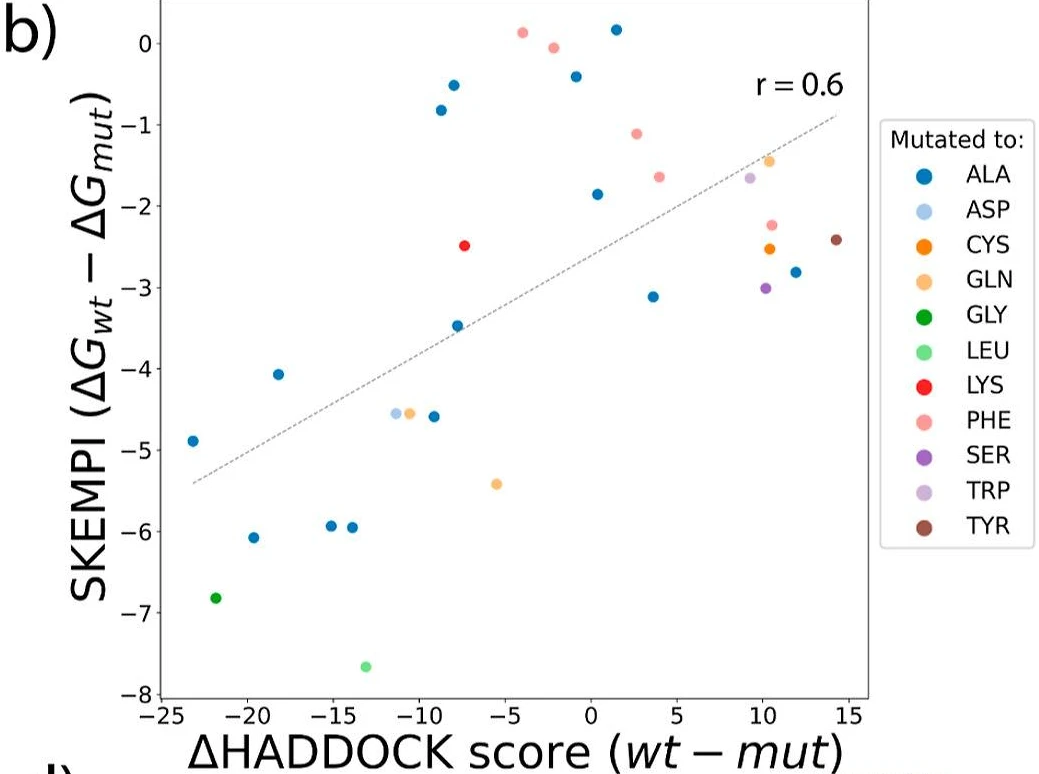
Figure 1. Pearson correlation (r = 0.6) of HADDOCK alascan score differences versus SKEMPI ΔΔG values for single-point mutations in the barnase–barstar complex. (Giulini M.; et al, 2025)
Reference
- Giulini M, Reys V, Teixeira JMC, et al. HADDOCK3: A Modular and Versatile Platform for Integrative Modeling of Biomolecular Complexes. J Chem Inf Model. 2025;65(13):7315-7324.
Need validated protein-protein docking data to advance your PPI or biologics pipeline? Our team can design a docking campaign tailored to your target pair, interface biology, and therapeutic modality. Contact our scientific team today to start your project.