Antibody Aggregation & Solubility Prediction
 Aggregation Prediction
  Solubility Modeling
  Formulation Guidance
 AI models trained on clinical-stage antibody datasets predict aggregation, solubility, and viscosity risks before you enter CMC, cutting late-stage formulation failures.
Why Antibody Aggregation & Solubility Prediction Is the Critical Foundation
Antibody programs fail CMC when candidates aggregate at therapeutic concentrations or clog delivery devices. Seed-stage biotechs lack the analytical bandwidth to screen every variant for colloidal stability. Pharma teams need early warning systems that flag formulation liabilities before IND-enabling studies. We deliver AI-predicted aggregation risk, biophysical validation, and formulation guidance — ensuring your lead survives high-concentration development.
What Sets the Platform Apart
Clinical-Trained AI
Models trained on 500+ clinical-stage antibodies correlate sequence features with real-world aggregation and immunogenicity outcomes.
High-Concentration Focus
Predictions validated at 50–150 mg/mL therapeutic concentrations, not just dilute analytical conditions.
Formulation Integration
AI recommendations for buffer, pH, and excipient selection feed directly into CMC stability protocols.
Technology Suite
AI-Based Aggregation Prediction
Sequence-Based Risk Scoring, Structure-Aware Hotspot Detection, and Self-Association Prediction

Key Features:
- Sequence-Based Risk Scoring — CamSol, SAP, and proprietary ML models predict aggregation-prone regions from primary sequence and predicted structure.
- Structure-Aware Hotspot Detection — IgFold models identify surface-exposed hydrophobic patches and charge asymmetry that drive colloidal instability.
- Self-Association Prediction — Machine learning classifiers trained on SEC-MALS and DLS data predict reversible self-association and phase separation.
Ideal For: Early-stage triage of hybridoma panels; humanized or matured candidates entering CMC; bispecific formats with inherent aggregation risk.
What We Offer:
A per-variant aggregation risk score with structural rationale and recommended mutations. Seed-stage biotechs receive a ranked developability report before committing to gene-to-protein production. Pharma teams get batch-level risk stratification for lead selection.
Solubility & Viscosity Modeling
Molecular Dynamics Solubility, Colloidal Interaction Mapping, and AI Formulation Optimization

Key Features:
- Molecular Dynamics Solubility — All-atom MD calculates protein-solvent interaction energies and preferential hydration to predict solubility limits.
- Colloidal Interaction Mapping — DLVO and patchy particle models predict concentration-dependent viscosity and opalescence from sequence charge and hydrophobicity distributions.
- AI Formulation Optimization — Neural network models recommend buffer pH, ionic strength, and excipient combinations to maximize solubility and minimize viscosity.
Ideal For: High-concentration subcutaneous formulations; IV formulations requiring rapid infusion; lyophilized products needing reconstitution stability.
What We Offer:
A formulation guidance report with predicted solubility curves, viscosity profiles, and excipient recommendations. For CMC teams, we deliver buffer screening protocols that reduce analytical development time by 50%.
Developability Scoring & Formulation Guidance
Integrated Developability Index, Forced Degradation Prediction, and Stability Protocol Design

Key Features:
- Integrated Developability Index — Composite score combining aggregation, solubility, viscosity, immunogenicity, and manufacturability metrics for holistic candidate ranking.
- Forced Degradation Prediction — AI models predict thermal, oxidative, and photolytic degradation pathways based on sequence and formulation context.
- Stability Protocol Design — Accelerated stability study designs with statistically powered time points and analytical methods for ICH guideline alignment.
Ideal For: IND-enabling programs requiring comprehensive CMC packages; biosimilar development with strict stability matching; combination products with device compatibility requirements.
What We Offer:
A developability dossier with risk scores, mitigation strategies, and stability protocols. For regulatory submissions, we provide justification for formulation and container closure selections.
Platform Instrumentation
Core Instruments
| Instrument | Capability |
|---|---|
| NVIDIA DGX H100 | AI aggregation and solubility model inference at scale |
| Malvern MicroCal PEAQ-DSC | Differential scanning calorimetry for thermal stability and unfolding thermodynamics |
| Wyatt DynaPro NanoStar | DLS for aggregation kinetics and colloidal stability screening |
| Shimadzu Nexera XS | UHPLC for purity, charge variant, and size exclusion analysis |
| Applied Photophysics Chirascan | Circular dichroism for secondary structure and conformational stability |
| Tecan Infinite M Plex | Multimode plate reading for high-throughput solubility and thermal shift assays |
| Sartorius CellCelector | Automated single-cell cloning for stable CHO line development |
| Olympus IXplore Spin | Live-cell imaging for intracellular aggregation and stress response |
| Thermo Scientific Forma 3111 | CO2 incubator for controlled temperature and humidity stress studies |
Standardized Workflow
Project Workflow
A milestone-driven execution system from sequence to formulation-ready data.


01 Target Review
- Antibody sequence and format assessment- Target concentration and route of administration
Deliverable: Developability assessment plan
02 AI Prediction
- Aggregation risk scoring and hotspot mapping
- Solubility and viscosity prediction
- Deliverable: AI risk report + mutation recommendations
03 Biophysical Validation
04 Formulation Design
- Buffer and excipient recommendation
- Formulation pH and ionic strength optimization
- Deliverable: Formulation guidance report
Sample Requirements
- Antibody VH/VL or full IgG sequences
- Desired formulation concentration and route (SC, IV, IM)
- Known stability issues (if any)
- Target product profile and CMC timeline
Standard Deliverables
Frequently Asked Questions
Case Study
Case Study: PLM-Driven Developability Triage for Aggregation Risk Screening
Goal:
Benchmark a sequence-only, AI-assisted pipeline that uses antibody-specific protein language models (PLMs) to encode VH/VL pairs and cluster clinically developable antibodies, implicitly flagging aggregation-prone outliers before experimental screening.
Key Data:
- PLM-encoded clinical clustering: AntiBERTy embeddings of 144 clinical-stage and 10,000 library antibodies were projected via kernel PCA (γ = 500). Clinical mAbs clustered tightly at the origin, while repertoire antibodies dispersed radially; approved mAbs showed a significantly tighter distribution than discontinued candidates, indicating superior biophysical uniformity.
- Supervised triage of approved vs. discontinued: A LinearSVC classifier on AntiBERTy encodings (k = 2,500 features) achieved MCC = 0.80 ± 0.08 (sensitivity 0.86; specificity 0.93). The model identified VH Framework 3—not CDR-H3—as the highest-information region for clinical success, linking framework-level stability to developability.
Why it matters:
This independent study demonstrates that PLMs implicitly learn developability-relevant signatures—including aggregation propensity and solubility—from raw sequence data. By triaging libraries against clinical-grade embedding clusters, the pipeline offers a scalable, compute-light strategy to de-risk antibodies early, directly supporting our AI-driven Aggregation & Solubility Prediction capabilities.
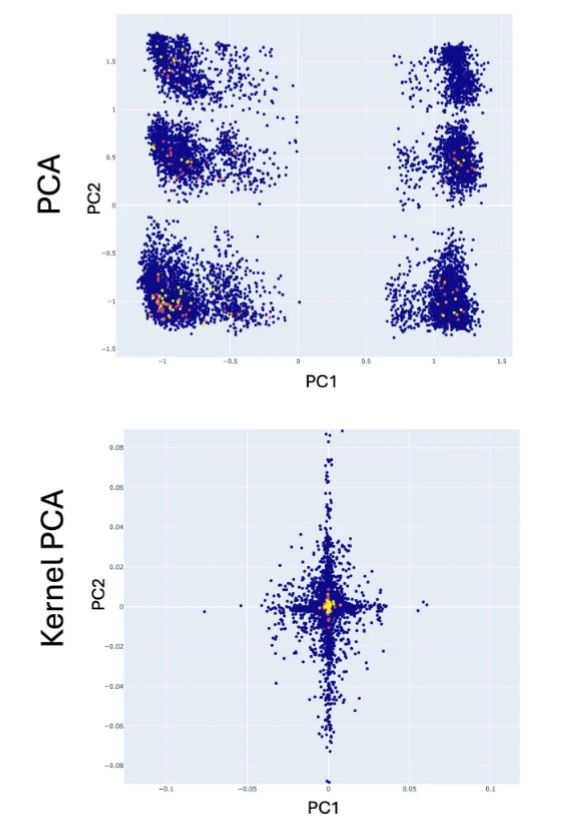
Figure 1. Kernel PCA projection of AntiBERTy-encoded antibody sequences reveals clinical-stage mAbs (yellow) tightly clustered at the origin while library antibodies (blue) disperse radially, demonstrating PLM-based segregation of developable candidates. (Sweet-Jones J.; et al. 2025)
Reference
Sweet-Jones J, Martin ACR. An antibody developability triaging pipeline exploiting protein language models. MAbs. 2025 Dec;17(1):2472009.
Our technical team responds within 24 hours. All inquiries protected under NDA.