Structural Data Processing Services
 X-ray Data Processing
  Cryo-EM Reconstruction
  Model Building & Refinement
 Raw data contains signal, but extracting a reliable model requires expert phasing. We process your data through AI-assisted pipelines, delivering validated coordinates for SBDD and regulatory submission.
Why Structural Data Processing Is the Critical Bridge
Collecting data is not solving structure. Seed-stage biotechs watch precious beamtime or microscope sessions sit idle because no one on the team can process the output. Pharma teams have terabytes of Cryo-EM movies or diffraction images that never become coordinates because the processing queue is months long. Our platform closes this gap by transforming raw experimental data into validated structural models through specialized phasing, image processing, and reconstruction pipelines — without you building a computational crystallography or Cryo-EM team.
What Sets the Platform Apart
Raw-to-Model Pipeline
We start from your raw diffraction images or movie stacks, not from a downloaded PDB file. Every step from data reduction to final model is traceable and reproducible.
AI-Assisted Processing
Machine learning classifiers accelerate particle picking, 2D classification, and density modification, reducing processing time by 30–50% while preserving accuracy.
Regulatory-Grade Output
Deliverables include full data processing statistics, validation reports, and formatted structure factors or EM maps — ready for PDB/EMDB deposition and IND documentation.
Technology Suite
X-ray Crystallography Data Analysis
Diffraction Data Processing to Atomic Model
Key Features:
- Data reduction and scaling with XDS/DIALS; space group determination and twinning analysis.
- Experimental phasing (MAD/SAD) and molecular replacement with Phaser; density modification and automated model building with Phenix/ARP/wARP.
- Ligand and water validation; TLS and anisotropic refinement; final geometry validation for PDB deposition.
Ideal For: Datasets from in-house or synchrotron sources; co-crystal soaking campaigns; fragment screening hit validation.
What We Offer:
You send us raw diffraction images. We return a refined model with electron density maps, complete statistics, and a processing report. For hit-to-lead teams, this means turning screening crystals into binding mode hypotheses within days.
Cryo-EM / ET Data Analysis
Image Processing, Reconstruction & Model Building
Key Features:
- Motion correction (MotionCor2), CTF estimation (Gctf/CTFFIND4), and particle picking (crYOLO/Topaz) for single-particle analysis.
- 2D/3D classification and refinement in cryoSPARC/RELION; local and non-uniform refinement for resolution extension.
- Map-to-model building with Namdinator/Coot; B-factor sharpening and half-map FSC validation for EMDB deposition.
Ideal For: Large complexes; membrane proteins; conformationally heterogeneous samples; tomography datasets.
What We Offer:
We process your movie stacks through classification and reconstruction to produce a sharpened map and fitted model. For gene-to-structure programs, this is how you validate your protein production pipeline with atomic-resolution evidence.
Platform Instrumentation
Core Instruments & Software
| Instrument / Software | Capability |
|---|---|
| NVIDIA DGX A100 | Real-time cryoSPARC/RELION 3D reconstruction and classification |
| NVIDIA RTX A6000 Cluster | Particle picking, motion correction, and map sharpening |
| Phenix Suite | X-ray phasing, density modification, and crystallographic refinement |
| Coot / Namdinator | Map-to-model building and MD flexible fitting |
| cryoSPARC / RELION | Single-particle analysis and non-uniform refinement |
| Bruker AVANCE NEO 600 MHz | NMR validation for cross-method confirmation |
Standardized Workflow
Project Workflow
A milestone-driven execution system from raw data to validated model.


01 Data Ingestion
- Data quality assessment and format conversion
- Experimental parameter review (wavelength, detector, temperature)
- Deliverable: Data inventory + quality summary
02 Processing
- Data reduction / motion correction and CTF estimation
- Phasing or particle picking and 2D classification
- Deliverable: Intermediate maps or class averages
03 Reconstruction
- Density modification / 3D classification and refinement
- Resolution estimation and map sharpening
- Deliverable: Sharpened map + FSC curves
04 Model Building
- Automated model building and manual fitting
- Map-to-model validation and geometry optimization
- Deliverable: Initial model + fit statistics
05 Validation
- Final refinement and validation (MolProbity / EMRinger)
- PDB/EMDB deposition preparation
- Deliverable: Final model + deposition-ready files + technical report
Sample Requirements
- Raw Data: Diffraction images (CBF/SMV/H5) or Cryo-EM movies (MRC/TIFF/LZW)
- Experimental Metadata: Data collection parameters, sample conditions, and prior processing attempts
- Prior Phasing Info: Heavy atom derivatives, anomalous scatterers, or known homologous models (if applicable)
- Project Background: Target class, intended use (docking, publication, regulatory), and resolution expectations
Standard Deliverables
- Processed and scaled structure factors (MTZ) or sharpened EM map (MRC)
- Refined structural model with full geometry validation (PDB)
- Data processing statistics (completeness, R-merge, CC1/2, or FSC curves)
- Electron density or EM map figures for publication
- PDB/EMDB deposition-ready files and validation reports
- Final technical report with processing parameters and SBDD recommendations
- Electronic data package (raw processing logs, intermediate maps, analysis scripts)
Frequently Asked Questions
Case Study
Case Study: CryoDRGN-AI: Neural Ab Initio Reconstruction of Challenging Cryo-EM and Cryo-ET Datasets
Goal:
Resolve structural heterogeneity from cryo-EM and cryo-ET data without prior pose estimation or initial models.
Key Data:
- Hybrid pose estimation: Hierarchical search + SGD achieves 20× speedup with accuracy matching cryoSPARC.
- Ab initio heterogeneity: Resolves continuous conformational landscapes of spliceosome, ribosome, and SARS-CoV-2 spike without starting models.
- Junk robustness: Reconstructs DSL1/SNARE complex from majority-outlier datasets, recovering motions missed by standard workflows.
- New state discovery: Identifies a previously undescribed "supercomplex" state of human erythrocyte ankyrin-1 containing six distinct membrane proteins.
- Cryo-ET capability: Single-shot ab initio subtomogram averaging of M. pneumoniae 70S ribosome resolves three elongation cycle states in situ.
Why it matters:
For drug developers relying on cryo-EM data, this study establishes that AI-driven ab initio reconstruction eliminates manual filtering bottlenecks. By recovering full heterogeneity in a single run — including from junk-heavy or in situ datasets — cryoDRGN-AI compresses processing timelines from weeks to days while revealing biologically critical states that traditional pipelines discard.
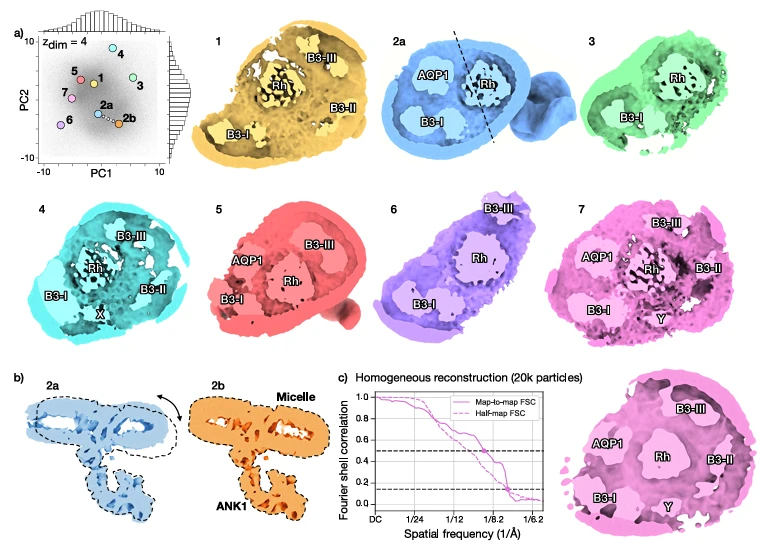
Figure 1. CryoDRGN-AI ab initio reconstruction of the human erythrocyte ankyrin-1 complex and identification of a new "supercomplex" state. (Levy A.; et al. 2025)
Reference
Levy A, et al. CryoDRGN-AI: Neural ab initio reconstruction of challenging cryo-EM and cryo-ET datasets. bioRxiv [Preprint]. 2025 Apr 28:2024.05.30.596729.
Our technical team responds within 24 hours. All inquiries protected under NDA.