AI-Based Toxicity Prediction (hERG, Ames, Carcinogenicity)
AI models trained on regulatory databases predict hERG blockade, Ames positivity, and carcinogenic signals before you commit to costly synthesis and safety studies.
Why AI-Based Toxicity Prediction Is the Critical Foundation
Late-stage toxicity attrition destroys program timelines and budgets. Seed-stage biotechs cannot afford hERG counter-screens for every analog; pharma teams need early genotoxicity flags to guide medicinal chemistry away from problematic scaffolds. We deliver AI-predicted cardiac, mutagenic, and carcinogenic risk scores — integrated with QSAR and microsomal stability data to prioritize safe leads before in vitro ADMET spend.
What Sets the Platform Apart
Multi-Endpoint AI
Single platform predicts hERG IC50, Ames mutagenicity, and carcinogenicity class simultaneously, eliminating siloed vendor contracts.
Regulatory-Trained Models
Models trained on FDA-approved drugs, withdrawn compounds, and ICH M7 guidance datasets ensure predictions align with regulatory expectations.
Structure-Alert Integration
Real-time structural alert flagging (Michael acceptors, aromatic nitro groups, anilines) triggers automatic medicinal chemistry redesign suggestions.
Technology Suite
hERG Toxicity Prediction
IC50 Regression Models and Channel State Modeling for Cardiac Safety
Key Features:
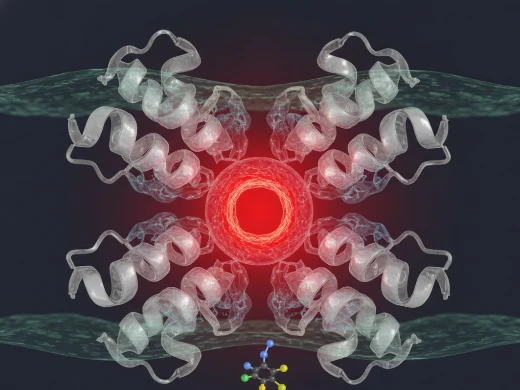
- IC50 Regression Models — Graph neural networks and ensemble ML predict hERG pIC50 within 0.5 log units, trained on 15,000+ patch-clamp measurements.
- Channel State Modeling — Structure-based docking into open and closed hERG states identifies high-risk binding poses beyond 2D QSAR.
- Therapeutic Index Calculation — Integration of predicted hERG IC50 with target potency to estimate cardiac safety margins.
- Analog Rescue Design — AI suggests polarity-enhancing or steric-bulking substitutions that reduce hERG binding while preserving target affinity.
Ideal For: CNS and oncology programs where hERG liability is common; lead optimization campaigns requiring real-time toxicity feedback; virtual screening triage of large libraries.
What We Offer:
A ranked hERG risk report with predicted IC50, binding pose visualization, and rescue mutation suggestions. Seed-stage biotechs avoid expensive patch-clamp outsourcing for obvious liabilities. Pharma teams integrate hERG scores into MPO dashboards.
Compound Toxicity Prediction (Mutagenicity, Carcinogenicity)
Ames Mutagenicity Classifiers and Carcinogenicity Bioassay Models

Key Features:
- Ames Mutagenicity Classifiers — BERT-based models and expert rule engines (Derek Nexus, Sarah) predict bacterial reverse mutation outcomes with >85% accuracy.
- Chromosomal Aberration Prediction — ML models trained on in vitro micronucleus and chromosome aberration data flag clastogenic potential.
- Carcinogenicity Bioassay Models — Predictors trained on 2-year rodent bioassay outcomes and human epidemiological data estimate TD50 and human relevance.
- Expert Rule Integration — ICH M7 structural alerts (alkyl halides, epoxides, N-nitrosamines) combined with AI predictions for hybrid risk scoring.
Ideal For: IND-enabling programs requiring genotoxicity packages; impurity qualification under ICH M7; lead selection where regulatory safety is paramount.
What We Offer:
A comprehensive toxicity dossier with Ames, chromosomal aberration, and carcinogenicity risk scores per compound. For CMC teams, we deliver impurity risk assessments and control strategy recommendations.
Platform Instrumentation
Core Instruments
| Instrument | Capability |
|---|---|
| Molecular Devices FLIPR Penta | High-throughput hERG and cardiac ion channel screening in live cells |
| Agilent 1290 Infinity II / 6470 LC-MS | Metabolite identification and reactive intermediate trapping |
| BioTek Cytation 5 | Multimode imaging for cytotoxicity and genotoxicity cell-based assays |
| Beckman Coulter Biomek i7 | Automated liquid handling for Ames and micronucleus assay setup |
| Corning Epic | Label-free cell sensor for real-time cytotoxicity and impedance monitoring |
| Agilent Seahorse XF Pro | Metabolic stress profiling for mitochondrial toxicity assessment |
| IntelliCyt iQue3 | High-throughput flow cytometry for micronucleus and cell cycle analysis |
| Hamilton VANTAGE | Automated compound preparation and serial dilution for toxicity panels |
Standardized Workflow
Project Workflow
A milestone-driven execution system from compound to toxicity risk profile.


01 Target Review
- Compound library and target indication- Prior toxicity data and known liabilities
Deliverable: Toxicity assessment plan
02 AI Prediction
- hERG, Ames, and carcinogenicity batch prediction- Per-compound risk scores and confidence intervals
Deliverable: AI prediction report
03 Structure Alert Review
- Expert rule flagging and structural alert review- Medicinal chemistry rescue suggestions
Deliverable: Alert memo + redesign suggestions
04 Risk Ranking
- Composite risk score and therapeutic index- Rank ordering with lead optimization rationale
Deliverable: Prioritized risk matrix
05 In Vitro Validation
- FLIPR hERG confirmation- Ames / micronucleus assay (if required)
Deliverable: Validated toxicity profile + final report
Sample Requirements
- Compound structures (SDF/SMILES) for 1–500 analogs
- Target pharmacology data (IC50/Kd) for therapeutic index calculation
- Known structural alerts or reactive metabolite concerns
- Regulatory pathway (IND, NDA, ICH M7 context)
Standard Deliverables
- hERG pIC50 prediction with confidence intervals
- Ames mutagenicity probability and structural alert flags
- Carcinogenicity risk classification (TD50 estimation)
- Therapeutic index calculation (safety margin vs. target potency)
- Medicinal chemistry rescue suggestions for high-risk compounds
- Final toxicity risk report with regulatory formatting
Frequently Asked Questions
Case Study
Case Study: XGBoost-ISE Ensemble for hERG Cardiotoxicity Screening
Goal: Benchmark an interpretable, ensemble-based QSAR pipeline that predicts hERG potassium channel inhibition from 2D molecular descriptors, with built-in applicability domain and confidence stratification for early-stage safety triage.
Key Data:
- Imbalanced-data robustness: An ensemble of 29 XGBoost classifiers was trained on balanced subsets drawn from a 291K-molecule hERG database (29:1 imbalance ratio), achieving SE = 0.83 and SP = 0.90 on external test sets while minimizing false negatives.
- Descriptor refinement & interpretability: Recursive variable selection reduced 4,298 descriptors to 22, then to 8 mechanistically meaningful descriptors (e.g., peoe_VSA8, ESOL, SdssC, amine counts), preserving predictive power and revealing structure–liability relationships.
- ISE-map confidence grading: The Isometric Stratified Ensemble (ISE) map stratifies predictions by consensus level (CL) and applicability domain level (ADL). Selecting high-confidence strata (CL ≥ 4, ADL ≤ 1) improved MCC from 0.41 to 0.72 on the external test set while covering 64% of compounds.
Why it matters: This independent 2025 study demonstrates that a low-dimensional, ensemble-QSAR strategy with explicit confidence grading can reliably flag hERG liabilities from HTS-scale chemical libraries without wet-lab screening. Its model-agnostic ISE framework and reduced descriptor set offer a deployable, interpretable blueprint for our AI-Based Toxicity Prediction services—directly supporting early cardiotoxicity risk assessment and candidate triage.
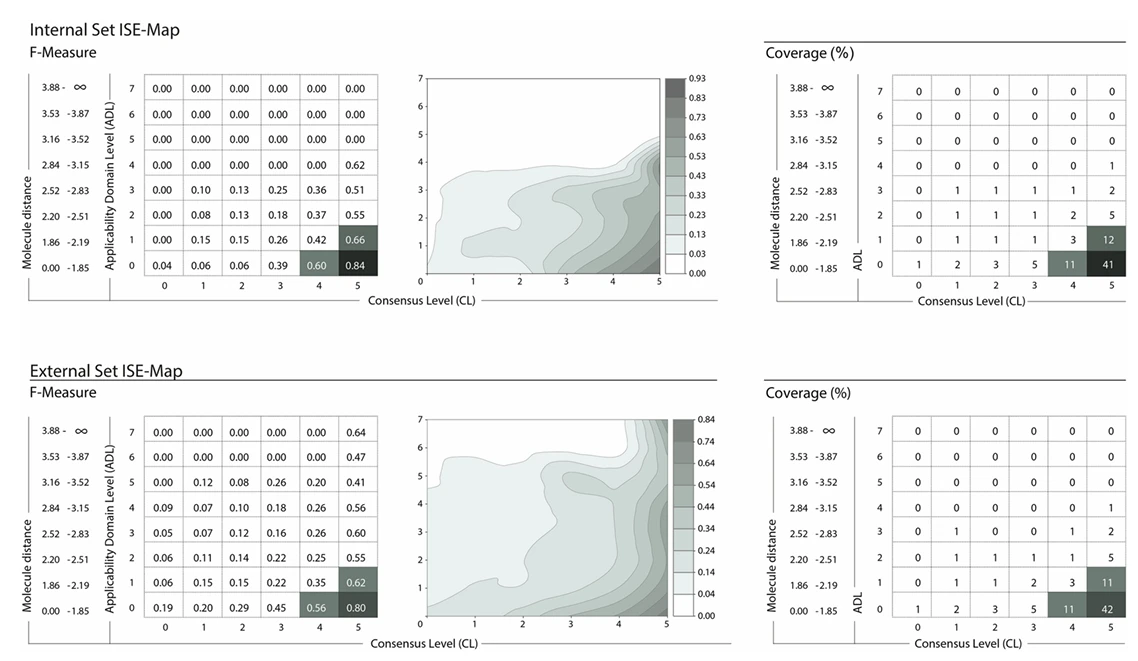
Figure 1. ISE-map contour plots of F-measure values stratified by consensus level (CL) and applicability domain level (ADL) for internal and external test sets, enabling reliability-based compound triage. (Falcón-Cano G, et al. 2025)
Reference
Falcón-Cano G, et al. hERG toxicity prediction in early drug discovery using extreme gradient boosting and isometric stratified ensemble mapping. Sci Rep. 2025 May 4;15(1):15585.
Our technical team responds within 24 hours. All inquiries protected under NDA.