AI-Enhanced Cryo-Electron Microscopy (Cryo-EM) Services
No crystal? No problem. Our platform deploys AI-enhanced single-particle analysis and Micro-ED to resolve membrane proteins, large complexes, and nanoparticles at near-atomic resolution — with direct handoff to Molecular Docking Services and Molecular Dynamics (MD) Simulations.
Creative Biostructure at a Glance
Over a decade of trusted expertise powering biotech, pharma, and research institutions worldwide to advance therapeutic innovation.






Why Partner With Us
Most cryo-EM programs stall not because the target is intractable — but because the pipeline is fragmented. Virtual biotechs lack the Krios access, GPU clusters, or model-building expertise to turn micrographs into coordinates. Pharma teams lose months coordinating sample prep, data collection, and processing across separate vendors. We built this platform to eliminate that friction: one team where AI-driven particle picking, 3D reconstruction, and model building share the same milestone clock.
Your CapEx is in compute and chemistry. Ours is in electron microscopy infrastructure and cryo-EM expertise.
| Stage | What We Deliver | What You Don't Need to Build |
|---|---|---|
| AI Sample Prep | Vitrification optimization prediction; grid quality pre-screening via negative stain TEM | Cryo-EM facility |
| Data Collection | Krios G4i remote operation; automated low-dose imaging with real-time ice quality assessment | Synchrotron/cryo-EM partnership |
| AI Processing | Topaz deep learning particle picking; cryoSPARC 3D classification; cryoDRGN-AI heterogeneity analysis | GPU cluster |
| Structure Solution | AlphaFold3-guided model building; ISOLDE refinement; MolProbity validation | Bioinformatics team |
| Data Handoff | Docking-ready maps + direct transition to SBDD or Lead Optimization | — |
Production-Ready Deliverables: Every structure ships with EMDB-ready maps, PDB coordinates, local resolution estimates, and direct handoff to Molecular Docking or Fragment-based Screening.
- ✓ Milestone-based pricing aligned with your fundraising cycles
- ✓ No vendor coordination overhead — sample prep, data collection, processing, and model building under a single project manager
Membrane proteins. Large complexes. Flexible assemblies. "Undruggable" is our starting point.
Proven track record where others fail
Class B GPCRs, ion channels, multi-subunit transcription complexes, and nucleic acid-protein assemblies — targets that resist crystallization due to conformational flexibility or low symmetry.
Multi-modal pivot capability
When cryo-EM particles are too heterogeneous, we deploy cryoDRGN-AI to resolve discrete states; when crystals are too small for X-ray, we pivot to Micro-ED without restarting the project clock.
IP firewall & encrypted data infrastructure
Full audit trails, GLP-ready documentation, client retains 100% ownership of all maps, models, and processing parameters.
Core Service Modules
Service Module At-a-Glance
| Service | Core Capability | Structural + Computational Integration | Typical Timeline |
|---|---|---|---|
| Single Particle Analysis (SPA) | Membrane proteins, large complexes, nanoparticles; 2.5–4 Å resolution | AlphaFold3 initial fitting; cryoDRGN-AI heterogeneity; ISOLDE refinement; handoff to MD/Docking | 4–8 weeks |
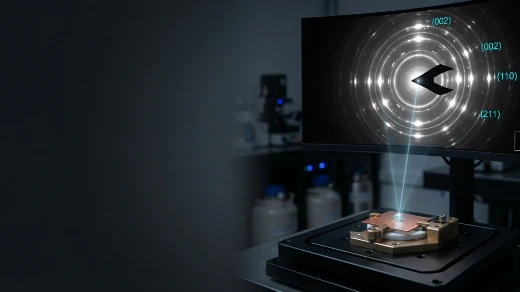
| Micro-ED Services | Sub-micrometer crystals; protein, peptide, and small-molecule microcrystals | Dose-optimized data processing; structure solution for targets unsuitable for X-ray; integration with CADD pipeline | 2–4 weeks |
Single Particle Analysis (SPA)
AI-Guided Reconstruction from Micrographs to Atomic Models
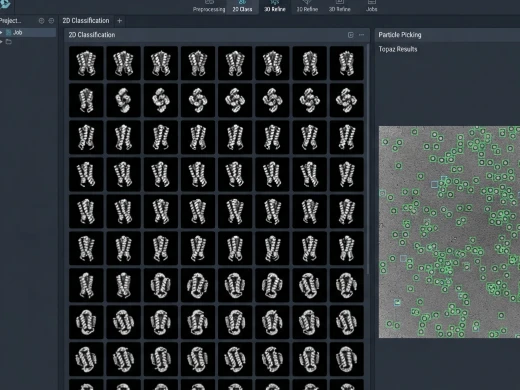
Key Features:
- Deep Learning Particle Picking — Topaz and cryoSPARC blob picker trained on membrane protein datasets, reducing false positives by 40% compared to template matching.
- AI-Assisted 3D Classification — cryoSPARC heterogeneous refinement resolves discrete conformational states; cryoDRGN-AI maps continuous flexibility for intrinsically disordered regions.
- AlphaFold3-Guided Model Building — Initial models fitted into density with ISOLDE and Coot, refined against EMRinger and MolProbity scores.
- Docking-Ready Map Delivery — Sharpened maps with local resolution filtering, directly compatible with Molecular Docking and FEP calculations.
What We Offer: For Fragment-based Screening programs, SPA delivers GPCR and ion channel structures without crystallization — enabling SPR and STD-NMR hit validation with atomic-resolution binding site maps. For gene therapy biotechs, AAV capsid structures at 2.8 Å support CMC comparability studies.
Explore Single Particle Analysis (SPA) →Micro-ED Services
Electron Diffraction from Crystals Too Small for X-Ray
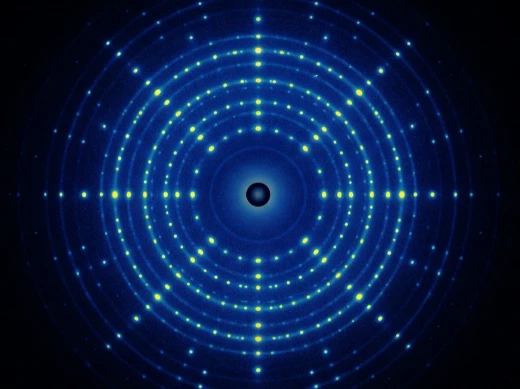
Key Features:
- Sub-Micrometer Crystal Diffraction — Continuous rotation Micro-ED on crystals <1 µm, bypassing the size limitations of conventional X-ray crystallography.
- Dose-Optimized Data Processing — Multi-crystal dose-weighted merging strategies limit radiation damage, improving resolution and data completeness (Bwanika et al., 2025).
- Integrated Structure Solution — Direct methods and molecular replacement pipelines linked to our AI-Assisted X-ray Crystallography workflow for seamless target handoff.
- Small-Molecule & Peptide Capable — Protein microcrystals, peptide polymorphs, and small-molecule phase identification for hit-to-lead programs.
What We Offer: For membrane protein targets that form microcrystals in lipidic cubic phase but fail to grow beyond 5 µm, Micro-ED provides an orthogonal path to atomic coordinates. For pharma crystallography groups, Micro-ED validates polymorphs and salt forms during Lead Optimization.
Explore Micro-ED Services →Technology Platform
Integrated Cryo-EM Infrastructure: AI Processing + Data Collection + Model Building, Zero Handoffs
Traditional cryo-EM splits sample prep, imaging, and computation across separate groups — losing critical quality context at every handoff. Our platform unifies all stages under one project team, with AI predictions informing grid design and experimental maps feeding back into model training.
Computational Platform — Dry Lab
| Capability | Details |
|---|---|
| AI Particle Picking Engine | Topaz, cryoSPARC blob picker, and Cryo-IEF foundation model (Yan et al., 2025) for automated particle detection in heterogeneous datasets |
| 3D Reconstruction & Heterogeneity | cryoSPARC, RELION, and cryoDRGN-AI for discrete classification and continuous conformational landscape mapping |
| AI Model Building | CryoAtom (Su et al., 2025), DeepTracer, and AlphaFold3-guided fitting in ISOLDE/Coot |
| Map Validation & QA | DeepQs local quality scoring, DAQ score, EMRinger, and MolProbity for map-to-model fidelity |
| Micro-ED Data Processing | DIALS, PETS2, and dose-weighted merging with radiation damage mitigation protocols |
Experimental Crystallography Platform — Wet Lab
| Capability | Details |
|---|---|
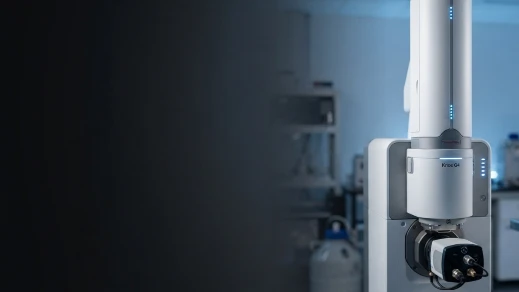
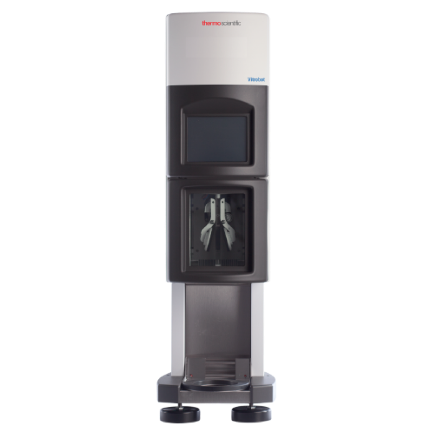
| Cryo-EM Imaging | Thermo Fisher Krios G4i (300 kV, Falcon 4i, Selectris X energy filter); Glacios 2 (200 kV) for screening |
| Sample Vitrification | Vitrobot Mark IV with automated blotting; chameleon vitrification for optimized ice thickness control |
| Grid Preparation | C-Flat, UltrAuFoil, and lacey carbon with automated glow discharge; MISO microfluidic purification compatible (Eluru et al., 2025) |
| Micro-ED Diffraction | JEOL JEM-ARM200F (200 kV) with CETA camera; continuous rotation ED with low-dose protocols |
| In-House Computing | GPU cluster (A100/H100) for real-time 2D classification and on-the-fly data quality assessment |
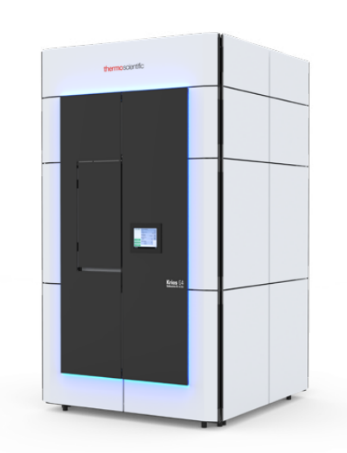
Thermo Fisher Krios G4i
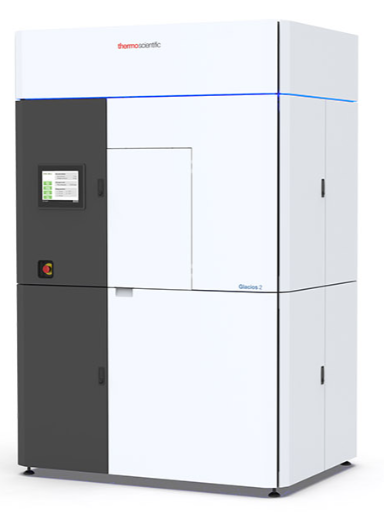
Thermo Fisher Glacios 2
Vitrobot Mark IV
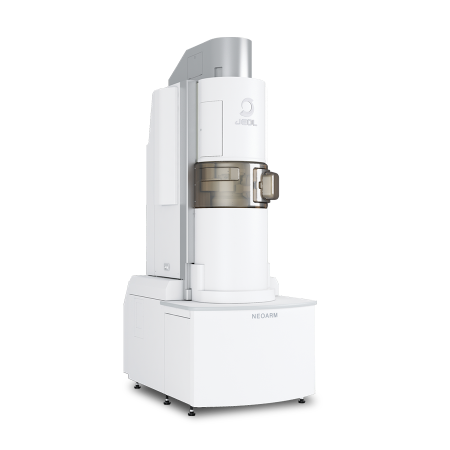
JEOL JEM-ARM200F
Platform Edge: The ability to assess grid quality via negative stain TEM on Monday, collect Krios data on Tuesday, and deliver 3D reconstructions by Friday — all under one project team — compresses traditional 3-month structure determination into 2-week iterations.
Closed-Loop Discovery Engine
When AI Prediction Meets Electron Density Truth
Static AI models predict structures from sequence. Experimental cryo-EM reveals the conformational reality that models miss — ligand-induced changes, domain rotations, and ordered lipid densities. Our platform feeds every experimental map back into the design cycle.
AI Structure Prediction
AlphaFold3 generates initial models; low-confidence regions and flexible loops flagged for experimental focus
→ Feeds into Sample Design
Cryo-EM Data Collection + AI Particle Picking
Deep learning detection and automated low-dose imaging maximize high-quality particle yield
→ Feeds into 3D Reconstruction
Heterogeneity Analysis + Model Building
cryoDRGN-AI resolves conformational states; docking and virtual screening protocols updated with ligand-bound maps
→ Feeds into CADD
Structural Feedback
Experimental coordinates retrain target-specific AlphaFold3 parameters and improve next-target prediction accuracy
→ Feeds back into AI
Industrial Value:
For Biotechs
Your first cryo-EM map calibrates the AI models for your second target. Structural validation from Phase 0 becomes training data for Phase 1 — a compounding learning partnership.
For Pharma
Every computational prediction is linked to an experimental outcome with project ID, timestamp, and model version — fully audit-ready for regulatory submissions and internal portfolio reviews.
Project Management & Execution
Project Workflow
A standardized, milestone-driven execution system. From sample intake to deposition-ready coordinates.


01 Sample QC
Deliverable: Sample quality report
02 Grid Prep
- Vitrification optimization; automated blotting; grid quality assessment
Deliverable: Grid set with vitrification parameters
03 Data Collection
- Krios G4i automated data collection; real-time ice thickness and drift monitoring
Deliverable: Raw micrograph dataset
04 AI Processing
- Topaz particle picking; cryoSPARC 3D classification; cryoDRGN-AI heterogeneity analysis
Deliverable: 3D reconstruction with resolution estimate
05 Model Building
- AlphaFold3-guided fitting; ISOLDE refinement; MolProbity validation
Deliverable: Atomic model with validation statistics
Sample Requirements
| Sample Type | Specification |
|---|---|
| Protein/Complex | >95% purity; >0.5 mg/mL; NanoDSF Tm >45°C; DLS PDI <1.2 |
| Membrane Protein | Nanodisc or detergent-solubilized; lipid composition specified; Target Protein Production history preferred |
| Nanoparticles | AAV/VLP/exosome; >10¹² particles/mL; minimal aggregation by DLS |
| Micro-ED Samples | Sub-micrometer crystals; crystal size distribution and solvent content data |
| Prior Data | Negative stain EM images (if available); previous biochemical characterization |
Standard Deliverables
Upon project completion, clients receive comprehensive experimental reports including:
- Sharpened cryo-EM density map (EMDB-ready format)
- Atomic model (PDB format) with full validation statistics (EMRinger, MolProbity)
- Local resolution map and B-factor distribution
- Heterogeneity analysis report (conformational states, if applicable)
- Molecular Docking-ready coordinate files
- Direct handoff to Molecular Docking, MD Simulation, or Lead Optimization
Our technical team responds within 24 hours. All inquiries protected under NDA.
Frequently Asked Questions
Case Study
Case #1: Nanoparticle Characterization by Cryo-TEM
Goal: Characterize the morphology, size distribution, and structural heterogeneity of a customer's nanoparticle formulation — a lyophilized powder containing vesicles and sugar excipients — to support formulation optimization and CMC documentation.
Key Data:
- Sample: Customer-provided lyophilized powder; resuspended in PBS with gentle pipetting
- Grid prep: 10-fold dilution; 3 µL on glow-discharged copper grid; vitrified with Vitrobot Mark IV (FEI) in liquid ethane
- Imaging: FEI Talos F200C (200 kV); 25 cryo-TEM images at 22KX and 45KX
- Findings:
- SUV: 20–80 nm
- LUV: 100–1000 nm
- MLV: 100–5000 nm
- Emulsions: W/O and W/O-in-water (WOM) types coexisting with vesicles
Why it matters: Cryo-TEM resolved morphological heterogeneity that bulk techniques cannot distinguish. The SUV/LUV/MLV ratio and emulsion coexistence directly impact encapsulation efficiency, stability, and release kinetics — critical for lipid nanoparticle and liposome drug delivery programs.
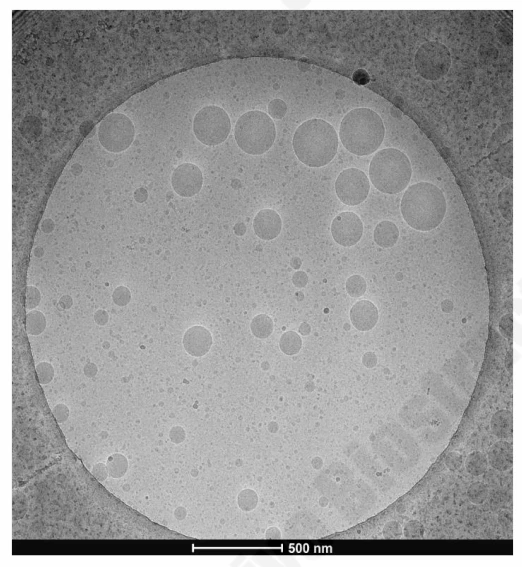
Figure 2. Representative cryo-TEM images of emulsion sample. W/O and W/O-in-water (WOM) multilamellar structures visible.
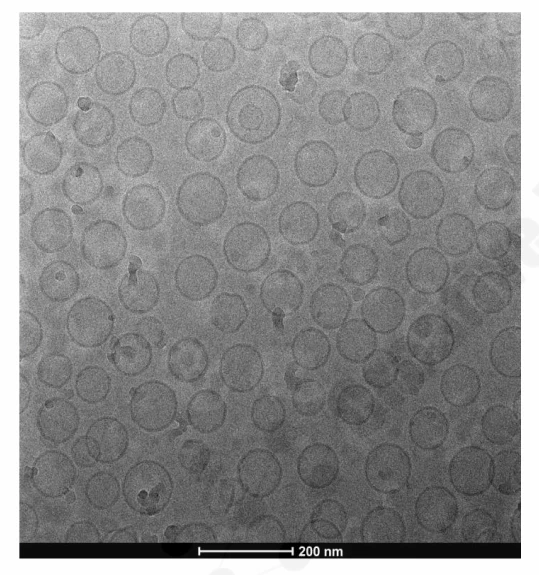
Figure 3. Representative cryo-TEM images of vesicle sample. Small unilamellar vesicles (SUV), large unilamellar vesicles (LUV), and multilamellar vesicles (MLV) identified.
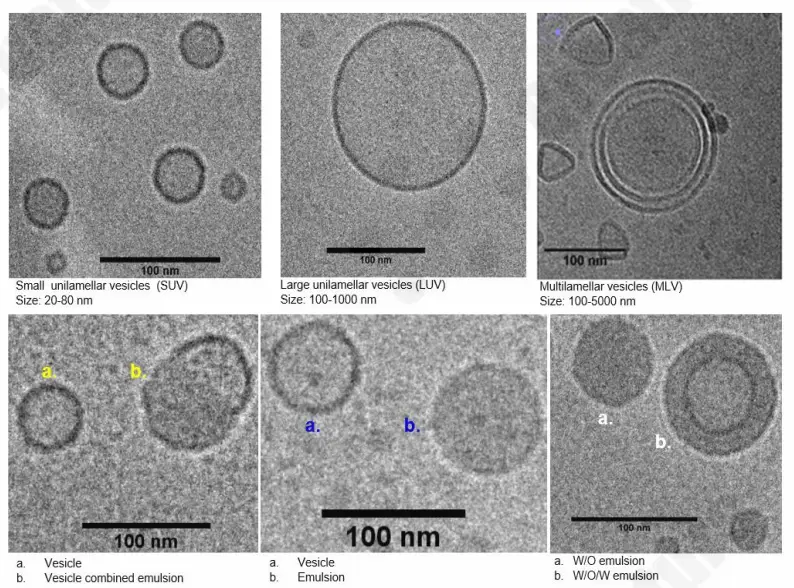
Figure 4. Representative particle morphology analyzed by Cryo-TEM. Overview showing heterogeneous coexistence of vesicles and emulsion droplets in the sample.
Need AI-enhanced cryo-EM to accelerate your structure-based drug discovery? Our team can design a customized cryo-EM pipeline tailored to your target class, particle properties, and regulatory milestones. Contact our scientific team today.