Epitope Mapping & Paratope Prediction
 Epitope Prediction
  Paratope Mapping
  Cross-Reactivity Scan
 AI predicts B-cell and T-cell epitopes, maps antibody paratopes, and scans cross-reactivity landscapes to de-risk immunogenicity and guide rational engineering.
Why Epitope Mapping & Paratope Prediction Is the Critical Foundation
Antibody programs stall when the epitope is unknown or when cross-reactivity triggers safety liabilities. Seed-stage biotechs pursuing vaccines or cell therapies need precise epitope maps to guide immunogen design. Pharma teams require paratope validation to ensure bispecific arms bind distinct epitopes. We deliver AI-predicted epitopes, structural paratope mapping, and cross-reactivity scans — de-risking programs before in vivo validation.
What Sets the Platform Apart
AI Epitope Prediction
BERT-based models trained on 100k+ antibody-antigen complexes predict epitope residues from sequence and structure with >80% precision.
Structural Paratope Validation
AlphaFold3 and IgFold models map paratope residues and CDR contribution to binding energy.
Cross-Reactivity De-Risking
Proteome-wide homology scanning identifies off-target epitopes and predicts anti-target liabilities before cell-based screening.
Technology Suite
AI-Driven Epitope Prediction
Linear and conformational epitope prediction using AI and transformer models
Key Features:
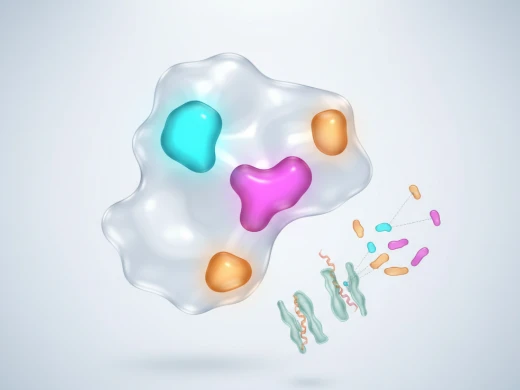
- B-Cell Epitope Mapping — Linear and conformational epitope prediction using BepiPred, DiscoTope, and proprietary transformer models trained on structural antibody-antigen data.
- T-Cell Epitope Prediction — MHC-I and MHC-II binding prediction for vaccine immunogen design and immunogenicity risk assessment.
- Discontinuous Epitope Assembly — Assembly of distant sequence segments into 3D epitope patches using AlphaFold-Multimer predicted complexes.
Ideal For: Vaccine immunogen design; cell therapy target validation; antibody programs requiring epitope binning for IP strategy.
What We Offer:
A ranked epitope map with residue-level confidence scores and 3D patch visualization. For vaccine programs, we identify conserved epitopes across viral variants. For antibody programs, we deliver epitope binning reports for competitive intelligence.
Paratope Mapping & CDR Annotation
Computational identification of paratope residues and CDR classification
Key Features:
- Paratope Residue Identification — Computational alanine scanning and FEP decomposition identify CDR residues driving antigen binding and energetics.
- CDR Canonical Classification — Automated classification of paratope loops into known canonical forms, predicting binding geometry and affinity maturation potential.
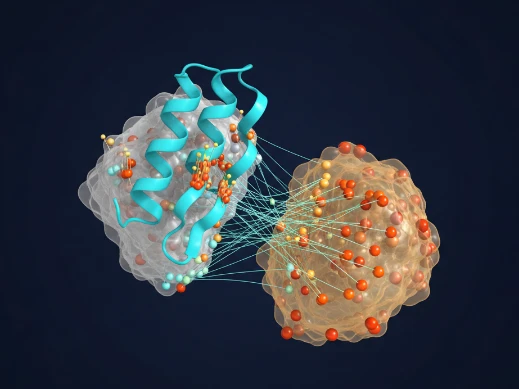
- Epitope-Paratope Interface Analysis — MD-based hotspot mapping of hydrogen bonds, salt bridges, and hydrophobic contacts at the antibody-antigen interface.
Ideal For: Bispecific design requiring non-overlapping paratopes; antibody-drug conjugate programs needing epitope-mediated internalization; patent strategy requiring epitope differentiation.
What We Offer:
A paratope report with per-residue binding energy contributions, CDR canonical assignments, and interface contact maps. For bispecific programs, we confirm arm-specific epitope binding with no cross-blocking.
Cross-Reactivity & Selectivity Profiling
Proteome-wide homology scanning and species conservation analysis
Key Features:
- Proteome-Wide Homology Scan — BLAST and structural alignment against the human proteome to identify off-target epitopes with >70% sequence similarity.
- Cross-Species Epitope Conservation — Prediction of epitope conservation across model organisms (mouse, cyno, rat) to guide toxicology study design.
- Anti-Drug Antibody (ADA) Risk Mapping — Identification of T-cell epitopes within the target antigen that may trigger unwanted immune responses against the therapeutic target itself.
Ideal For: First-in-human antibody programs; cell therapy targets expressed on normal tissues; vaccine programs requiring species-specific immunogen validation.
What We Offer:
A cross-reactivity risk report with off-target epitope list, species conservation map, and toxicology recommendations. For IND-enabling programs, we provide epitope-based safety rationale for regulatory submissions.
Platform Instrumentation
Core Instruments
| Instrument | Capability |
|---|---|
| NVIDIA DGX H100 | AI epitope and paratope model inference at scale |
| Zeiss LSM 900 | Confocal microscopy for cellular epitope localization and co-localization |
| Thermo Scientific Orbitrap Exploris 480 | High-resolution MS for epitope mapping by HDX-MS and crosslinking |
| Bruker timsTOF Pro | Ion mobility MS for peptide epitope separation and identification |
| Molecular Devices ImageXpress Nano | High-content imaging for cellular cross-reactivity screening |
| Sartorius Incucyte SX5 | Live-cell imaging for target expression and antibody binding kinetics |
| Hamilton Microlab STAR | Automated peptide array and ELISA setup for epitope validation |
| BioTek Cytation 5 | Imaging multimode detection for epitope binding assays |
Standardized Workflow
Project Workflow
A milestone-driven execution system from antigen to validated epitope map.


01 Target Review
- Antigen sequence and antibody V-genes
- Target indication and safety context
02 AI Prediction
- B-cell and T-cell epitope prediction
- Paratope residue scoring
- Deliverable: AI epitope/paratope report
03 Structural Mapping
- AlphaFold3 complex modeling
- Interface contact map and CDR annotation
- Deliverable: Structural interface map
04 Cross-Reactivity Scan
- Proteome-wide homology scan
- Species conservation analysis
- Deliverable: Cross-reactivity risk report
05 Experimental Validation
- HDX-MS epitope confirmation
- Cell-based cross-reactivity assay
- Deliverable: Validated epitope map + safety dossier
Sample Requirements
- Antigen sequence (protein, peptide, or pathogen genome)
- Antibody VH/VL sequences (if paratope mapping required)
- Target species and safety context (normal tissue expression, autoimmune risk)
- Known competitor epitopes (for binning, if available)
Standard Deliverables
- AI-predicted B-cell and T-cell epitope maps
- Paratope residue contribution and CDR annotation
- Structural interface contact map
- Cross-reactivity and species conservation report
- HDX-MS or cell-based validation data (if selected)
- Final technical report with regulatory recommendations
Frequently Asked Questions
Case Study
Case Study: AI-Driven Surface Paratope Prediction Across the Full Fab Domain
Goal: Benchmark an antigen-agnostic, surface-based deep learning pipeline that predicts paratope binding sites across the entire Fab region by fusing geometric, chemical, and electrostatic features.
Key Data:
- Full-Fab SOTA results: ParaSurf's hybrid 3D ResNet–transformer architecture achieves state-of-the-art AUC-ROC/AUC-PR on three benchmarks (PECAN, Paragraph-expanded, MIPE) at CDR±2, Fv, and full-Fab evaluation levels.
- CDR-H3/L3 precision: On the Paragraph-expanded dataset, the model attains AUC-ROC 0.959 / AUC-PR 0.895 for CDR-H3 and AUC-ROC 0.989 / AUC-PR 0.910 for CDR-L3, outperforming prior graph-network methods.
- Open-source release: Complete code, datasets, preprocessing pipelines, and trained weights—including single-chain-only modes—are publicly available.
Why it matters: This independent 2025 study validates that surface-based deep learning can capture geometric and physicochemical interaction fingerprints across the full Fab framework without antigen input. By delivering residue-level binding scores with SOTA accuracy, it demonstrates AI-driven paratope mapping as a scalable, deployable strategy for therapeutic antibody design—directly supporting our epitope mapping and paratope prediction capabilities.
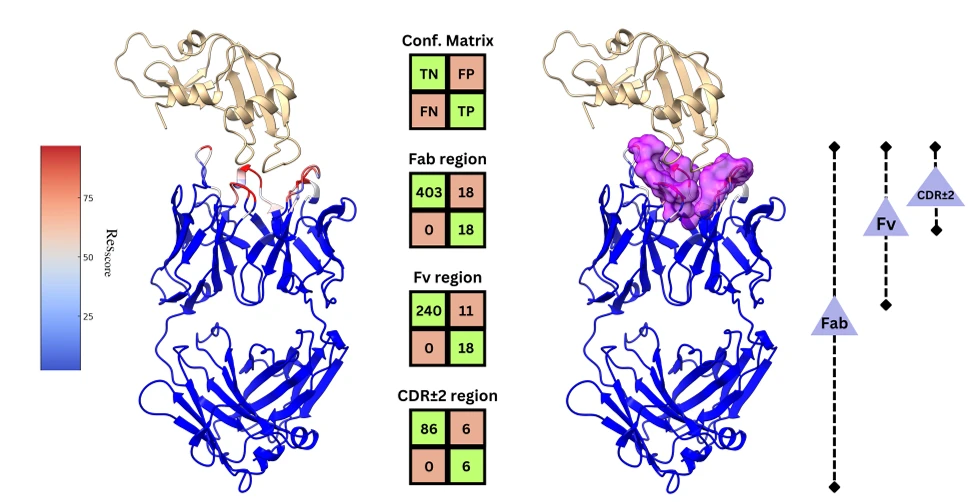
Figure 1. Predicted paratope binding sites and confusion matrices for the 1H0D antibody–antigen complex across Fab, Fv, and CDR±2 regions. (Papadopoulos AM, et al. 2025)
Reference
Papadopoulos AM, et al. ParaSurf: a surface-based deep learning approach for paratope-antigen interaction prediction. Bioinformatics. 2025 Feb 4;41(2):btaf062.
Our technical team responds within 24 hours. All inquiries protected under NDA.