Nucleic Acid (DNA/RNA) MD Simulation
 DNA/RNA Dynamics
  Non-Canonical Folding
  Drug-NA Interactions
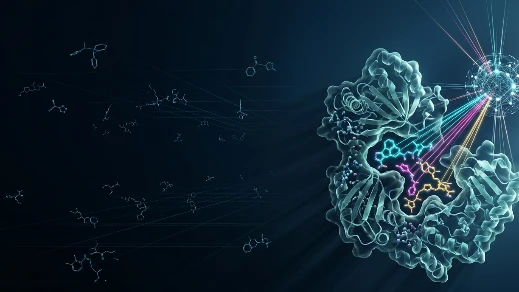
 Explicit-ion simulations that capture G-quadruplex stability, riboswitch ligand-induced folding, and protein-DNA recognition dynamics for emerging RNA-targeted therapeutics.
Why Nucleic Acid MD Simulation Is the Critical Foundation
RNA and DNA are no longer passive templates; they are drug targets with dynamic, ion-dependent folds. Seed-stage biotechs pursuing RNA-targeted small molecules cannot rely on static NMR structures that miss folding equilibria. Pharma teams need to understand how riboswitches, G-quadruplexes, and CRISPR guide RNAs respond to ligands and protein partners. We simulate nucleic acids with explicit ions and specialized force fields to reveal folding landscapes, intercalation pathways, and protein-nucleic acid interface dynamics.
What Sets the Platform Apart
Ion-Explicit Sampling
Explicit K+, Na+, and Mg2+ with nucleic-acid-specific ion parameters capture ion-dependent folding and G-quadruplex stability.
Non-Canonical Fold Discovery
Enhanced sampling (REMD, metadynamics) reveals riboswitch aptamer folding and G4 unfolding pathways invisible in static structures.
Direct Docking Handoff
Representative conformers feed directly into protein-nucleic acid docking and ligand-based screening for RNA-targeted campaigns.
Technology Suite
DNA/RNA All-Atom MD Simulation
Key Features:
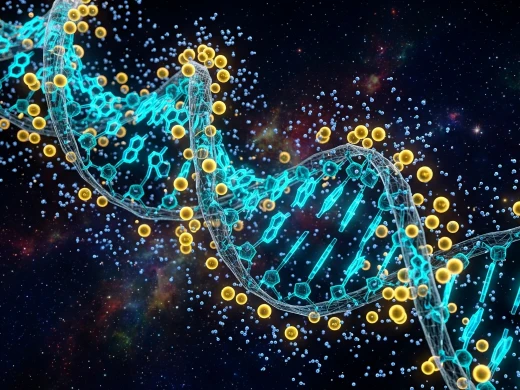
- Explicit Ion Environments — Physiological K+, Na+, and Mg2+ concentrations with nucleic-acid-specific ion parameters (Dang/ Cheatham; TIP3P-FB water).
- Specialized Force Fields — AMBER OL15/OL21 for RNA; BSC1/εζOL1 for DNA; CHARMM36 with nucleic acid corrections; compatible with protein parameters.
- Long-Chain Dynamics — Simulations of >100 bp DNA or long non-coding RNA segments capturing bending, twisting, and supercoiling.
- Quality Metrics — Backbone RMSD, sugar pucker distributions, glycosidic torsion, and base-pair opening frequencies monitored against NMR data.
Ideal For: RNA-targeted drug discovery; DNA-protein interaction studies; CRISPR-Cas9 guide RNA optimization; natural product DNA intercalator programs.
What We Offer:
Stable, ion-explicit trajectories with validated force-field choices. Seed-stage biotechs receive folding landscapes and ensemble structures for virtual screening. Pharma teams get raw trajectories and NMR-correlated validation reports.
Non-Canonical Structure & Folding Dynamics
Key Features:
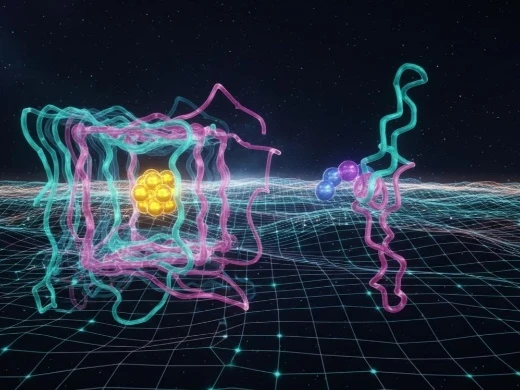
- G-Quadruplex (G4) Simulations — Folding/unfolding pathways of parallel, anti-parallel, and hybrid G4 topologies with explicit K+ coordination; ligand stabilization analysis.
- Riboswitch Aptamer Dynamics — Ligand-induced folding of purine, TPP, and SAM riboswitches; aptamer expression platform coupling.
- Hairpin & Loop Motifs — Thermodynamic stability of RNA hairpins, internal loops, and bulges; fragment binding to dynamic loops.
- Enhanced Sampling — REMD and well-tempered metadynamics to accelerate rare folding events and map free energy landscapes.
Ideal For: RNA-targeted small molecule programs; antiviral RNA structure disruption; oncology G4 stabilizer discovery.
What We Offer:
A folding landscape report with state populations, transition pathways, and ligand-induced shift maps. For lead optimization, we identify which ligand chemotypes stabilize vs. destabilize target folds.
Nucleic Acid-Drug & Protein Interaction Modeling
Key Features:
- Intercalation & Groove Binding — Simulations of small-molecule intercalation, major/minor groove binding, and covalent adduct formation with DNA/RNA.
- Protein-Nucleic Acid Interface — Dynamics of transcription factor-DNA recognition, CRISPR-Cas9/guide RNA complex stability, and nucleosome positioning.
- Selectivity Profiling — Comparative simulations of drug binding to target RNA vs. off-target DNA or structured RNA motifs to predict selectivity.
- Experimental Correlation — Back-calculation of NMR chemical shifts, CD spectra, and SAXS profiles for model validation.
Ideal For: RNA-targeted drug design; DNA-intercalator oncology programs; CRISPR guide RNA engineering; protein-nucleic acid docking refinement.
What We Offer:
An interaction report with binding mode movies, residence time distributions, and selectivity indices. For hit-to-lead, we recommend modifications that enhance target RNA affinity while minimizing genomic DNA intercalation.
Platform Instrumentation
Core Instruments
| Instrument | Capability |
|---|---|
| NVIDIA DGX H100 | Long-timescale nucleic acid simulations with explicit ion environments |
| GROMACS/AMBER HPC Cluster | REMD and enhanced sampling for RNA folding landscapes |
| Bruker AVANCE NEO 800 MHz | NMR validation of simulated RNA conformations and ion binding |
| JASCO J-1500 CD Spectrometer | Circular dichroism validation of G4 and RNA secondary structure |
| Waters ACQUITY UPLC H-Class | Purity profiling of RNA-targeted and DNA-intercalator ligands |
| PerkinElmer EnVision Nexus | Fluorescence intercalator displacement assay readout |
Standardized Workflow
Project Workflow
A milestone-driven execution system from sequence to dynamic nucleic acid model.


01 Target Review
- Sequence/structure assessment and ionic conditions
- Force-field selection (DNA vs. RNA vs. G4)
02 System Setup
- Ion placement and solvation with explicit counter-ions
- Restrained equilibration for non-canonical folds
03 Production MD
- Equilibration and production (1–5 μs)
- Enhanced sampling (REMD/metadynamics if required)
04 Analysis & Ranking
- Folding landscape and cluster analysis
- Ligand binding mode and residence time mapping
05 Validation
- NMR chemical shift validation
- CD spectroscopy correlation
Sample Requirements
- Nucleic Acid Sequence: DNA or RNA sequence (FASTA); known secondary structure (if any); target fold (G4, riboswitch, hairpin)
- Ligands: Small molecules, fragments, or proteins for interaction studies
- Ionic Conditions: Physiological K+/Na+/Mg2+ concentrations; special buffers (if any)
- Experimental Data: NMR/CD/SAXS for validation (optional)
Standard Deliverables
- Production trajectory with explicit ion system
- Secondary structure and folding population analysis
- Non-canonical fold dynamics report (G4, riboswitch)
- Ligand binding mode and selectivity assessment
- Ensemble conformers for docking and virtual screening
- Final technical report with SAR recommendations
Frequently Asked Questions
Case Study
Case Study: All-Atom MD Reveals Transcription-Driven RNA Folding Pathway Diversification
Goal: Benchmark a simplified all-atom MD framework for RNA co-transcriptional folding (CTF), comparing pathway preferences against free folding (FF) to validate atomic-resolution simulation of nucleic acid conformational ensembles.
Key Data:
- Convergent native state, divergent pathways: 800+ μs of all-atom MD showed RNA hairpin 1ZIH reaches identical native conformations under CTF and FF, yet CTF preferentially samples compact intermediates inaccessible to FF.
- Pathway bifurcation: FF favors a zipper-like route (PATH I) initiating near the loop region, whereas CTF biases toward distal-pair-first pathways (PATH II) via spatiotemporal coupling of transcription and folding.
- Transcription-rate modulation: CTF pathway preference varies with elongation speed (1–100 ns/nt), demonstrating that kinetic parameters encoded in synthesis reshape the RNA energy landscape beyond thermodynamic control.
Why it matters: This independent study offers third-party validation that all-atom MD captures non-equilibrium RNA folding dynamics inaccessible to static structure prediction. The demonstrated ability to resolve transcription-rate-dependent pathway switching and compact intermediate ensembles provides a rigorous benchmark for RNA-targeted therapeutic design—directly supporting our nucleic acid simulation capabilities from sequence to dynamic conformational landscapes.
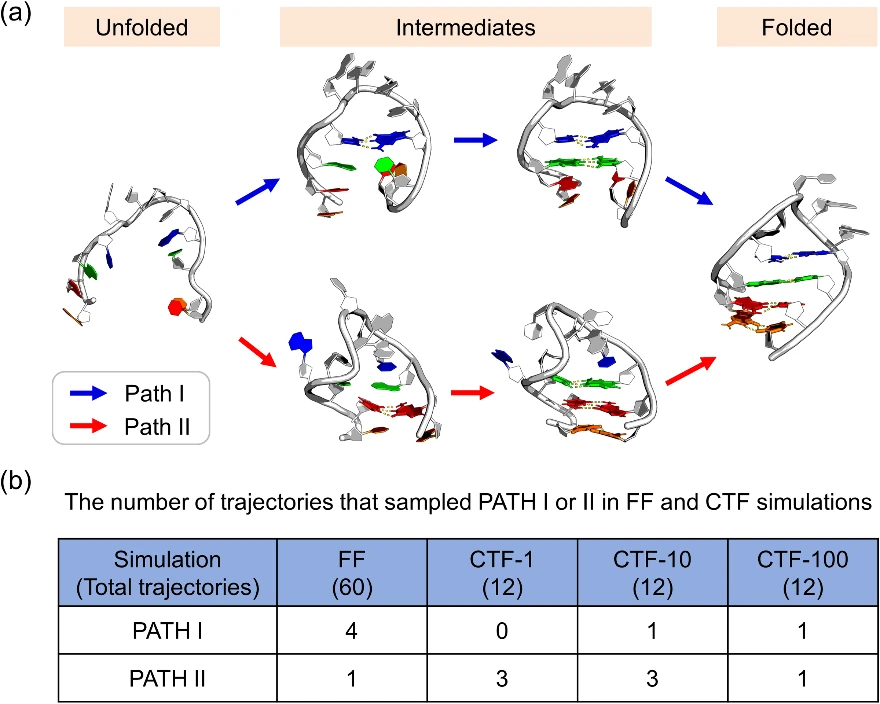
Figure 1. Folding pathway divergence of RNA hairpin 1ZIH. (a) Two distinct pathways defined by base-pair formation order: PATH I (loop-proximal 4C-9G forms first) versus PATH II (distal pairs form first). (b) Quantitative distribution showing FF preferentially follows PATH I, whereas CTF simulations at all tested elongation rates favor PATH II, revealing transcription-coupled reshaping of the folding landscape. (Tao P, et al. 2025)
Reference
Tao P.; et al. Transcription reshapes RNA hairpin folding pathways revealed by all-atom molecular dynamics simulations. PLoS Comput Biol. 2025 Sep 8;21(9):e1013472.
Our technical team responds within 24 hours. All inquiries protected under NDA.