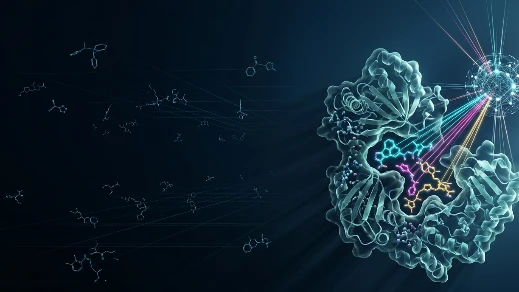
Binding Pocket & Druggability Analysis (Combination pocket drugability analysis)
 Pocket Detection
  AI Druggability Scoring
  Selectivity Profiling
 Many therapeutic targets lack obvious druggable pockets. We identify, score, and prioritize binding sites using AI classifiers and physics-based metrics, delivering actionable pocket maps for hit discovery.
Why Pocket Analysis Is the Critical First Gate
Structure-based drug design fails when the pocket is unknown or undruggable. Seed-stage biotechs lack computational chemistry teams to distinguish real pockets from false positives; pharma teams pursuing PPIs, allosteric modulators, or covalent inhibitors need precise pocket geometry to guide library design. Our platform combines AI druggability classifiers trained on thousands of co-crystal structures with MD-based pocket dynamics sampling, identifying both orthosteric and cryptic sites that survive experimental validation.
What Sets the Platform Apart
AI + Physics Hybrid
ML classifiers predict druggability from geometric descriptors. MD simulations sample pocket dynamics and transient openings.
Cryptic & Allosteric
Static structures miss cryptic pockets. MD ensemble analysis identifies transient sites invisible in single snapshots.
Selectivity-First
Every pocket is cross-referenced against the human structural proteome to flag off-target liability before synthesis.
Technology Suite
AI Pocket Detection & Druggability Scoring
Machine Learning Trained on Experimental Structures
Key Features:
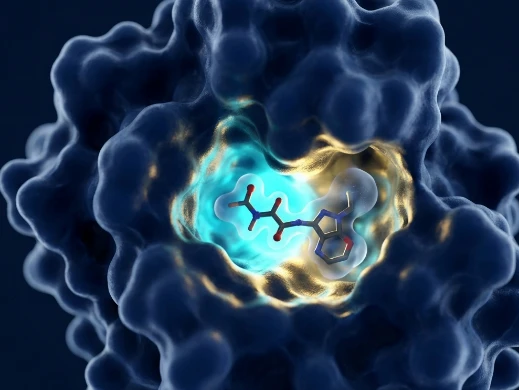
- ML classifiers (Random Forest/XGBoost) trained on 500+ co-crystal structures score pocket druggability from volume, lipophilicity, and hydrogen-bond potential.
- Deep learning models predict pocket ligandability probability for novel fold targets.
- pLDDT-weighted confidence scores for AlphaFold-derived pocket geometries.
Ideal For — Target prioritization; orphan proteins; undruggable targets.
What We Offer:
You receive a ranked pocket list with druggability scores, not just a surface visualization. For hit identification teams, this directs library design toward the most ligandable site.
Cryptic & Allosteric Site Discovery
Dynamic Pockets Invisible to Static Methods

Key Features:
- Microsecond-scale MD simulations identify transient pocket openings and allosteric communication pathways.
- Ensemble pocket detection across 50–200 conformers captures dynamic pocket landscapes.
- Cavity detection algorithms combined with MD trajectory analysis.
Ideal For — PPI disruptors; allosteric modulators; covalent inhibitor programs.
What We Offer:
For membrane proteins and PPI targets, cryptic pockets are often the only druggable option. Our MD-driven discovery finds binding sites that static models miss.
Selectivity Profiling & Target Prioritization
Off-Target Liability Before Synthesis
Key Features:
- Pocket signature matching against human structural proteome identifies potential off-target liabilities.
- Kinase selectivity profiling using binding site similarity matrices.
- Target prioritization reports with druggability-vs-novelty trade-off analysis.
Ideal For — Multi-target programs; kinase selectivity; lead optimization.
What We Offer:
You receive a selectivity risk report before investing in synthesis. For pharma teams, this prevents late-stage attrition. For biotechs, this prioritizes targets with the best ligandability-to-competition ratio.
Platform Instrumentation
Core Instruments
| Instrument / Software | Capability |
|---|---|
| NVIDIA DGX A100 | AI druggability model inference and large-scale MD |
| NVIDIA RTX A6000 Cluster | Real-time pocket visualization and ensemble analysis |
| GROMACS/AMBER HPC | Microsecond-scale MD for cryptic pocket sampling |
| FPocket / Ghecom Suite | Geometric cavity detection and volume calculation |
| RDKit / OpenEye Toolkits | Physicochemical descriptor calculation |
| Bruker AVANCE NEO 600 MHz | NMR validation of predicted pocket ligandability |
Standardized Workflow
Project Workflow
A milestone-driven execution system from target to prioritized pocket report.


01 Target Review
1. Sequence and structure analysis2. MSA and homology assessment
Deliverable: Target assessment report
02 Pocket Detection
- 1. Cavity detection on static structure
- 2. Initial pocket ranking by geometry
- Deliverable: Preliminary pocket map
03 MD Sampling
- 1. All-atom MD simulation
- 2. Ensemble pocket detection
- Deliverable: Dynamic pocket landscape
04 Druggability Score
- 1. ML druggability scoring
- 2. Cryptic site ranking
- Deliverable: Prioritized pocket list
05 Selectivity Check
- 1. Off-target liability scan
- 2. Selectivity risk report
- Deliverable: Final pocket report + SBDD recommendations
Sample Requirements
- Target structure: PDB file, AlphaFold model, or sequence for de novo modeling
- Known ligands: Any existing binders, cofactors, or reference compounds
- Project scope: Target class, intended therapeutic area, and selectivity requirements
- Prior data: Existing screening results or competitor intelligence (if available)
Standard Deliverables
- Pocket prioritization report with druggability scores
- Cryptic and allosteric site maps
- MD ensemble analysis (50–200 conformers)
- Selectivity profiling against human structural proteome
- Final technical report with SBDD recommendations
- Electronic data package (pocket trajectories, analysis scripts)
Frequently Asked Questions
Case Study
Case Study: Large-Scale GPCR MD Uncovers Hidden Allosteric Pockets & Lateral Gateways
Goal:
Map GPCR dynamic landscapes to expose concealed allosteric sites and membrane entry pathways invisible in static structures.
Key Data:
- 556.5 μs dataset: 190 GPCR structures (33 subtypes) reveal apo receptors transition to open states in ~7.8 μs, while antagonists/NAMs slow this 7×.
- Lipid insertion hotspots: Conserved TM1-TM7EC and TM3-TM4IC sites predict allosteric pockets; MD recovers 94% of experimentally observed lipid insertions.
- Hidden pocket dynamics: Allosteric sites fully close within nanoseconds upon ligand removal, but lipid insertions trigger reopening—exposing transient druggable cavities and lateral entry channels (e.g., rhodopsin TM5-TM6EC).
Why it matters:
Static cryo-EM structures systematically conceal GPCR druggable sites. By treating lipid insertions as dynamic probes, this work reveals allosteric pockets and lateral gateways that enable structure-based design against previously unexplored cavities—compressing target validation by capturing biologically critical states traditional pipelines discard.
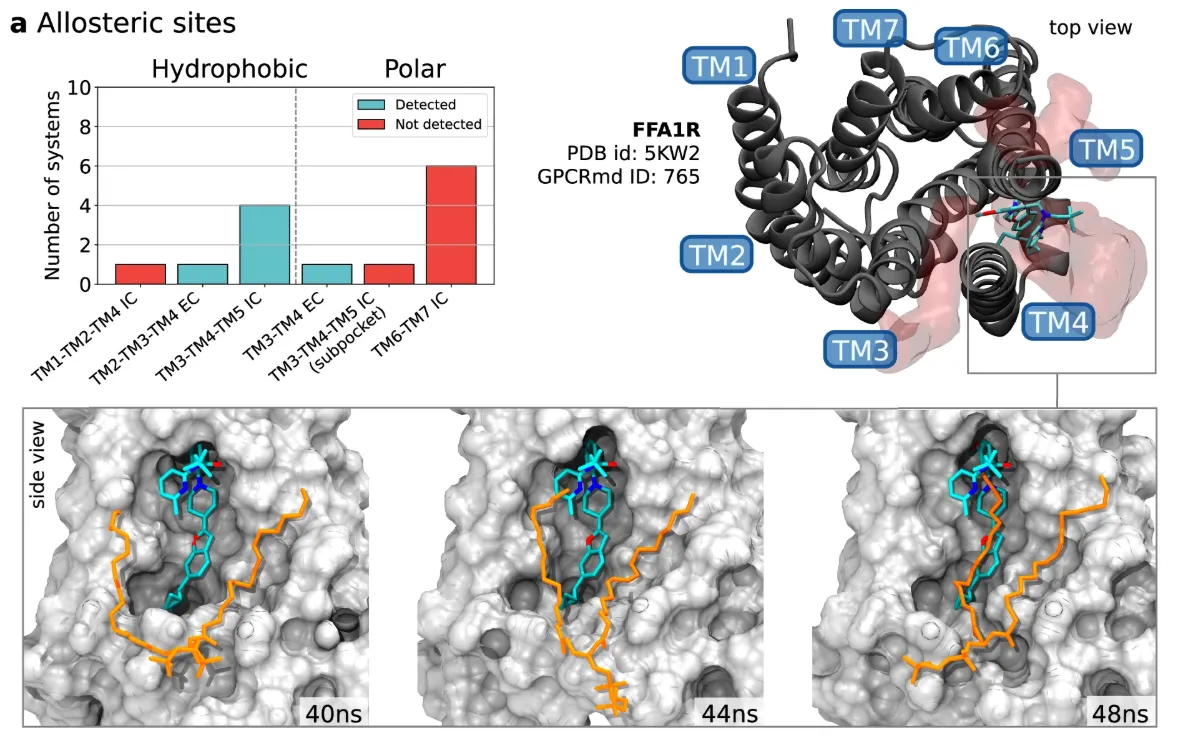
Figure 1. Lipid insertions in allosteric ligand-bound receptors by site location and polarity (top), exemplified by FFAR1 TM3-TM4-TM5IC pocket penetration (PDB: 5KW2, bottom). (Aranda-García D.; et al. 2025)
Reference
Aranda-García D, et al. Large scale investigation of GPCR molecular dynamics data uncovers allosteric sites and lateral gateways. Nat Commun. 2025 Feb 27;16(1):2020.
Our technical team responds within 24 hours. All inquiries protected under NDA.