Structure-Based Pharmacophore Modeling
 Pocket Feature Extraction
  Co-Crystal-Guided Modeling
  Virtual Screening Integration
 Structure-based pharmacophores extract essential binding features directly from protein-ligand co-crystal structures. We map pocket interactions into 3D feature queries for high-throughput virtual screening.
Why Structure-Based Pharmacophore Modeling Is the Critical Bridge Between Structure and Screening?
Co-crystal structures reveal where ligands bind, but not which features are essential for activity. Structure-based pharmacophore modeling translates pocket topology into searchable 3D queries, enabling screening without prior active compound knowledge.
What Sets the Platform Apart
Pocket Feature Extraction
Automated mapping of H-bond donors, acceptors, hydrophobic, and aromatic features from binding pocket residues. Benchmarked against PDB.
Co-Crystal-Guided Modeling
Pharmacophore hypotheses derived from co-crystal ligands and pocket topology. AlphaFold Protein Structure Prediction models supported when crystals are unavailable.
MD-Validated Features
Molecular Dynamics (MD) Simulations validate feature stability. Binding Free Energy Calculation (FEP/TI, MM/PBSA) rescoring confirms affinity correlation.
The Structure-Based Pharmacophore Suite
Pocket-Based Pharmacophore
Feature Detection from Binding Pocket Topology
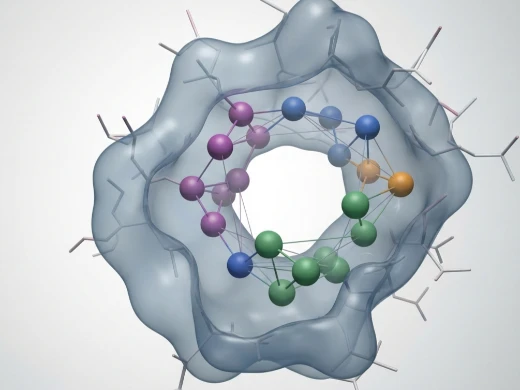
- Feature Detection from Pocket Topology — Automated identification of hydrogen bond donors, acceptors, hydrophobic regions, aromatic rings, and ionic interactions from binding pocket residue side chains.
- Exclusion Volume Mapping — Definition of forbidden regions where steric clashes prevent ligand binding.
- Ideal For — Targets with co-crystal structures; Hit Identification enrichment; scaffold-hopping from known binders.
For virtual biotechs with a single co-crystal structure, pocket-based pharmacophore generation identifies the essential feature set required for binding—enabling searches in Structure-Based Virtual Screening (SBVS) libraries for structurally novel replacements.
Hybrid Pharmacophore
Ligand-Receptor Feature Fusion
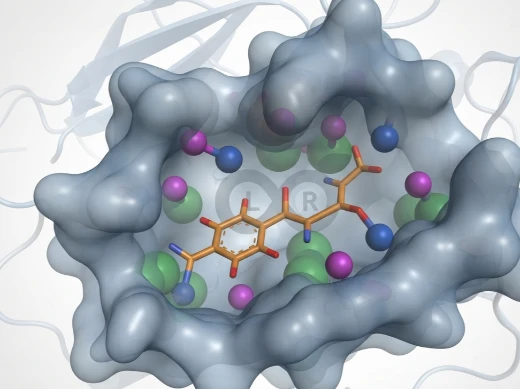
- Ligand-Receptor Feature Fusion — Combining pocket features with co-crystal ligand interaction patterns for enhanced selectivity.
- Constraint Optimization — Tightening or relaxing feature tolerances based on SAR data.
- Ideal For — Lead optimization; series expansion; selectivity profiling against off-target homologs.
For pharma teams optimizing a lead series, hybrid pharmacophores quantify how pocket feature adjustments affect affinity and selectivity. When combined with ADMET Prediction & Modeling, this guides medicinal chemistry toward potent, developable analogs.
Dynamic Pharmacophore
Ensemble Feature Extraction from MD Trajectories
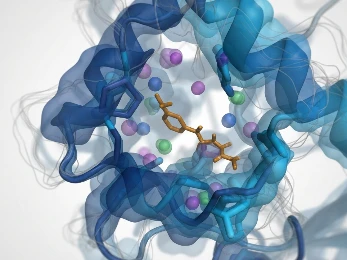
- Ensemble Feature Extraction — Pharmacophore features averaged across Molecular Dynamics (MD) Simulations trajectory snapshots.
- Induced-Fit Adaptation — Capture of transient pockets and alternative binding modes invisible in static crystal structures.
- Ideal For — Flexible targets; allosteric sites; Protein-Ligand Docking (Rigid / Flexible / Induced Fit Docking) companion screening.
Static models capture a single conformation. Dynamic pharmacophores average features across MD trajectory snapshots, capturing transient pockets and induced-fit adaptations invisible in crystal structures.
Platform Instrumentation
| Software / System | Core Capability |
|---|---|
| LigandScout | Automated structure-based pharmacophore generation from protein-ligand complexes with feature annotation and exclusion volumes. |
| Schrödinger Phase | Structure-based pharmacophore development with receptor site features and shape constraints. |
| MOE Pharmacophore | Pocket-based and hybrid pharmacophore generation with induced-fit and dynamic feature support. |
| Discovery Studio | Receptor-ligand pharmacophore modeling with site features and virtual screening integration. |
| PharmaCore | Automated workflow for generating 3D structure-based pharmacophores from PDB structures using UniProt IDs. |
| GROMACS 2023 + AMBER 22 | MD trajectory analysis for dynamic pharmacophore feature stability and ensemble extraction. |
| PyMOL + Maestro | Pharmacophore visualization, pocket feature mapping, and hit inspection. |
Standardized Workflow
Project Workflow
A standardized, milestone-driven execution system. From target structure to validated pharmacophore hypotheses—managed by a single computational project team, tracked in real time.


01 Target Review & Pocket Analysis
- Target structure review: PDB, AlphaFold, or Homology Modeling & Threading assessment.
- Co-crystal ligand analysis and interaction fingerprint extraction.
- Water molecule and ion placement assessment.
Deliverable: Prepared structure + pocket map.
02 Feature Extraction & Hypothesis Generation
- Binding pocket identification and druggability scoring.
- Feature mapping: H-bond donors, acceptors, hydrophobic, aromatic, ionic.
- Exclusion volume definition and tolerance optimization.
Deliverable: Pharmacophore hypothesis with feature definitions.
03 Virtual Screening Execution
- Pharmacophore query construction with feature spheres and exclusion volumes.
- Database screening: Structure-Based Virtual Screening (SBVS) libraries.
- ADMET Prediction & Modeling filtering.
Deliverable: Ranked hit list with pharmacophore fit scores.
04 Hit Refinement & Validation
- Hit clustering and scaffold diversity analysis.
- Pharmacophore fit scoring and Binding Free Energy Calculation (FEP/TI, MM/PBSA) rescoring.
- Molecular Dynamics (MD) Simulations for pose stability.
Deliverable: Refined hit dataset with stability metrics.
05 Report & Handoff
- Final pharmacophore report with hit list.
- Structural rationale: feature mapping, synthetic accessibility.
- Direct handoff to Hit Biophysical Characterization or Co-crystallization and Soaking if contracted.
Deliverable: Final report + data package + transition plan to Hit to Lead or Lead Optimization.
Sample Requirements
| Requirement | Details |
|---|---|
| Target structure | PDB ID or AlphaFold model; specify binding site residues or co-crystal ligand reference |
| Co-crystal ligands | Known binders for interaction fingerprint extraction and feature validation |
| Project scope | Hit identification, lead optimization, or scaffold-hopping |
| Prior screening data | Any existing virtual screening or docking results to avoid redundancy |
Standard Deliverables
- Prepared protein structure with pocket feature map and water network documentation
- Structure-based pharmacophore hypothesis with feature spheres, tolerances, and exclusion volumes
- Ranked hit list (top 100–500) with pharmacophore fit scores and scaffold diversity metrics
- Dynamic pharmacophore ensemble (if MD contracted)
- Electronic data package formatted for Structure-Based Virtual Screening (SBVS) or Hit to Lead handoff
Frequently Asked Questions
Case Study
Case Study: ML-Enhanced Structure-Based Pharmacophore Screening — 54-Fold Enrichment Improvement
Published Evidence:
Ahmadi A, et al. Linking machine learning and biophysical structural features in drug discovery. Front Mol Biosci. 2025 Jan 23;11:1305272.
Key Findings:
- ML-Pharmacophore Integration: An AI/ML framework prioritized pharmacophore features uniquely associated with ligand-selected protein conformations, integrating biophysical insights with machine learning.
- Enrichment Performance: Up to 54-fold improvement in database enrichment compared to random selection, demonstrating robustness across diverse protein targets.
- Conformation-Specific Features: Unlike conventional static methods, the approach identified features tied to conformations selected by ligands, offering a predictive framework for lead optimization.
Industrial Translation:
For seed-stage biotechs, this paradigm confirms that ML-enhanced structure-based pharmacophore screening achieves 54-fold enrichment without massive experimental datasets. For pharma teams, the conformation-specific feature identification reduces false positives and guides Lead Optimization with interpretable binding rationales. Our platform operationalizes this peer-reviewed approach within an audit-ready workflow, pairing structure-based pharmacophore generation with Molecular Dynamics (MD) Simulations validation and Binding Free Energy Calculation (FEP/TI, MM/PBSA) rescoring.
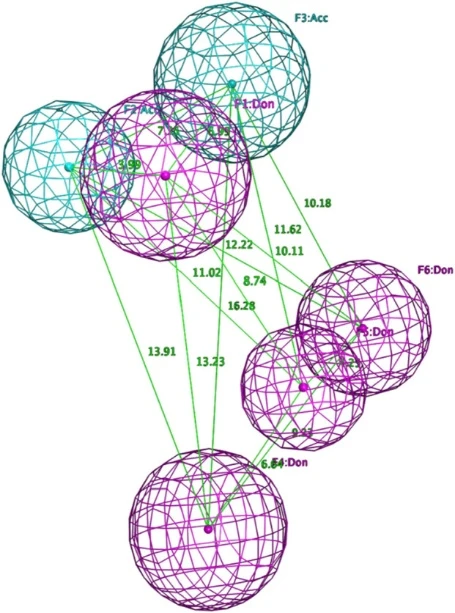
Figure 1. Final pharmacophore model of ADRB2. (Ahmadi A, et al. 2025)
Need validated structure-based pharmacophore data to advance your hit identification pipeline? Our team can design a pharmacophore campaign tailored to your target structure, pocket biology, and screening goals. Contact our scientific team today to start your project.