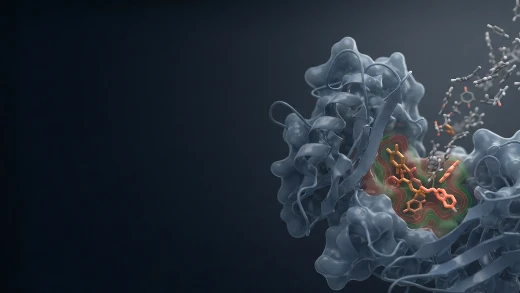
Scaffold Hopping Analysis
 AI-Driven Core Replacement
  3D Shape-Preserving Generation
  Multilevel Virtual Screening Validation
 Patent-protected scaffolds block commercialization. We replace molecular cores while preserving 3D shape and pharmacophore features, delivering patent-clear candidates with validated binding hypotheses.
Why Scaffold Hopping Analysis Is the Critical Bridge Between Chemistry and IP Freedom?
A potent lead is worthless if the scaffold is patented. While standard medicinal chemistry tweaks side chains, our scaffold hopping approach reimagines the core itself—AI models learn the 3D shape and pharmacophore signature of a reference compound, then generate structurally novel, synthetically accessible candidates with entirely different cores, ready for Structure-Based Virtual Screening (SBVS) validation.
What Sets the Platform Apart
Generative RL Core Design
Unconstrained full-molecule generation via reinforcement learning replaces predefined substructure rules. Novel cores emerge naturally.
3D Shape-Preserving Matching
ROCS shape and pharmacophore color scores constrain generation to bioactive conformations. Scaffold dissimilarity enforced by ECFP Tanimoto distance.
Multilevel Validation Pipeline
Molecular Dynamics (MD) Simulations and Binding Free Energy Calculation (FEP/TI, MM/PBSA) validate top candidates before synthesis commitment.
The Scaffold Hopping Suite
Generative RL Scaffold Hopping
Unconstrained Full-Molecule Generation
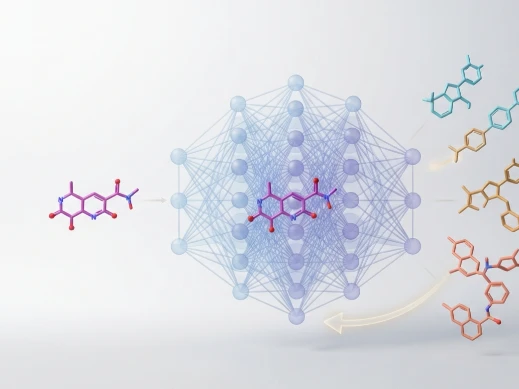
- Reinforcement Learning Agent — LSTM generator trained on ChEMBL, fine-tuned on a reference molecule, and steered by a scaffold-hopping scoring function rewarding 3D similarity and low scaffold overlap.
- ScaffoldFinder Algorithm — Fuzzy substructure matching identifies decorations in generated designs, cleaves them, and compares the remaining core to the reference scaffold via ECFP dissimilarity.
- Ideal For — Patent-blocked leads; series rescue when ADMET is scaffold-locked; De Novo Drug Design campaigns starting from a single active.
For biotechs with one confirmed hit and a looming patent expiry, generative RL explores chemical space beyond manual medicinal chemistry intuition. The agent invents cores that retain the reference's binding pose while shedding every atom of the original scaffold.
3D Shape-Matched Core Replacement
Volumetric and Pharmacophore Constraint Enforcement
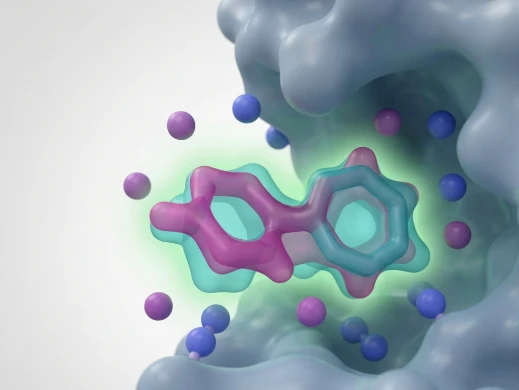
- ROCS Shape & Color Scoring — Generated conformers aligned to the reference crystallographic pose; shape overlap and pharmacophore feature matching quantified.
- Conformer Ensemble Sampling — Up to 32 geometry-optimized conformers per stereoisomer evaluated; highest-scoring conformer drives selection.
- Ideal For — Kinases, proteases, and targets where shape complementarity dominates binding; Protein-Ligand Docking (Rigid / Flexible / Induced Fit Docking) companion campaigns.
Shape is the silent driver of selectivity. A core replacement that preserves the reference's volume and feature layout often retains potency even when 2D structure diverges completely. Our 3D scoring pipeline ensures generated candidates fit the binding pocket envelope, not just the pharmacophore query.
Multilevel Virtual Screening Integration
From Billions to Bench-Validated Candidates

- Shape Similarity Pre-filter — ROCS or TurboHopp reduces billion-compound libraries to manageable subsets.
- Multitask Deep Learning Activity Prediction — Neural models predict target engagement before docking investment.
- Molecular Docking & MD Refinement — Protein-Ligand Docking (Rigid / Flexible / Induced Fit Docking) and Molecular Dynamics (MD) Simulations validate binding mode stability.
- Ideal For — Large-library campaigns; resistance-mutation targeting; Hit Identification from ultra-large make-on-demand catalogs.
Scaffold hopping without validation is speculation. Our multilevel pipeline filters generated candidates through shape, activity prediction, docking, and free energy calculation—delivering a synthesis-ready shortlist with mechanistic rationale.
Platform Instrumentation
| Software / System | Core Capability |
|---|---|
| RuSH (REINVENT) | Generative RL for unconstrained scaffold hopping with 3D shape and pharmacophore similarity rewards. |
| TurboHopp | Consistency-model-accelerated pocket-conditioned 3D scaffold hopping; 30× faster than diffusion-based generation. |
| ROCS (OpenEye) | Rapid 3D shape and pharmacophore color matching for conformer alignment and scoring. |
| ChemBounce | Computational framework for scaffold hopping via structurally diverse scaffold generation with synthetic feasibility filtering. |
| Schrödinger Glide + LigPrep | High-precision docking and conformer preparation for post-generation validation. |
| GROMACS 2023 + AMBER 22 | All-atom MD for post-hopping pose stability and Binding Free Energy Calculation (FEP/TI, MM/PBSA). |
| NVIDIA A100 GPU Cluster | Parallelized generative RL sampling and billion-compound shape screening. |
| RDKit + ScaffoldFinder | ECFP scaffold dissimilarity calculation and fuzzy decoration matching. |
Standardized Workflow
Project Workflow
A standardized, milestone-driven execution system. From reference compound to patent-clear candidates—managed by a single computational project team, tracked in real time.


01 Reference Compound Review & 3D Profiling
- Reference compound analysis: PDB co-crystal or docked pose.
- 3D shape and pharmacophore feature extraction.
- Conformer ensemble generation (up to 32 per stereoisomer).
Deliverable: Reference 3D profile + feature map.
02 Generation Mode Selection
- Strategy selection: generative RL, 3D shape matching, or multilevel screening.
- Decoration definition and scaffold dissimilarity thresholds.
- Conformer sampling parameters and diversity filter settings.
Deliverable: Generation strategy with shape and dissimilarity targets.
03 AI-Driven Scaffold Generation
- Full-molecule generation or database search execution.
- ScaffoldFinder cleavage and ECFP dissimilarity evaluation.
- Diversity filter enforcement to prevent scaffold duplication.
Deliverable: Generated candidate set with scaffold diversity metrics.
04 Multilevel Validation & Ranking
- Shape and pharmacophore fit rescoring.
- Multitask DL activity prediction and docking validation.
- Molecular Dynamics (MD) Simulations for top candidates (if contracted).
Deliverable: Validated subset with binding mode rationale.
05 Report & Handoff
- Final ranked candidate list with IP novelty assessment.
- Synthetic accessibility and route analysis.
- Direct handoff to Hit Biophysical Characterization or synthesis if contracted.
Deliverable: Final report + data package + transition plan to Hit to Lead or Lead Optimization.
Sample Requirements
| Requirement | Details |
|---|---|
| Reference compound | SMILES/SDF of the active molecule; PDB ID of co-crystal structure preferred |
| Target structure | PDB ID or AlphaFold model for 3D shape matching and docking validation |
| Patent constraints | Known patent claims or scaffold classes to avoid |
| Project scope | Patent avoidance, series rescue, or de novo lead generation |
| Prior data | Any SAR, ADMET flags, or resistance-mutation data to guide decoration preservation |
Standard Deliverables
- Reference compound 3D profile with shape and pharmacophore feature map
- Generated candidate set (100–500) with scaffold diversity and ECFP dissimilarity metrics
- 3D shape and pharmacophore fit scores for each candidate
- Multitask DL activity predictions and docking scores (if multilevel validation contracted)
- Synthetic accessibility assessment and route recommendations
- Electronic data package formatted for Structure-Based Virtual Screening (SBVS) or Hit to Lead handoff
Frequently Asked Questions
Case Study
Case Study: Multilevel Virtual Screening Delivers Fourth-Generation EGFR Inhibitors with Novel Scaffolds
Published Evidence:
Sun Z, Li Y, Liu J, et al. Accelerating Scaffold Hopping in Fourth-Generation Epidermal Growth Factor Receptor Inhibitors via Multilevel Virtual Screening. ACS Med Chem Lett. 2025 Sep 30;16(10):1927-1934.
Key Findings:
- Multilevel Strategy: Integration of 3D shape similarity screening, multitask deep learning activity prediction, molecular docking, and MD simulations screened 18 million drug-like molecules.
- Hit Validation: Twelve candidates underwent in vitro enzymatic testing, yielding three novel scaffold inhibitors against the triple-mutant L858R/T790M/C797S EGFR.
- Lead Compound: Compound L15 achieved IC50 = 16.43 nM against the triple mutant with 5-fold selectivity over wild-type EGFR (IC50 = 80.96 nM). Comparable potency was observed against the Δ746-750/T790M/C797S variant (IC50 = 16.53 nM).
- Mechanistic Insight: Free energy decomposition revealed dominant hydrophobic interactions with LEU718 and LEU792 stabilizing the binding conformation, providing a structural rationale for the scaffold hop.
What This Means for Pipeline Development:
For biotechs facing resistance mutations or patent cliffs, this case demonstrates that scaffold hopping via multilevel virtual screening delivers sub-20 nM leads against historically difficult targets from ultra-large libraries. The combination of 3D shape pre-filtering, deep learning activity prediction, and MD validation reduces synthesis risk by validating binding mechanisms before compound commitment. Our platform replicates this peer-reviewed workflow, pairing generative RL core replacement with ADMET Prediction & Modeling and Molecular Dynamics (MD) Simulations to deliver patent-clear, resistance-aware candidates.
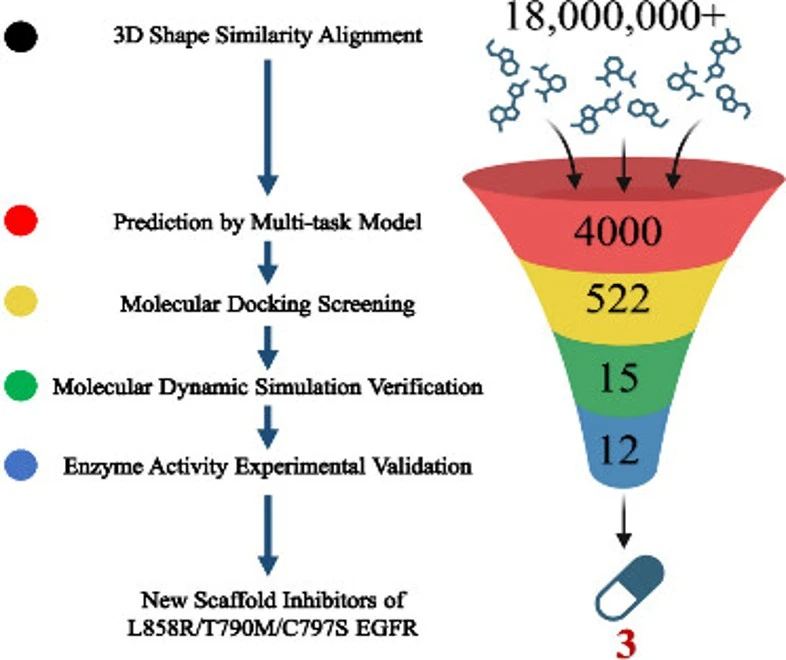
Figure 1. Schematic diagram of the multilevel virtual screening process. (Sun Z, et al., 2025)
Reference
- Sun Z, Li Y, Liu J, et al. Accelerating Scaffold Hopping in Fourth-Generation Epidermal Growth Factor Receptor Inhibitors via Multilevel Virtual Screening. ACS Med Chem Lett. 2025 Sep 30;16(10):1927-1934.
Need to escape a patent block or rescue a scaffold-locked series? Our team can design a scaffold hopping campaign tailored to your reference compound, target, and IP constraints. Contact our scientific team today to start your project.