Reverse Docking & Target Fishing
 Proteome-Wide Reverse Docking
  Ligand-Based Target Fishing
  Polypharmacology & Off-Target Profiling
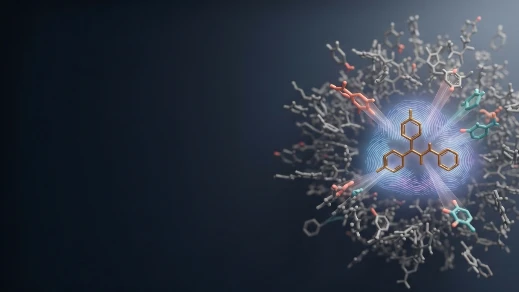
 You have a compound with activity—now you need the target. Reverse docking screens your molecule against thousands of protein structures to prioritize binding partners, while ligand-based target fishing extracts target hypotheses from chemical similarity networks.
Why Reverse Docking & Target Fishing Is the Critical Bridge Between Phenotype and Target?
Phenotypic screening delivers hits without mechanisms, stalling investor conversations for biotechs and surfacing late-stage toxicity or missed repurposing opportunities for pharma. Traditional target identification—affinity chromatography, mass spectrometry—is low-throughput and protein-centric. Reverse docking inverts the paradigm: one ligand screened against thousands of AlphaFold-enabled protein structures, transforming orphan compounds into target-backed assets with experimental validation.
What Sets the Platform Apart
AlphaFold-Enabled Structural Proteomics
Thousands of human protein structures predicted by AlphaFold Protein Structure Prediction and refined by All-Atom Protein MD Simulation populate the target library. Binding pockets identified by Binding Pocket & Druggability Analysis.
Consensus Reverse Docking
Multiple docking engines (Glide, Vina, AutoDock) score the same ligand across the proteome. Consensus ranking mitigates inter-target scoring noise—a known failure mode of single-engine reverse docking.
Wet-Lab Target Validation
Top predicted targets are validated by MagHelix™ Surface Plasmon Resonance (SPR), MagHelix™ Bio-layer Interferometry (BLI), or cellular thermal shift assay (CETSA). Computational hypothesis becomes experimental fact.
The Reverse Docking & Target Fishing Suite
Reverse Docking
Structure-Based Proteome-Wide Target Prediction
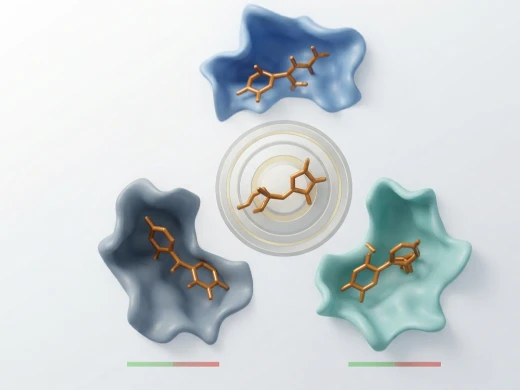
- AlphaFold Target Library — A curated database of 5,000+ human protein structures with predicted binding pockets, refined by All-Atom Protein MD Simulation for conformational stability.
- Multi-Engine Consensus Scoring — The query compound is docked against every target using Glide, Vina, and AutoDock; scores are normalized and ranked to reduce inter-protein scoring bias.
- Ideal For — Drug repurposing; off-target prediction; mechanism-of-action elucidation for phenotypic screening hits.
For virtual biotechs with a single active compound from a cell-based assay, reverse docking delivers a ranked target hypothesis list in days—guiding the next round of Hit Biophysical Characterization or CRISPR validation without proteomics infrastructure. For pharma teams, profiling a lead candidate against the human structural proteome identifies safety liabilities before GLP tox.
Ligand-Based Target Fishing
Chemical Similarity Network Analysis
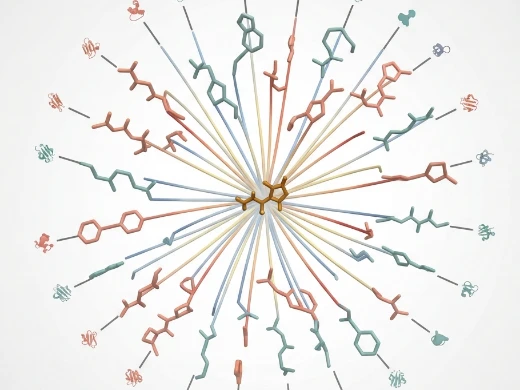
- 2D/3D Fingerprint Matching — The query compound is compared against ChEMBL and internal bioactivity databases using ECFP, pharmacophore, and shape descriptors to identify target associations.
- SwissTargetPrediction-Style Integration — Combined 2D Tanimoto and 3D Electroshape scoring with logistic regression models trained on known ligand-target pairs.
- Ideal For — Natural product target deconvolution; metabolite target identification; targets without crystal structures.
When structural data is scarce, ligand-based fishing leverages the principle that similar ligands bind similar targets. For biotechs exploring traditional medicine or microbiome metabolites, this provides target hypotheses even for compounds that defy crystallization. When combined with Ligand-Based Virtual Screening (LBVS), it builds a target interaction network around the query molecule.
Polypharmacology Profiling
Multi-Target Interaction Mapping
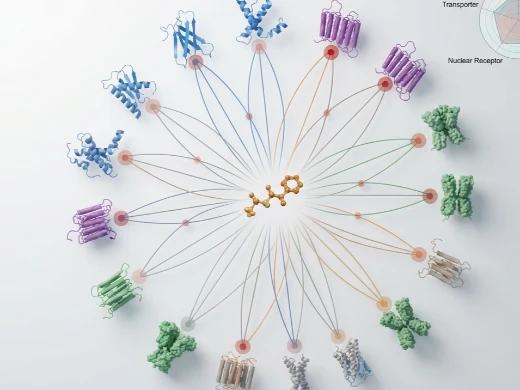
- Target Panel Construction — Disease-relevant or adverse-event-associated protein panels are assembled from DrugBank, ChEMBL, and KEGG.
- Off-Target Risk Scoring — Kinase family panels, GPCR subsets, and ion channel libraries are screened to flag promiscuity or selectivity issues.
- Ideal For — Safety pharmacology; drug repurposing; combination therapy design; ADMET Prediction & Modeling integration.
Most drugs bind more than one target. Polypharmacology profiling turns this from a liability into intelligence. For biotechs developing kinase inhibitors, screening against the full kinome identifies both therapeutic targets and hematological safety risks. For pharma teams, it reveals repurposing opportunities—unexpected target engagements that explain clinical observations.
Platform Instrumentation
| Software / System | Core Capability |
|---|---|
| HelixFold3 | End-to-end reverse screening unifying protein folding and ligand docking into a single predictive framework; outperforms step-wise reverse docking. |
| AutoDock Vina + Glide + GOLD | Multi-engine reverse docking with consensus scoring and normalized rank aggregation across diverse protein targets. |
| AlphaFold Protein Structure Database | 5,000+ predicted human protein structures with pLDDT confidence filtering for docking-grade model selection. |
| GROMACS 2023 + AMBER 22 | All-Atom Protein MD Simulation for target structure refinement and pocket stability validation before docking. |
| RDKit + ChEMBL API | ECFP fingerprint generation, 2D/3D similarity calculation, and bioactivity database querying for ligand-based target fishing. |
| SwissTargetPrediction-style ML | Combined 2D/3D similarity logistic regression models for target probability scoring. |
| NVIDIA A100 GPU Cluster | Parallelized proteome-wide docking and HelixFold3 inference on thousands of targets. |
| PyMOL + Maestro | Reverse docking pose inspection, pocket comparison, and target family interaction analysis. |
Standardized Workflow
Project Workflow
A standardized, milestone-driven execution system. From active compound to validated target—managed by a single project team, tracked in real time.


01 Compound Review & Target Library Assembly
- Compound structure and activity context review.
- Target library selection: full proteome, kinome, or custom disease panel.
- AlphaFold Protein Structure Prediction quality filtering and pocket identification.
Deliverable: Target library coverage report + compound profile.
02 Reverse Docking / Fishing Execution
- Reverse docking against AlphaFold structural proteome.
- Ligand-based fishing against ChEMBL and internal databases.
- Polypharmacology panel screening (if applicable).
Deliverable: Raw docking scores and similarity rankings.
03 Target Prioritization & Consensus Ranking
- Multi-engine score normalization and rank aggregation.
- Target family clustering and druggability assessment.
- Off-target risk flagging and selectivity index calculation.
Deliverable: Prioritized target list with confidence scores.
04 Wet-Lab Validation Design
- Validation assay design: SPR, BLI, or CETSA.
- Binding Free Energy Calculation (FEP/TI, MM/PBSA) for top target-ligand pairs.
- Molecular Dynamics (MD) Simulations for complex stability.
Deliverable: Validation plan + stability metrics.
05 Report & Handoff
- Comprehensive target hypothesis report.
- Mechanism-of-action narrative and repurposing recommendations.
- Direct handoff to Hit Biophysical Characterization or biology team.
Deliverable: Final report + data package + transition plan to Hit to Lead or safety assessment.
Sample Requirements
| Requirement | Details |
|---|---|
| Query compound | SMILES/SDF; source (natural product, synthetic, approved drug, metabolite) |
| Activity context | Cell-based assay results, phenotypic endpoint, or clinical observation |
| Target library scope | Full human proteome, kinome, GPCRome, or custom disease panel |
| Prior target knowledge | Any suspected targets or known target families to include/exclude |
| Validation preference | SPR, BLI, CETSA, or cellular target engagement assay |
Standard Deliverables
- Ranked target hypothesis list (top 20–50) with docking scores and confidence metrics
- Ligand-based target fishing similarity table with ChEMBL bioactivity cross-references
- Polypharmacology risk profile with off-target family annotations
- Top target-ligand complex models with interaction fingerprints
- Validation assay recommendations and experimental design
- Electronic data package formatted for Hit Biophysical Characterization or biology team handoff
Frequently Asked Questions
Case Study
Case Study: HelixFold3 End-to-End Reverse Screening — From Sequence to Target in a Single Framework
Published Evidence:
Zhang S, et al. End-to-End Reverse Screening Identifies Protein Targets of Small Molecules Using HelixFold3. arXiv preprint. 2025;arXiv:2601.13693.
Key Findings:
- Unified Framework: HelixFold3 simultaneously models protein folding from sequence and ligand docking within a single end-to-end process, eliminating error propagation across decoupled steps (structure prediction → pocket identification → docking → scoring).
- Benchmark Performance: Tested on ~100 ligands against ~1,000 human proteins. Achieved 38.0% Top-1% success rate—several-fold improvement over conventional step-wise reverse docking even when baselines used crystal structures.
- Off-Target Prediction: For Ibrutinib, identified the on-target BTK (ipTM rank 2/436) and achieved 100% Top-10 success rate for bleeding-related off-targets (TEC, TXK, BLK, ITK) by recognizing Tec-family kinase active-site conservation.
From Orphan Compound to Target-Backed Asset:
For seed-stage biotechs with phenotypic hits but no target, this paradigm demonstrates that end-to-end reverse screening—combining structure prediction and ligand docking in a single AI framework—delivers target hypotheses with structural fidelity that step-wise methods cannot match. For pharma teams, the off-target prediction accuracy for kinase families validates the platform as a pre-clinical safety tool. Our platform operationalizes this peer-reviewed architecture within an audit-ready workflow, pairing HelixFold3-style end-to-end modeling with All-Atom Protein MD Simulation refinement and MagHelix™ Surface Plasmon Resonance (SPR) validation to ensure computational targets withstand experimental scrutiny.
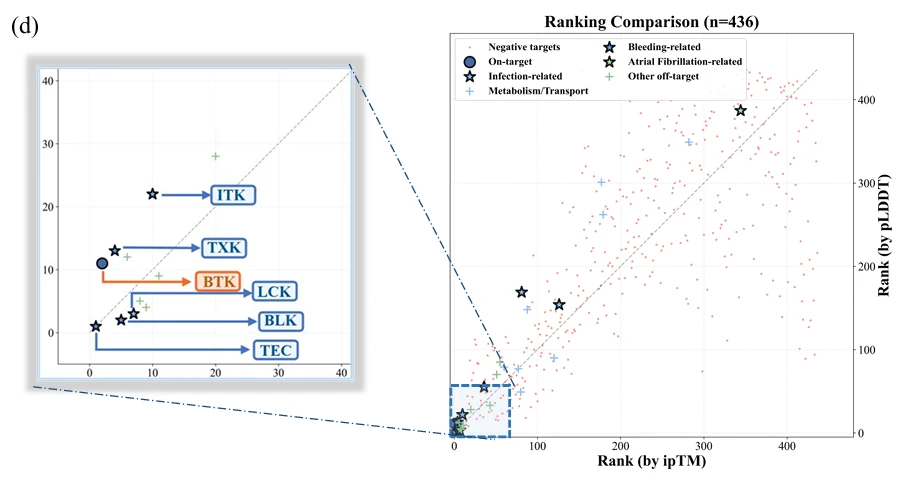
Figure 1. Case studies for reverse screening: ranking comparison between ipTM and pLDDT metrics. (Zhang S, et al. 2025)
Reference
- Zhang S, et al. End-to-End Reverse Screening Identifies Protein Targets of Small Molecules Using HelixFold3. arXiv preprint. 2025;arXiv:2601.13693.
Need to identify the target of your bioactive compound? Our team can design a reverse docking or target fishing campaign tailored to your compound class, activity profile, and validation needs. Contact our scientific team today to start your project.