AI-Enhanced Virtual Screening
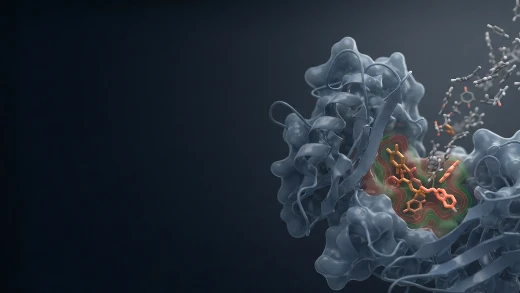
 GNN-Based Pre-Screening
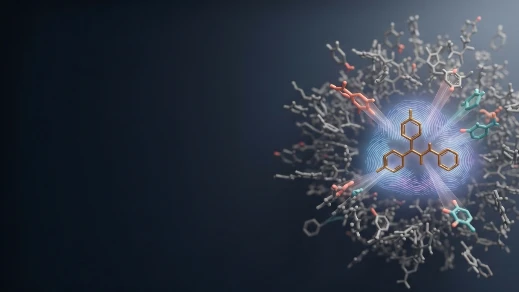
  Multitask Activity Prediction
  AI-Driven Consensus Ranking
 Traditional docking evaluates every compound individually. Our AI layer pre-scores billion-compound libraries in hours, surfacing high-probability hits before docking investment.
Why AI-Enhanced Virtual Screening Is the Critical Bridge Between Scale and Speed?
Brute-force docking of a billion-compound library takes months. For seed-stage biotechs, that timeline consumes runway before a single compound is synthesized. For pharma teams, it ties up HPC resources and delays portfolio decisions. AI-enhanced virtual screening replaces exhaustive energy evaluation with learned binding patterns—graph neural networks encode molecular topology, multitask models predict target engagement, and consensus algorithms rank candidates by confidence. The result is a 100–1000× speedup without sacrificing the enrichment quality that experimental teams depend on.
What Sets the Platform Apart
GNN Embedding Pre-Screening
Graph neural networks encode molecular topology and protein context into embedding space. Similarity search in embedding space reduces billion-compound libraries to manageable subsets in hours.
Multitask Activity Prediction
Multitask deep neural networks trained on cross-target datasets predict activity for novel scaffolds with limited target-specific data. Extrapolation validated on internal benchmarks.
AI-Driven Consensus Ranking
GNN scores, multitask predictions, and physics-based docking scores are fused into a unified ranking. ADMET Prediction & Modeling filters liabilities before synthesis.
The AI-Enhanced Virtual Screening Suite
GNN-Based Pre-Screening
Graph Neural Network Ligand Prioritization
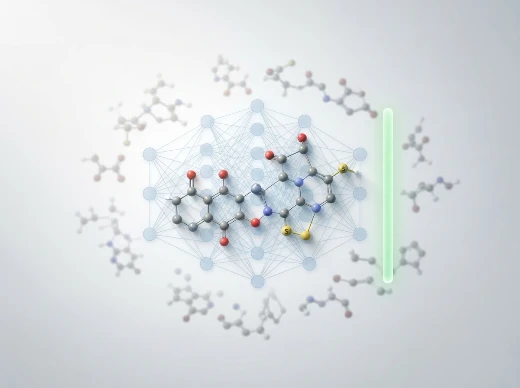
- Molecular Graph Encoding — SMILES strings transformed into molecular graphs optimized for GNN models, encoding descriptors such as molecular weight, fingerprints, and topological features.
- Embedding Space Similarity Search — Compounds ranked by graph embedding similarity to known actives, enabling sublinear scaling with library size.
- Ideal For — Billion-compound library triage; Hit Identification acceleration; ultra-large make-on-demand catalogs.
For virtual biotechs without HPC infrastructure, GNN pre-screening identifies high-probability candidates from billion-compound libraries on cloud GPU instances in hours. For pharma teams, embedding-based filtering reduces downstream Protein-Ligand Docking (Rigid / Flexible / Induced Fit Docking) workloads by 2–3 orders of magnitude.
Multitask Activity Prediction
Cross-Target Deep Learning for Data-Scarce Targets
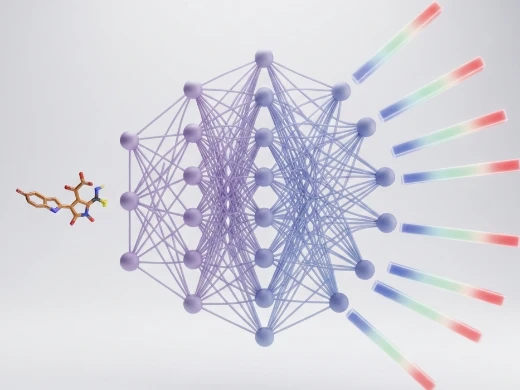
- Shared Representation Learning — Multitask neural networks trained on diverse target families learn transferable binding features, enabling prediction for targets with <100 known actives.
- Extrapolation Validation — Models evaluated on scaffold-out and target-family-out benchmarks to ensure generalization beyond training chemical space.
- Ideal For — Novel targets with limited SAR; De Novo Drug Design seeding; resistance-mutation profiling.
Data scarcity kills ML models. For biotechs pioneering first-in-class targets, multitask learning leverages cross-target patterns to predict activity where single-target models fail. When combined with Pharmacophore Modeling & Screening, this delivers ranked hit lists with mechanistic interpretability.
AI-Driven Consensus Ranking
Fusing Neural and Physics-Based Scores
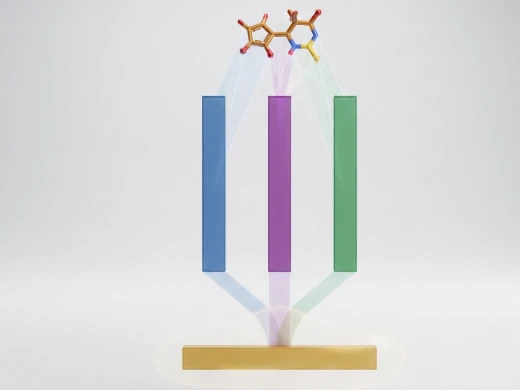
- Score Fusion Architecture — GNN embedding similarity, multitask activity probability, and docking score combined via learned weighting calibrated on enrichment benchmarks.
- Uncertainty Quantification — Prediction variance reported per compound, flagging high-confidence hits versus exploratory borderline candidates.
- Ideal For — Final candidate prioritization before synthesis; Lead Optimization series selection; portfolio resource allocation.
No single score captures binding. Our consensus architecture weights neural predictions by their target-specific accuracy, physics-based scores by pocket confidence, and ADMET Prediction & Modeling filters by developability—delivering a single ranked list that balances potency, novelty, and tractability.
Platform Instrumentation
| Software / System | Core Capability |
|---|---|
| VirtuDockDL | GNN-based ligand prioritization and descriptor analysis with automated virtual screening pipeline. |
| DeepChem | Open-source deep learning for drug discovery with CNN, GNN, and multitask model implementations. |
| GNINA 1.0 | CNN-enhanced docking with GPU acceleration for pose prediction and affinity estimation. |
| AutoDock Vina 1.2.0 | Ultra-large library docking with batch-mode execution and flexible side-chain sampling. |
| RDKit + scikit-learn | Molecular graph construction, fingerprint generation, and custom ML pipeline development. |
| PyTorch / TensorFlow | Deep learning framework for GNN and multitask neural network training and inference. |
| NVIDIA A100 GPU Cluster | Parallelized GNN embedding generation and billion-compound similarity search. |
| PyMOL + Maestro | Hit visualization, embedding space inspection, and interaction analysis. |
Standardized Workflow
Project Workflow
A standardized, milestone-driven execution system. From compound library to AI-ranked, validated hit list—managed by a single computational project team, tracked in real time.


01 Library Review & Target Profiling
- - Compound library selection: Enamine, ChEMBL, ZINC, or custom.
- - Target structure review: PDB, AlphaFold, or Homology Modeling & Threading.
- - Known actives and decoys for model calibration.
Deliverable: Library coverage report + target profile.
02 AI Model Selection & Calibration
- - Model selection: GNN embedding, multitask DNN, or hybrid consensus.
- - Retrospective benchmarking against known actives (ROC-AUC, EF1%).
- - Calibration with target-specific experimental data.
Deliverable: Model benchmark report + calibration metrics.
03 GNN Pre-Screening Execution
- - Molecular graph generation and embedding computation.
- - Embedding space similarity search and subset extraction.
- - Library size reduction: billion to 10,000–100,000 candidates.
Deliverable: Filtered subset with GNN similarity scores.
04 Multitask Prediction & Consensus Ranking
- - Multitask activity prediction and docking rescoring.
- - Consensus score fusion and uncertainty quantification.
- - ADMET Prediction & Modeling filtering and liability flagging.
Deliverable: Consensus-ranked list with uncertainty estimates.
05 Report & Handoff
- - Final AI-ranked hit list with confidence intervals.
- - Enrichment metrics and synthetic priority recommendations.
- - Direct handoff to Hit Biophysical Characterization or Co-crystallization and Soaking if contracted.
Deliverable: Final report + data package + transition plan to Hit to Lead or Lead Optimization.
Sample Requirements
| Requirement | Details |
|---|---|
| Compound library | Enamine REAL, ChEMBL, ZINC, or custom corporate library; specify preferred vendor |
| Target structure | PDB ID, AlphaFold model, or Homology Modeling & Threading; specify binding site |
| Known actives | 5–50+ confirmed actives for GNN embedding anchor and model calibration |
| Known decoys | Inactive compounds or property-matched decoys for benchmark validation |
| Project scope | Hit identification, lead optimization, or scaffold-hopping |
| Prior data | Any existing SAR, docking, or ADMET flags to guide model selection |
Standard Deliverables
- AI-enhanced ranked compound list (top 1,000–10,000) with GNN embedding similarity scores
- Multitask deep learning activity prediction table with probability estimates
- Retrospective enrichment benchmarking report (ROC-AUC, EF1%, EF5%)
- Consensus ranking table with uncertainty quantification
- Top-hit Protein-Ligand Docking (Rigid / Flexible / Induced Fit Docking) poses and interaction fingerprints (if contracted)
- Electronic data package formatted for Structure-Based Virtual Screening (SBVS) or Ligand-Based Virtual Screening (LBVS) handoff
Frequently Asked Questions
Case Study
Case Study: VirtuDockDL — GNN Pipeline for Accelerated Virtual Screening
Published Evidence:
Noor F, et al. Deep learning pipeline for accelerating virtual screening in drug discovery. Sci Rep. 2024 Nov 16;14(1):28321.
Key Findings:
- GNN-Based Ligand Prioritization: Molecular graphs constructed from SMILES strings encode topological and descriptor features for Graph Neural Network analysis, enabling automated compound prioritization.
- Benchmark Performance: 99% accuracy, F1 score of 0.992, and AUC of 0.99 on the HER2 dataset—surpassing DeepChem (89%) and AutoDock Vina (82%).
- Validation on Diverse Targets: Successfully applied to Marburg virus VP35 protein, HER2 (cancer), TEM-1 beta-lactamase (bacterial infections), and CYP51 (fungal infections).
- Integrated Workflow: Combines molecular graph construction, GNN modeling, virtual screening, compound clustering, and AutoDock Vina docking into a unified Python-based platform.
Closing the Loop from Algorithm to Assay:
For seed-stage biotechs, VirtuDockDL demonstrates that a single GNN pipeline can replace months of brute-force docking with hours of embedding-based pre-screening—preserving runway while generating validated hit lists. For pharma teams, the integration of GNN prioritization with traditional docking validation offers a scalable path to billion-compound campaigns without proportional HPC cost inflation. Our platform operationalizes this peer-reviewed architecture within an audit-ready workflow, pairing GNN embedding generation with multitask activity prediction and Binding Free Energy Calculation (FEP/TI, MM/PBSA) to ensure AI-surfaced candidates withstand experimental scrutiny.
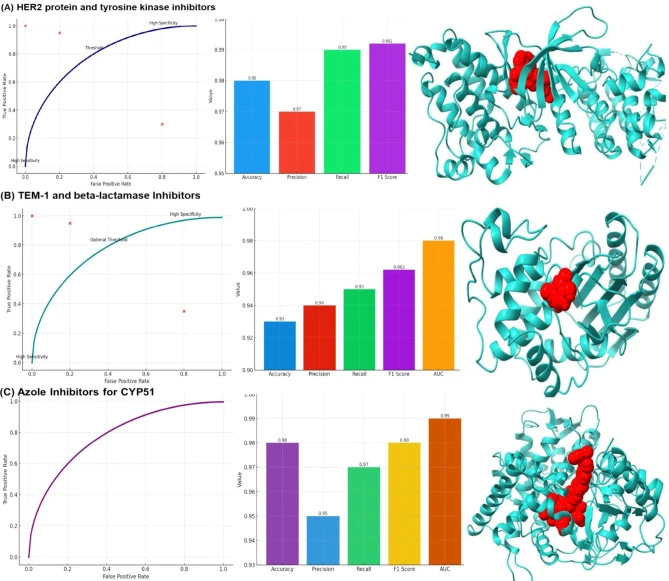
Figure 1. Predictive model performance and binding analysis for (A) HER2 tyrosine kinase, (B) TEM-1 β-lactamase, and (C) CYP51 azole inhibitors, showing ROC curves, metrics, and Discovery Studio docking visualizations. (Noor F, et al. 2024)
Reference
- Noor F, et al. Deep learning pipeline for accelerating virtual screening in drug discovery. Sci Rep. 2024 Nov 16;14(1):28321.
Need AI-enhanced virtual screening to accelerate your hit identification timeline? Our team can design a screening campaign tailored to your target, compound library, and computational budget. Contact our scientific team today to start your project.