P-gp Substrate Prediction
 Graph Convolutional Networks
  Multimodal Transporter Learning
  Caco-2/BBB Validation
 P-gp evicts over 50% of CNS drug candidates from the brain and drives multidrug resistance in oncology. Our platform deploys graph convolutional networks to predict substrate affinity and inhibition—validated through Caco-2 assays and BBB exposure quantification.
Why P-gp Prediction Is the Critical Gate for CNS and Oncology Programs?
A seed-stage biotech targeting Alzheimer's needs confidence its compound will cross the blood-brain barrier, not be effluxed back into plasma. A pharma team advancing an oncology portfolio must know whether P-gp overexpression will neutralize its therapeutic in resistant tumors. Traditional rule-based alerts catch known substrates but miss novel chemotypes. Our GCN models learn from molecular topology and transporter sequence jointly, identifying efflux liabilities invisible to static descriptors—delivering BBB penetration forecasts and MDR risk assessments with quantified confidence.
What Sets the Efflux Platform Apart
Graph Convolutional Networks
GCNs process molecular graphs with integrated gradients attribution, achieving >0.85 CCR on substrate prediction and highlighting substructures driving efflux recognition.
Multimodal Transporter Learning
Multi-task learning combines compound molecular graphs with MDR1/BCRP amino acid sequences, capturing transporter-specific binding determinants beyond ligand-only models.
Caco-2/BBB Validation Loop
Predictions proceed to Caco-2 bidirectional permeability assays and Kp,uu,brain measurement for BBB exposure validation, closing the computational-experimental loop.
The P-gp Substrate Prediction Suite
Substrate Prediction & BBB Exposure Assessment
Forecast Brain Penetration from Structure
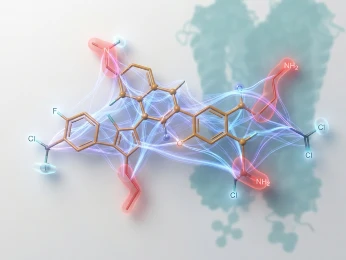
- GCN Substrate Classification — Graph convolutional networks predict P-gp substrate probability with integrated gradients highlighting primary amines, flexible chains, and ring systems as efflux drivers.
- Brain Exposure Scoring — Combined P-gp/BCRP substrate prediction with physicochemical properties (TPSA, HBD) generates a composite brain exposure score correlating with measured Kp,uu,brain.
- Ideal For — CNS program triage, Alzheimer's and Parkinson's drug design, and ADMET Prediction & Modeling integration.
For virtual biotechs without transporter infrastructure, substrate prediction eliminates costly Caco-2 screening of obvious efflux liabilities. For pharma, brain exposure scoring guides dose optimization and formulation strategy for CNS indications.
Inhibition Prediction & DDI Risk Assessment
Quantify P-gp Perpetrator Potential
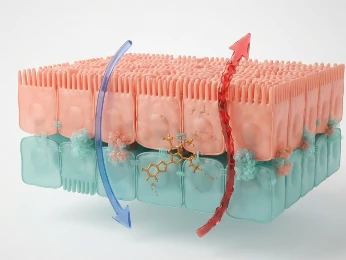
- Inhibitor Classification — Deep neural network and XGBoost ensemble models predict P-gp inhibition with CCR >0.80, identifying hydrophobic substructures and multiple H-bond donors/acceptors as binding drivers.
- Co-Medication Risk Matrix — Perpetrator-victim interaction scoring against P-gp dependent drugs (digoxin, paclitaxel, HIV protease inhibitors) with clinical relevance thresholds.
- Ideal For — Regulatory DDI assessment, oncology combination therapy design, and Lead Optimization stage compound selection.
When combined with P450 Enzyme Substrate/Inhibitor Prediction, inhibition predictions enable full transporter-enzyme DDI risk assessment for complex polypharmacy scenarios.
Multidrug Resistance & Tumor Efficacy Forecasting
Predict Chemotherapy Failure from Efflux Liability
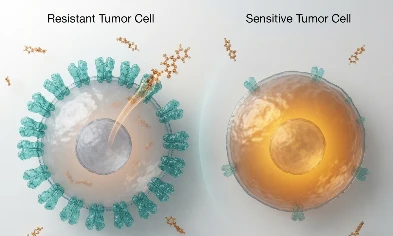
- MDR1 Overexpression Sensitivity — P-gp substrate probability correlates with intracellular accumulation in resistant cell lines, forecasting efficacy loss in MDR1-high tumors.
- Resistance Reversal Strategy — Identification of P-gp inhibitor co-administration opportunities or structural modifications to evade efflux (reducing molecular weight, increasing polarity).
- Ideal For — Oncology program risk assessment, combination therapy design, and Molecular Dynamics (MD) Simulations of transporter-ligand binding dynamics.
For oncology teams, MDR forecasting transforms P-gp prediction from a liability filter into a strategic tool for resistance management and combination therapy design.
Platform Instrumentation
| Software / System | Core Capability |
|---|---|
| PyTorch Geometric / DGL | Graph convolutional network training and molecular graph embedding for transporter interaction prediction. |
| GCN + Integrated Gradients | Substructure attribution for P-gp efflux driver identification using Captum interpretability framework. |
| Multimodal DNN | Combined molecular graph and transporter sequence encoding for MDR1/BCRP activity prediction. |
| Caco-2 Cell System | Bidirectional permeability assay (A→B/B→A) with efflux ratio determination for substrate validation. |
| MDCK-MDR1 Monolayer | Polarized cell line overexpressing human MDR1 for net efflux ratio quantification. |
| LC-MS/MS Quantification | Parent compound and metabolite measurement in apical and basolateral compartments. |
| CDD Vault / Dotmatics | ELN-integrated data management and handoff to ADMET Prediction & Modeling. |
Standardized Workflow
Project Workflow
A standardized, milestone-driven execution system. From compound structure ingestion to Caco-2 validation and handoff—managed by a single computational project team, tracked in real time.


01 Data Ingestion & Curation
- Receive compound structures (SMILES/SDF). Standardize and query curated P-gp/BCRP datasets.
Deliverable: Curated dataset + chemical space assessment.
02 GCN Training & Multimodal Learning
- Train GCN on molecular graphs. Deploy multimodal learning with MDR1/BCRP sequences.
Deliverable: Trained GCN with integrated gradients interpretability.
03 Substrate/Inhibitor Classification
- Predict substrate and inhibitor classification with confidence scores. Apply integrated gradients for substructure analysis.
Deliverable: Substrate/inhibitor predictions with substructure rationale.
04 Brain Exposure & MDR Analysis
- Generate brain exposure score and MDR risk forecast. Design resistance reversal strategies.
Deliverable: Brain exposure score + MDR risk assessment + reversal proposals.
05 Caco-2 Validation & Handoff
- Validate via Caco-2 or MDCK-MDR1 bidirectional assay. Determine efflux ratio and Kp,uu,brain correlation.
Deliverable: Validation data + transition to Lead Optimization or ADMET Prediction & Modeling.
Sample Requirements
| Requirement | Details |
|---|---|
| Compound structures | SMILES or SDF format; 1–10,000+ compounds accepted |
| Known transporter data | Internal Caco-2 efflux ratio or MDR1 inhibition values for model calibration (optional) |
| Indication context | CNS (BBB penetration), oncology (MDR), or general absorption/distribution |
| Project scope | Early triage, lead optimization support, or regulatory DDI submission |
| Prior data | Any P450 or ADMET flags for polypharmacy risk |
Standard Deliverables
- P-gp substrate and inhibitor probability scores with GCN confidence intervals
- Integrated gradients substructure attribution maps highlighting efflux drivers
- Brain exposure score correlating with predicted Kp,uu,brain
- MDR risk forecast for oncology programs with resistance reversal strategies
- DDI perpetrator-victim risk matrix against P-gp dependent co-medications
- Electronic data package for ADMET Prediction & Modeling integration
- Direct handoff to Caco-2/MDCK-MDR1 validation, Molecular Dynamics (MD) Simulations, or Lead Optimization
Frequently Asked Questions
Case Study
Case Study: Machine Learning Modeling for ABC Transporter Efflux and Inhibition
Published Evidence:
Zhu H, et al. Machine learning modeling for ABC transporter efflux and inhibition: data curation, model development, and new compound interaction predictions. Mol Pharmaceutics. 2025.
Key Findings:
- Curated contemporary datasets for P-gp, BCRP, MRP1, and MRP2 produced 104 QSAR models (DNN, RF, SVM, XGB) with CCR ranging from 0.685 to 0.935 across substrate and inhibition endpoints.
- P-gp substrate predictions were driven by polar functional groups, tertiary amines, and flexible chains—aligning with known pharmacophore requirements. Inhibitor predictions linked to hydrophobic substructures and multiple H-bond donors/acceptors.
- Brain exposure evaluation revealed compounds with low Kp,uu,brain (<0.1) were twice as likely to be predicted as P-gp/BCRP substrates than high-exposure compounds. Loperamide and methotrexate—known P-gp substrates with poor CNS penetration—were correctly identified.
Industrial Translation:
The University of North Carolina team demonstrates that contemporary ML models trained on curated datasets reliably predict ABC transporter interactions and correlate with brain exposure outcomes. For seed-stage biotechs, this eliminates costly Caco-2 screening of obvious efflux liabilities. For pharma teams, the brain exposure scoring framework provides a quantitative bridge between in silico prediction and in vivo CNS penetration, accelerating CNS program decisions. Our platform operationalizes this peer-reviewed paradigm by integrating GCN predictions with Caco-2/MDCK-MDR1 validation and Molecular Dynamics (MD) Simulations, delivering transporter-ready compound profiles from design to development.
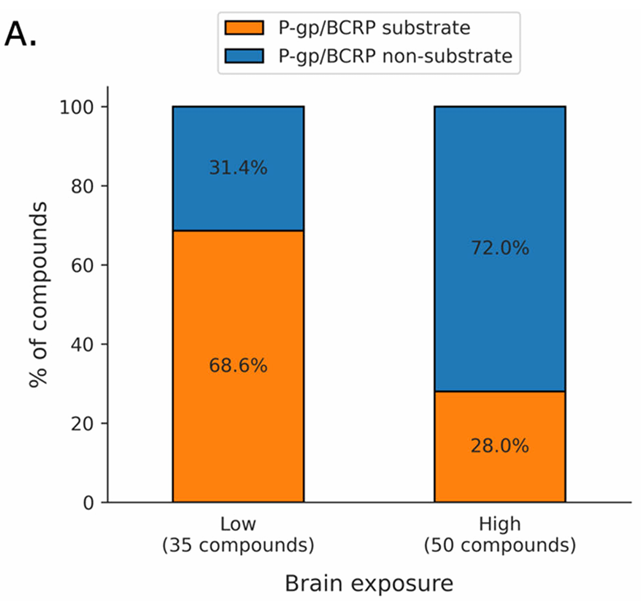
Figure 1. Comparison of P-gp/BCRP substrate and nonsubstrate predictions across the 85 compounds with high (Kp,uu,brain ≥ 0.1) and low (Kp,uu,brain < 0.1) brain exposure. (Zhu H, et al. 2025)
Reference
- Zhu H, et al. Machine learning modeling for ABC transporter efflux and inhibition: data curation, model development, and new compound interaction predictions. Mol Pharmaceutics. 2025.
Need AI-enhanced P-gp substrate prediction to optimize your CNS penetration or oncology efficacy? Our team can design a customized efflux transporter assessment pipeline tailored to your indication, chemical series, and regulatory milestones. Contact our scientific team today.