Microsomal Stability Prediction
 Graph Contrastive Learning
  Interspecies Difference Modeling
  HLM/MLM Validation
 Metabolic liability discovered post-synthesis kills programs. Our platform deploys graph contrastive learning trained on cross-species liver microsome data to predict human and mouse metabolic stability—validated through LC-MS/MS quantified HLM and MLM assays.
Why Microsomal Stability Prediction Is the Critical Gate for PK-Driven Design?
A seed-stage biotech advancing an oral kinase inhibitor needs confidence that hepatic clearance will not exceed portal blood flow. A pharma team optimizing a CNS compound must ensure metabolic stability sufficient for BBB penetration. Traditional QSAR models predict stability from fixed descriptors but miss the bond-level structural features that CYP enzymes actually attack. Our GCL-based models learn from molecular topology itself, identifying metabolic soft spots—O-demethylation sites, benzylic carbons, unhindered ethers—while highlighting stabilizing features like fluorine substitution and amide linkages. Predictions are refined through interspecies difference learning, delivering human-relevant clearance forecasts with quantified uncertainty.
What Sets the Stability Platform Apart
Graph Contrastive Learning
GNNs pretrained on 2.58M unlabeled molecules via graph contrastive learning capture bond-level features invisible to descriptor-based models. RMSE <28% on human liver microsome stability.
Interspecies Difference Modeling
Multi-task learning of human-mouse stability differences accounts for species-specific enzymatic landscapes, improving prediction accuracy for compounds with large interspecies divergence.
HLM/MLM Validation Loop
Predictions proceed to LC-MS/MS quantified HLM and MLM assays for t½ and CLint determination, with results feeding back into model refinement.
The Microsomal Stability Prediction Suite
Human Liver Microsome (HLM) Stability Prediction
Forecast Human Hepatic Clearance from Structure

- Graph-Level Stability Scoring — Message-passing neural networks predict percentage parent remaining at 30 min, directly convertible to intrinsic clearance (CLint) and hepatic extraction ratio.
- Soft Spot Identification — Edge attention analysis highlights bonds vulnerable to CYP450 oxidation (ethers, benzylic carbons, unhindered aromatics) in red, and stabilizing features (fluorines, amides, steric hindrance) in blue.
- Ideal For — Oral bioavailability assessment, first-pass effect prediction, and ADMET Prediction & Modeling integration.
For virtual biotechs without PK infrastructure, HLM predictions guide synthesis priorities before any wet-lab investment. For pharma, soft spot maps direct medicinal chemistry toward metabolic block strategies.
Mouse Liver Microsome (MLM) Stability Prediction
Bridge Preclinical Species to Human PK
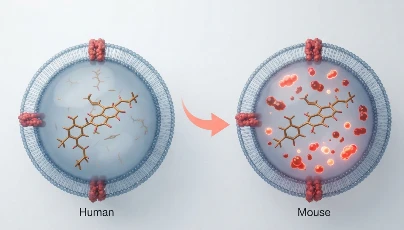
- Cross-Species Translation — MLM predictions with interspecies difference correction account for the fact that mice possess more CYP genes than humans, often metabolizing compounds faster.
- PKPD Bridging — MLM stability data informs dose selection for efficacy studies, while HLM predictions guide human dose projection via allometric scaling.
- Ideal For — Preclinical program design, IND-enabling PK package assembly, and Lead Optimization stage compound selection.
When combined with P450 Enzyme Substrate/Inhibitor Prediction, MLM/HLM predictions reveal which isoforms drive species differences—critical for translational PK strategy.
Metabolic Soft Spot Analysis & Stabilization Design
From Liability Map to Structural Solution
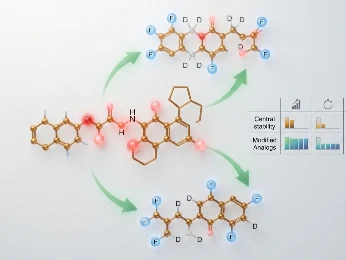
- EdgeSHAPer Analysis — Bond-centric Shapley value attribution identifies the top 10 destabilizing substructures (aromatic ethers, benzylic carbons) and top 10 stabilizing motifs (amines, fluorinated aromatics, amides).
- Structural Modification Guidance — Fluorine substitution at metabolic soft spots, deuteration of C-H bonds, and steric hindrance introduction to block CYP access.
- Ideal For — Medicinal chemistry optimization, patent strategy for metabolite coverage, and QSAR Analysis model building.
Edge attention maps transform stability prediction from a pass/fail filter into a design tool. When combined with Molecular Dynamics (MD) Simulations, soft spot predictions correlate with CYP-enzyme binding pose stability.
Platform Instrumentation
| Software / System | Core Capability |
|---|---|
| PyTorch Geometric / DGL | Graph neural network training and message passing for molecular stability prediction. |
| MetaboGNN Framework | Graph contrastive learning with interspecies difference modeling for HLM/MLM stability. |
| EdgeSHAPer | Bond-centric Shapley value attribution for metabolic soft spot identification. |
| HLM Stability Assay | NADPH-dependent human liver microsome incubation with LC-MS/MS parent quantification. |
| MLM Stability Assay | Mouse liver microsome parallel incubation for cross-species comparison. |
| LC-MS/MS System | High-resolution mass spectrometry for parent depletion kinetics and metabolite identification. |
| CDD Vault / Dotmatics | ELN-integrated data management and handoff to ADMET Prediction & Modeling. |
Standardized Workflow
Project Workflow
A standardized, milestone-driven execution system. From compound structure ingestion to HLM/MLM validation—managed by a single computational project team, tracked in real time.


01 Data Ingestion & Curation
- Receive compound structures (SMILES/SDF).
- Standardize and assess chemical space coverage against training set.
Deliverable: Curated dataset + chemical space assessment.
02 GCL Pretraining & Fine-Tuning
- Pretrain GNN on 2.58M unlabeled molecules via graph contrastive learning.
- Fine-tune on HLM/MLM stability data.
Deliverable: Fine-tuned GCL model with <28% RMSE.
03 Interspecies Difference Learning
- Deploy multi-task learning of human-mouse stability differences.
- Validate against external test sets.
Deliverable: Interspecies-adjusted stability predictions.
04 Soft Spot Analysis & Design
- Extract edge attention weights via EdgeSHAPer.
- Identify destabilizing/stabilizing substructures. Propose modifications.
Deliverable: Soft spot map + stabilization design proposals.
05 HLM/MLM Validation & Handoff
- Validate predictions via HLM/MLM LC-MS/MS assays.
- Determine t½, CLint, and extraction ratio. Handoff to Lead Optimization.
Deliverable: Validation data + PK risk assessment + transition plan.
Sample Requirements
| Requirement | Details |
|---|---|
| Compound structures | SMILES or SDF format; 1–10,000+ compounds accepted |
| Known stability data | Internal HLM/MLM t½ or CLint values for model calibration (optional) |
| Target PK profile | Desired oral bioavailability, half-life, or hepatic extraction ratio |
| Project scope | Early triage, lead optimization support, or IND-enabling PK package |
| Prior data | Any P450 or ADMET flags for metabolic pathway context |
Standard Deliverables
- HLM and MLM stability predictions (percentage remaining at 30 min) with confidence intervals
- Intrinsic clearance (CLint) and hepatic extraction ratio estimates
- Edge attention soft spot maps highlighting metabolic liabilities and stabilizing features
- Interspecies difference analysis with translational PK implications
- Structural modification proposals for metabolic stabilization
- Electronic data package for ADMET Prediction & Modeling integration
- Direct handoff to HLM/MLM LC-MS/MS validation, P450 Enzyme Substrate/Inhibitor Prediction, or Lead Optimization
Frequently Asked Questions
Case Study
Case Study: MetaboGNN — Graph Contrastive Learning with Interspecies Difference Modeling for Liver Microsomal Stability
Published Evidence:
Lee S, et al. MetaboGNN: predicting liver metabolic stability with graph neural networks and cross-species data. J Cheminform. 2025;17:89.
Key Findings:
- MetaboGNN achieved RMSE 27.91 for HLM and 27.86 for MLM, outperforming pretrained chemical language models (ChemBERTa, MolT5, MolFormer) and graph baselines (GIN, GAT, GraphSAGE).
- Interspecies difference learning reduced prediction error by 7.4% for human and 3.0% for mouse, with greatest improvement for compounds showing large HLM–MLM divergence.
- EdgeSHAPer analysis identified known metabolic soft spots (O-demethylation sites, benzylic carbons) and stabilizing features (fluorinated aromatics, amides), aligning with established medicinal chemistry strategies.
- The model achieved AUROC >0.80 and AUPRC >0.85 for binary stability classification, with Matthews correlation coefficient 0.4781—significantly higher than existing methods.
Industrial Translation:
The Seoul National University team demonstrates that graph contrastive learning with interspecies difference modeling outperforms both descriptor-based QSAR and pretrained chemical language models for microsomal stability prediction. For seed-stage biotechs, this eliminates the need for costly HLM screening of every analog. For pharma teams, the soft spot interpretability provides actionable medicinal chemistry guidance—fluorination at red-highlighted bonds, amide introduction at stabilizing positions—accelerating lead optimization cycles. Our platform operationalizes this peer-reviewed framework by integrating MetaboGNN predictions with LC-MS/MS validated HLM/MLM assays and P450 Enzyme Substrate/Inhibitor Prediction, delivering PK-ready compound profiles from design to development.
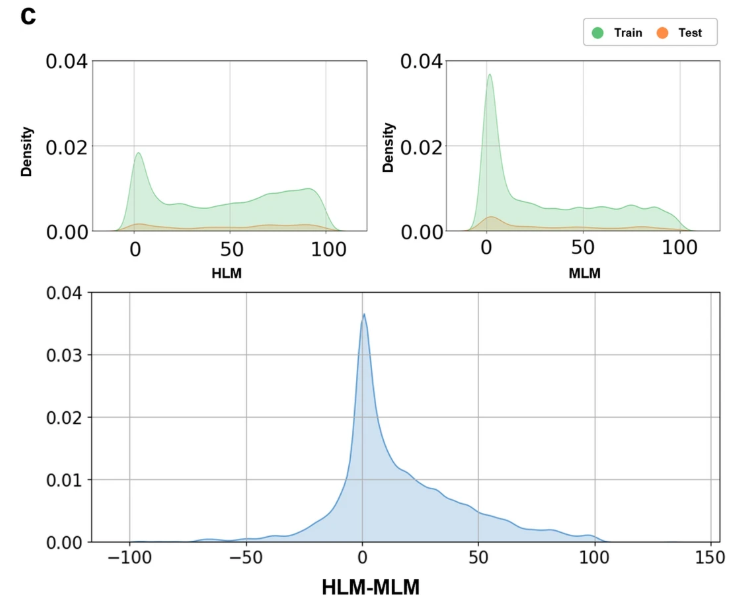
Figure 1. KDE plots of human (HLM) and mouse (MLM) liver microsomal stability distributions in training and test sets, with HLM–MLM differences highlighting interspecies metabolic variability. (Lee S, et al. 2025)
Reference
- Lee S, et al. MetaboGNN: predicting liver metabolic stability with graph neural networks and cross-species data. J Cheminform. 2025;17:89.
Need AI-enhanced microsomal stability prediction to optimize your compound's PK profile? Our team can design a customized metabolic stability assessment pipeline tailored to your target indication, route of administration, and regulatory milestones. Contact our scientific team today.