hERG Toxicity Prediction
 Graph Neural Network Scoring
  Ensemble Confidence Mapping
  Patch-Clamp Validation
 hERG blockade remains the leading cause of drug-induced QT prolongation and market withdrawal. MagHelix™ deploys graph neural networks trained on the largest public hERG datasets, combined with isometric stratified ensemble confidence mapping, to flag cardiac liabilities before a single compound is synthesized.
Why hERG Prediction Is the Critical Gate for Drug Safety?
A seed-stage biotech advancing a kinase inhibitor series cannot afford a late-stage hERG failure. A pharma team optimizing a CNS-targeting scaffold needs early confidence that peripheral cardiac risk is controlled. The MagHelix™ platform predicts hERG inhibition at the design stage using AI models benchmarked against patch-clamp and thallium flux data—delivering interpretable, confidence-scored predictions that guide medicinal chemistry away from liability before Lead Optimization investment.
What Sets the Prediction Platform Apart
Graph Neural Network Scoring
GNN models trained on 291,000+ compounds achieve AUC-ROC >0.94, operating directly on molecular graphs without manual feature engineering.
Ensemble Confidence Mapping
Isometric Stratified Ensemble (ISE) mapping stratifies predictions by consensus level and applicability domain, reducing false negatives critical for safety.
Electrophysiology Validation
Patch-clamp electrophysiology and thallium flux assays validate AI predictions, closing the computational-experimental loop.
The hERG Prediction Suite
GNN-Based Inhibition Prediction
Graph-Level Learning for Mechanistic Interpretability

- Message Passing Neural Networks — Directed MPNNs propagate atomic features across molecular graphs, capturing hERG-relevant pharmacophores (basic nitrogen, aromatic rings, lipophilicity).
- Attention Mechanism — Atom-level attention weights identify structural alerts driving hERG liability, enabling rational design of escape vectors.
- Ideal For — Early-stage Lead Optimization triage, scaffold evaluation, and ADMET Prediction & Modeling integration.
For virtual biotechs, GNN predictions flag liability before synthesis commitment. For pharma, attention maps guide medicinal chemistry toward hERG-safe analogs while preserving target potency.
Ensemble Confidence & Applicability Domain
Stratified Reliability for Safety-Critical Decisions

- XGBoost Ensemble — 29 base models trained on balanced subsets address class imbalance (29:1 non-inhibitor bias), minimizing false negatives.
- ISE Mapping — 2D stratification by consensus level and applicability domain level identifies high-confidence predictions (ACC >0.98, G-Mean >0.94).
- Ideal For — Regulatory submission support, virtual screening triage, and risk-based compound prioritization.
The ISE map provides a graphical reliability tool: compounds in CL 4–5 and ADL 0–1 strata achieve near-perfect specificity, ensuring safe compounds are not prematurely discarded.
Mechanistic Interpretation & Escape Design
From Prediction to Rational Detoxification
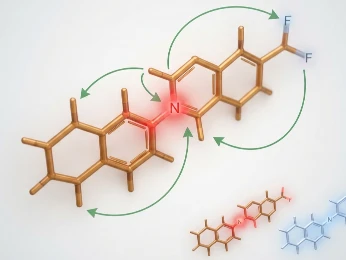
- Descriptor Importance — Recursive variable selection identifies 8 key descriptors (E-state indices, autocorrelations, basic nitrogen counts) governing hERG liability.
- Structure-Activity Insights — Protonated tertiary amines and lipophilic aromatic systems drive inhibition; polarity reduction and steric shielding attenuate risk.
- Ideal For — Medicinal chemistry guidance, patent strategy, and QSAR Analysis model refinement.
When combined with Molecular Docking Services, mechanistic insights guide the design of hERG-sparing analogs with preserved target affinity.
Platform Instrumentation
| Software / System | Core Capability |
|---|---|
| PyTorch Geometric / DGL | Graph neural network training and message passing for molecular property prediction. |
| XGBoost / Scikit-learn | Ensemble gradient boosting and recursive variable selection for hERG classification. |
| KNIME / Pipeline Pilot | Automated QSAR workflow deployment and ISE map generation. |
| Patch-Clamp System | Manual and automated whole-cell electrophysiology for hERG current validation. |
| FluxOR Thallium Flux | High-throughput fluorescence-based hERG channel functional assay. |
| Schrödinger LiveDesign | Integration of hERG predictions with ADMET Prediction & Modeling and Molecular Docking Services. |
| CDD Vault / Dotmatics | ELN-integrated data management and handoff to Hit Biophysical Characterization. |
Standardized Workflow
Project Workflow
A standardized, milestone-driven execution system. From compound structure ingestion to experimental validation and handoff—managed by a single computational project team, tracked in real time.


01 Data Ingestion & Curation
- Receive compound structures (SMILES/SDF).
- Standardize, deduplicate, and assign hERG labels from ChEMBL/PubChem or internal data.
Deliverable: Curated dataset + quality report.
02 Model Training & Validation
- Train GNN and XGBoost ensemble on curated dataset.
- Validate against external test sets (Ogura, PubChem AID 588834, Tox21).
Deliverable: Validated model with AUC-ROC >0.94.
03 Ensemble Prediction & Confidence Mapping
- Deploy ISE mapping for confidence stratification.
- Flag high-risk compounds in low-confidence strata.
Deliverable: Ranked compound list with ISE confidence scores.
04 Mechanistic Analysis & Escape Design
- Extract atom-level attention weights and descriptor importance.
- Design hERG-sparing analogs.
Deliverable: Structural rationale + escape vector proposals.
05 Experimental Validation & Handoff
- Validate predictions via patch-clamp or thallium flux.
- Handoff to Lead Optimization or ADMET Prediction & Modeling.
Deliverable: Validation report + transition plan.
Sample Requirements
| Requirement | Details |
|---|---|
| Compound structures | SMILES or SDF format; 1–10,000+ compounds accepted |
| Known hERG data | Internal IC₅₀ or % inhibition values for model calibration (optional) |
| Target class | Kinase, GPCR, ion channel, or other; desired safety margin |
| Project scope | Early triage, lead optimization support, or regulatory submission |
| Prior ADMET data | Any solubility, permeability, or metabolic stability flags |
Standard Deliverables
- hERG inhibition probability scores with GNN and ensemble confidence intervals
- ISE map stratification with applicability domain assignment
- Atom-level attention maps highlighting liability-driving structural features
- Descriptor importance analysis and mechanistic interpretation report
- hERG-sparing analog design proposals with synthetic accessibility assessment
- Electronic data package for MagHelix™ CADD Platform integration
- Direct handoff to Patch-Clamp Electrophysiology, ADMET Prediction & Modeling, or Lead Optimization
Frequently Asked Questions
Case Study
Case Study: XGBoost-ISE Ensemble for Robust hERG Toxicity Prediction
Published Evidence:
Falcón-Cano G, et al. hERG toxicity prediction in early drug discovery using extreme gradient boosting and isometric stratified ensemble mapping. Sci Rep. 2025;15:15585.
Key Findings:
- An XGBoost ensemble of 29 base models trained on balanced subsets achieved robust performance across highly imbalanced external test sets (ACC 0.90, SE 0.83, SP 0.91).
- ISE mapping stratified predictions by consensus level and applicability domain, enabling high-confidence compound selection with ACC 0.98 and G-Mean 0.94 at CL 4–5.
- Recursive variable selection reduced 4,298 descriptors to 8 interpretable variables, revealing E-state indices and basic nitrogen counts as key hERG liability drivers.
- Prospective validation on PubChem HTS and Tox21 datasets confirmed generalizability to standardized assay platforms.
Industrial Translation:
The research team demonstrates that ensemble confidence mapping transforms hERG prediction from a binary liability flag into a stratified risk assessment tool. For seed-stage biotechs, this means early triage of kinase inhibitor series without costly late-stage surprises. For pharma teams, the ISE map provides a regulatory-friendly framework for justifying compound advancement decisions. Our MagHelix™ platform operationalizes this peer-reviewed approach by integrating GNN and XGBoost-ISE predictions with Patch-Clamp Electrophysiology validation and ADMET Prediction & Modeling, delivering cardiac safety confidence from design to development.
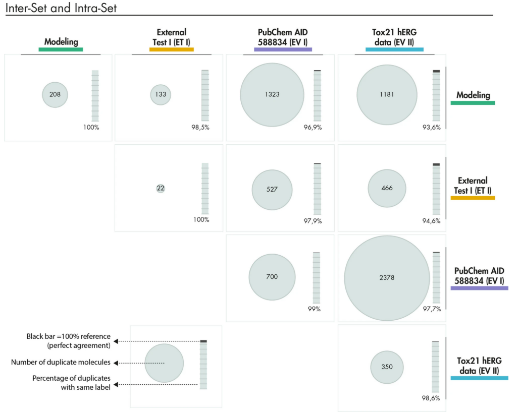
Figure 1. Inter-set and intra-set hERG classification agreement for duplicate molecules, showing diagonal intra-set consistency and upper-triangle inter-set overlap counts with label concordance percentages. (Falcón-Cano G, et al. 2025)
Reference
- Falcón-Cano G, et al. hERG toxicity prediction in early drug discovery using extreme gradient boosting and isometric stratified ensemble mapping. Sci Rep. 2025;15:15585.
Need AI-enhanced hERG toxicity prediction to de-risk your lead series? Our team can design a customized cardiac safety assessment pipeline tailored to your target class, chemical series, and regulatory milestones. Contact our scientific team today.