Zebrafish Disease Model Generation
Rodent models take 6–12 months and burn preclinical budgets before you know if your target is viable. Zebrafish offer a genetically tractable vertebrate alternative—71% human gene homology, optical transparency, and F1 validation in 8–12 weeks—but only when the genome editing is precise, the phenotyping is rigorous, and the model is delivered screening-ready. The MagHelix™ platform generates CRISPR-engineered disease models with validated phenotypic endpoints, directly integrated into our toxicity and efficacy screening pipeline. Whether you need a fast, cost-effective in vivo target validation system as a virtual biotech, or a scalable, audit-ready disease model platform as a pharma team, we deliver validated lines with the phenotypic data to support your IND-enabling decisions.
Why Zebrafish Disease Models Are the Critical Bridge Between Cells and Rodents?
Cell-based assays lack physiological relevance. Rodent models consume 6–12 months and six-figure budgets before delivering data. For seed-stage biotechs running lean, this gap kills programs before they reach the clinic. For pharma teams, it delays target validation and forces early commitment to expensive mammalian studies.
Zebrafish close this gap as a whole-organism vertebrate system with 71% human gene homology, optical transparency for intravital imaging, and embryonic development in days rather than weeks. The MagHelix™ platform does not merely inject CRISPR reagents and hand you a genotype report. We deliver screening-ready disease models: precision-edited lines, validated phenotypic endpoints, and direct integration into toxicity and efficacy workflows—so your model transitions directly into compound evaluation without vendor handoffs.
What Sets the MagHelix™ Platform Apart
Genome Editing Precision, Not Guesswork
Optimized sgRNA design with off-target prediction algorithms, high-efficiency RNP delivery into single-cell embryos, and rigorous germline transmission screening. Every null mutant is validated at both genomic (frameshift confirmation by Sanger sequencing) and protein levels (RT-qPCR / western blot). We do not deliver mosaic founders and call it a model.
Phenotypic Validation, Not Just Genotype Confirmation
Every model is delivered with a complete phenotypic dataset: survival curves, locomotor behavioral analysis, organ-specific fluorescence imaging, and neuroanatomical quantification. For neurodegeneration targets, this means motor deficit quantification. For oncology models, this means tumor burden and metastasis tracking. You receive a disease model with documented endpoints, not a fish tank.
Integrated Screening Pipeline, Not an Isolated Service
Disease model generation sits within the MagHelix™ Zebrafish Screening Platform. The same team that generates your C9orf72 knockout runs the toxicity and efficacy screens. No handoff friction. No re-establishment of husbandry conditions. One project team, one data architecture, one accountability chain.
The MagHelix™ Zebrafish Disease Model Suite
Null Mutant Generation
Precision Knockouts for Loss-of-Function Target Validation
Key Features:
- CRISPR-Cas9 RNP Delivery — Optimized sgRNA design with computational off-target prediction; high-efficiency ribonucleoprotein injection into single-cell embryos.
- Rigorous Genotype-to-Phenotype Validation — HRM analysis and Sanger sequencing confirm frameshift deletions; germline transmission screening validates heritable lines, not mosaic founders.
- Ideal For — Loss-of-function target validation; essential gene viability studies; comparative phenotyping against wild-type and heterozygous siblings.
Explore the Power of Screening-Ready Knockouts:
For virtual biotechs validating a novel target, a null mutant generated in 8–10 weeks provides in vivo evidence of target engagement and disease relevance before you commit to rodent model development. For pharma teams, our standardized phenotyping protocols deliver survival curves, behavioral endpoints, and organ-specific readouts that integrate directly into target validation and lead optimization decision gates. Every null mutant is delivered with complete genotype documentation and off-target validation sequencing—data you can defend to your CSO and your reviewers.
Custom Mutant & Patient-Variant Models
Human Disease Alleles in a Vertebrate Context
Key Features:
- Precision Knock-in via HDR — Site-directed knock-in of human patient mutations, disease-associated SNPs, or structural variants into the zebrafish ortholog using homology-directed repair templates.
- Allele-Specific Phenotyping — Comparative analysis of patient-variant lines against wild-type and null backgrounds, enabling allele-specific rescue studies and variant pathogenicity scoring.
- Ideal For — Patient-specific disease modeling; rare genetic disorder validation; variant-of-unknown-significance (VUS) functional characterization.
Why It Matters:
Patient-variant models transform zebrafish from a generic tool into a precision medicine platform. For biotechs developing allele-specific therapies, we generate the exact variant you need to test compound selectivity. For pharma teams exploring genetically defined patient subpopulations, our knock-in lines provide preclinical validation of target-disease linkage with human-relevant alleles—not just gene-level knockouts. The HDR template design and phenotypic rescue screening are managed by the same project team, ensuring variant fidelity from construct to behavior.
Transgenic Reporter Models
Real-Time In Vivo Visualization of Disease and Drug Response
Key Features:
- Tissue-Specific Fluorescent Reporters — Custom transgenic lines with tissue-specific promoters (neuronal, cardiac, vascular, hepatic) and photon-quantifiable reporters for intravital live imaging.
- Cre-lox Lineage Tracing — Inducible recombination systems for temporal control of gene expression and cell-fate tracking during disease progression or drug treatment.
- Ideal For — Real-time drug response tracking; cell-type-specific toxicity assessment; developmental toxicity and teratogenicity screening.
How It Works:
Transgenic reporters turn disease progression and drug response into observable, quantifiable light signals. For cardiotoxicity programs, cardiac-specific GFP lines reveal arrhythmia and morphogenesis defects in real time. For neurodegeneration models, neuronal reporters quantify axonal degeneration and synaptic loss without terminal sampling. These lines integrate directly into our high-content screening workflow, enabling compound evaluation at 96-well scale with sub-millimeter resolution.
In Vivo Phenotypic Validation
Standardized, Quantifiable Disease Endpoints
Key Features:
- Behavioral & Locomotor Profiling — Automated larval tracking (distance, velocity, thigmotaxis) under alternating light-dark cycles; standardized protocols for motor deficit quantification.
- Organ-Specific Imaging & Morphometrics — Fluorescence microscopy and confocal imaging for cardiac morphogenesis, vascular patterning, neuroanatomical quantification, and tumor burden assessment.
- Ideal For — Motor neuron disease validation; cardiovascular defect scoring; oncology xenograft monitoring; developmental toxicity phenotyping.
What We Offer:
Phenotypic validation is where most zebrafish CROs stop at gross morphology. We deliver standardized, statistically powered endpoint datasets: survival curves with Kaplan-Meier analysis, locomotor time-series with genotype stratification, and organ-specific morphometrics with automated image analysis. For ALS models, this means quantified motor deficits that correlate with human disease severity. For oncology programs, this means tumor volume tracking and metastasis scoring. Every dataset is delivered with full statistical documentation and QC metrics—formatted for direct inclusion in IND packages and investor data rooms.
Platform Instrumentation
| Instrument | Core Capability |
|---|---|
| Tecniplast ZEBTEC Multi-Rack System | Closed-loop recirculating aquaculture with automated water quality management. Temperature, pH, conductivity, and ammonia monitored continuously; UV sterilization and mechanical filtration maintain SPF-grade colonies. |
| Zeiss Stemi 508 + Eppendorf FemtoJet 4i | Stereomicroscope with 8:1 zoom range and LED fluorescence capability, paired with pneumatic microinjector for CRISPR RNP or transgene delivery into single-cell embryos. |
| Noldus DanioVision with EthoVision XT | Automated larval locomotor tracking chamber with controlled infrared illumination and programmable light-dark stimuli. Software quantifies distance, velocity, and movement patterning in multi-well formats. |
| Zeiss LSM 880 with Airyscan | Live-imaging confocal platform with fast Airyscan super-resolution module, temperature-controlled stage incubator, and multi-channel spectral detection for long-term embryonic observation. |
| Bio-Rad CFX384 Touch | Real-time PCR system with high-resolution melt (HRM) analysis for rapid, high-throughput mutation detection and zygosity screening in F0 mosaic and F1 founder animals. |
| Bio-Rad ChemiDoc MP + QuantStudio 5 | Chemiluminescent Western blot imaging with stain-free total protein normalization, paired with quantitative RT-PCR for knockout confirmation at the protein and transcript level. |
Standardized Workflow
Project Workflow
A standardized, milestone-driven execution system. From target gene selection to validated, screening-ready disease model delivery — managed by a single project team, tracked in real time.


01 Target Review & Model Design
- Target gene selection, human-zebrafish ortholog mapping, and disease context review.
- sgRNA / HDR template design with computational off-target analysis; delivery strategy selection (null, knock-in, or transgenic).
- Phenotypic endpoint planning: behavioral, morphological, or imaging-based readouts aligned with your downstream screening or IND goals.
Deliverable: Project proposal with Gantt-chart milestones, sgRNA design rationale, off-target risk matrix, and phenotyping protocol.
02 Genome Editing & Injection
- CRISPR-Cas9 RNP complex preparation or HDR template assembly.
- Microinjection into single-cell embryos with survival monitoring and injection efficiency tracking.
- Mosaic mutant screening at somatic level; identification of high-efficiency F0 founders for germline transmission.
Deliverable: Injection efficiency report + F0 founder identification + preliminary mosaic phenotype assessment.
03 Genotype Screening
- HRM-based high-throughput mutation detection in F0 and F1 generations.
- Sanger sequencing confirmation of frameshift deletions (null) or precise knock-in alleles (patient variants).
- Off-target site sequencing for predicted genomic loci; germline transmission rate documentation.
Deliverable: Genotype confirmation report + off-target validation data + F1 carrier identification.
04 Phenotypic Validation
- Comprehensive phenotypic characterization: survival curves, locomotor behavioral analysis, organ-specific imaging, and neuroanatomical quantification.
- Genotype-stratified analysis (+/+, +/-, -/- or patient-variant / WT / null) with statistical power calculations.
- Cross-species correlation when applicable (zebrafish phenotype vs. human clinical presentation or rodent model data).
Deliverable: Phenotypic dataset with statistical analysis + interpretive report + endpoint QC metrics.
05 Model Delivery & Handoff
- F1/F2 breeding colony establishment or cryopreserved sperm delivery as agreed.
- Complete project documentation: genotype records, phenotypic datasets, breeding protocols, and husbandry transfer instructions.
- Direct handoff to MagHelix™ Zebrafish Toxicity or Efficacy screening teams if downstream evaluation is contracted.
Deliverable: Final technical report + validated model line + electronic data package + screening transition plan (if applicable).
Sample Requirements
- Target gene: official gene symbol, species ortholog, and relevant literature or disease context
- Desired model type: null mutant, patient-variant knock-in, or transgenic reporter
- Phenotypic endpoints of interest for validation planning
- Any available patient mutation data, SNP coordinates, or structural variant information
Standard Deliverables
- Validated zebrafish mutant line(s) with genotype documentation
- Off-target validation sequencing data
- F1/F2 breeding colony or founder documentation as agreed
- Comprehensive phenotypic characterization dataset
- Interpretive validation report with study design and endpoint analysis
Frequently Asked Questions
Case Study
Case Study: CRISPR C9orf72 Knockout Model for ALS Target Validation
Goal:
Generate a stable, phenotypically validated C9orf72 knockout zebrafish model to recapitulate ALS loss-of-function pathogenesis and enable high-throughput in vivo compound rescue screening.
Key Data:
- Genotype: 2-bp frameshift deletion confirmed by Sanger sequencing; germline transmission validated in F1 generation.
- Phenotype: Significant reduction in survival and ALS-like motor deficits quantified by automated larval locomotor tracking (distance and velocity) under alternating light-dark cycles.
- Therapeutic validation: Serotonin receptor agonists (e.g., Pizotifen) significantly restored motor function, bridging invertebrate screening hits to vertebrate preclinical validation.
- Cross-species pipeline: Compounds previously identified in C. elegans screens were validated in the zebrafish model, demonstrating platform scalability from nematode to vertebrate therapeutic assessment.
Why it matters:
For ALS programs, rodent models take 12–18 months to generate and validate. This zebrafish model delivered phenotypically validated, screening-ready lines in 10 weeks, enabling compound rescue assessment at 1/10th the cost of equivalent mouse studies. For seed-stage biotechs, this timeline preserves runway while generating IND-relevant in vivo data. For pharma teams, the automated locomotor tracking and pharmacological rescue dataset provide the statistical power and mechanistic insight required for preclinical advancement decisions. The model is now integrated into our MagHelix™ Zebrafish Efficacy Screening pipeline for ongoing compound evaluation.
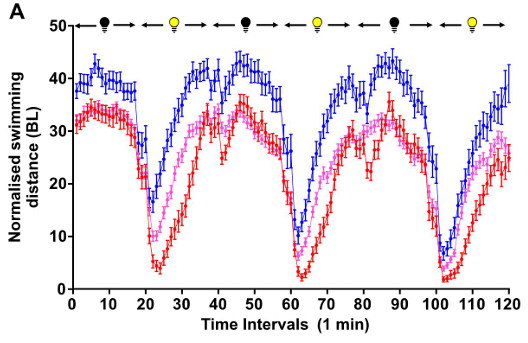
Figure 1. C9orf72 knockout reduces larval swimming activity. Normalized distance per minute over 120-min dark-light cycles for +/+, -/+, and -/- genotypes at 6 dpf (mean ± SEM). (Emond A, et al., 2026)
Reference
- Emond A, Laflamme C, Therrien M, et al. Characterization of a C9orf72 Knockout Danio rerio model for ALS and cross-species validation of potential therapeutics screened in Caenorhabditis elegans. PLoS One. 2026 Apr 10;21(4):e0346613.
Need a validated zebrafish disease model for your drug discovery program? Our team is ready to discuss your target, desired model type, and downstream screening goals. Contact our scientific team today to start your project.